
When To Replace Car Tires
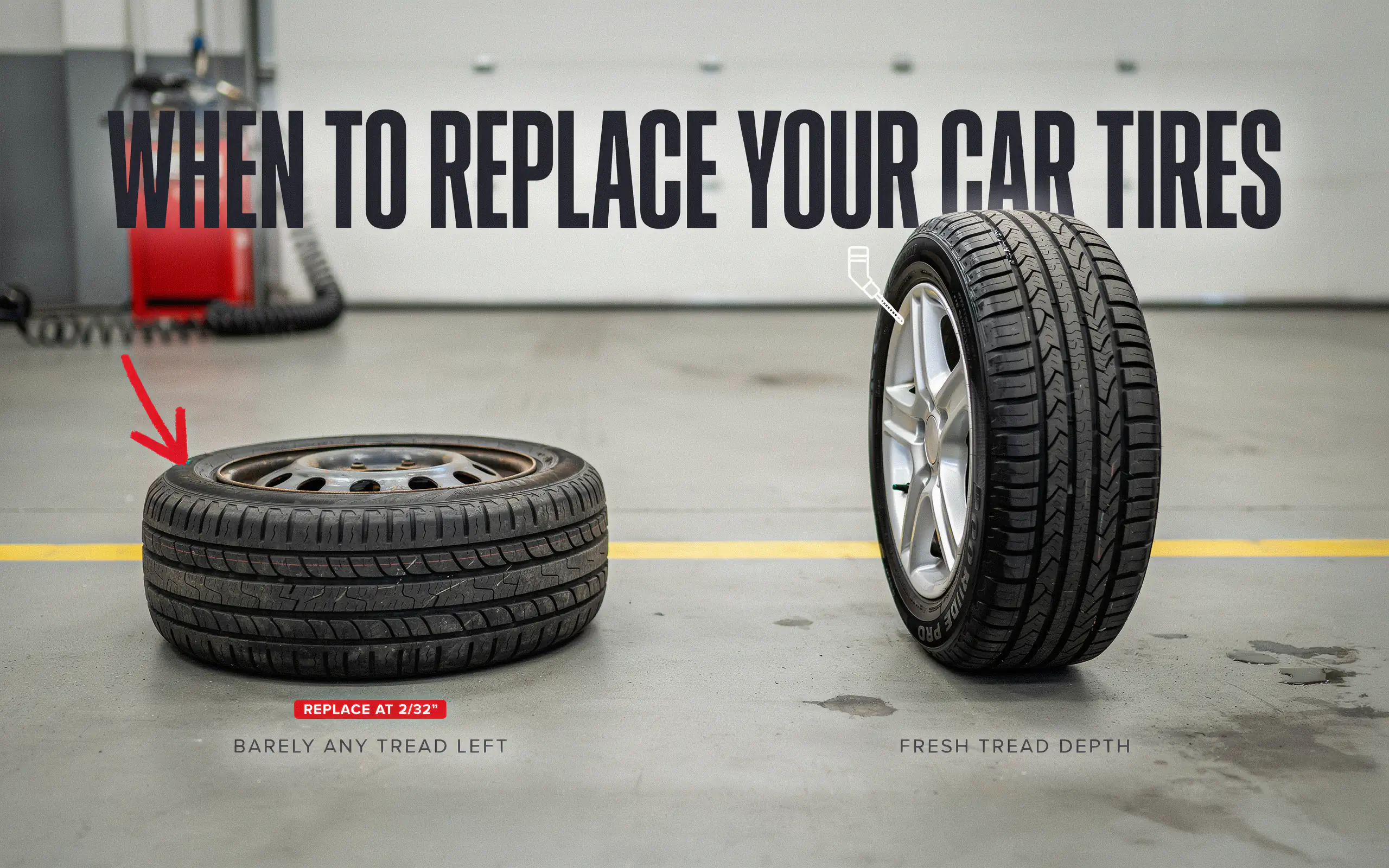
“Wondering when to replace car tires? Check tread depth, cracks, bulges, or vibration. Most tires need replacement every 25,000-50,000 miles or after 6 years. Stay safe on the road.”
Your car tires work hard every single day. They carry your vehicle’s weight, grip the road in rain and sun, and help you stop quickly when needed. But nothing lasts forever. Rubber gets old, tread wears down, and small damages can turn into big problems. So the big question for every driver is this: when to replace car tires? Knowing the answer can save you from blowouts, poor handling, and expensive repairs.
Many drivers wait too long because they do not know what to look for. Or they think a little wear is fine. But driving on bad tires puts you, your family, and others at risk. The good news is that checking your tires takes just a few minutes. And once you learn the seven clear signs, you will never have to guess again.
Let me walk you through everything you need to know. I will share simple tests, practical advice, and real-world warnings. By the end, you will feel confident about keeping your car safe.
“Your tires are the only thing between your car and the road. Don’t gamble with them.” – John Nielsen, AAA
How Long Do Car Tires Usually Last?
Before we get into the warning signs, let us talk about normal tire life. Most car tires last between 25,000 and 50,000 miles. But mileage is not the only factor. Time matters too. Rubber compounds break down even if you do not drive much. Heat, sunlight, and ozone in the air slowly damage the rubber.
Here is a simple breakdown of average tire life by type:
| Tire Type | Average Lifespan (Miles) | Average Lifespan (Years) |
|---|---|---|
| All-season tires | 40,000 – 60,000 | 4 – 6 |
| Performance tires | 20,000 – 35,000 | 3 – 5 |
| Touring tires | 50,000 – 70,000 | 5 – 7 |
| Winter/snow tires | 12,000 – 20,000 | 3 – 4 |
| All-terrain tires | 40,000 – 55,000 | 4 – 6 |
These numbers are just averages. Your actual results will depend on your driving habits, road conditions, climate, and how well you maintain your tires. But this table gives you a starting point. If you are near or past these ranges, it is time to inspect your tires closely.
Remember that tire manufacturers also recommend replacement after six years, regardless of tread depth. Some brands say ten years maximum, but six is the safest rule. So even if your tires look okay, age alone can be a good reason to replace car tires.
7 Key Signs You Need to Replace Car Tires
Now let us get to the heart of the matter. These seven signs are clear, easy to check, and reliable. If you notice any of them, do not wait. Get new tires as soon as you can.
1. Low Tread Depth
Tread is the grooved pattern on your tire. It pushes water away from the contact patch so you do not hydroplane. When tread gets too low, your car cannot grip wet roads. Stopping distances become much longer.
The legal minimum tread depth in most states is 2/32 of an inch. But safety experts suggest replacing tires at 4/32 of an inch for wet conditions. At 2/32, you are at high risk. You can check tread depth with a simple gauge or the penny test (I will explain that later).
If you see smooth sections or the tread bars (small rubber bridges inside the grooves) are flush with the tire surface, you must replace car tires immediately. Driving on bald tires is illegal in many places and very dangerous.
2. Visible Cracks or Dry Rot
Rubber contains oils that keep it flexible. Over time, heat and UV rays break down those oils. The rubber becomes hard and starts cracking. You might see small lines on the sidewall or between the tread blocks. This is called dry rot.
Dry rot means the tire structure is failing. Even if tread looks fine, cracks can lead to sudden blowouts. Run your hand along the sidewall (carefully, because cracks can be sharp). Look in the tread grooves too. If you see cracks deep enough to fit a fingernail, or cracks that go down to the fabric cords, you need to replace car tires right away.
“The average driver waits too long to replace car tires. Don’t be that driver.” – Lauren Fix, The Car Coach
3. Bulges or Blisters on the Sidewall
Sometimes you will see a bubble or bulge on the tire sidewall. This looks like a large pimple or a swollen spot. It happens when the inner liner gets damaged and air pushes through to the outer layers. A bulge is a weak point. It can burst without warning.
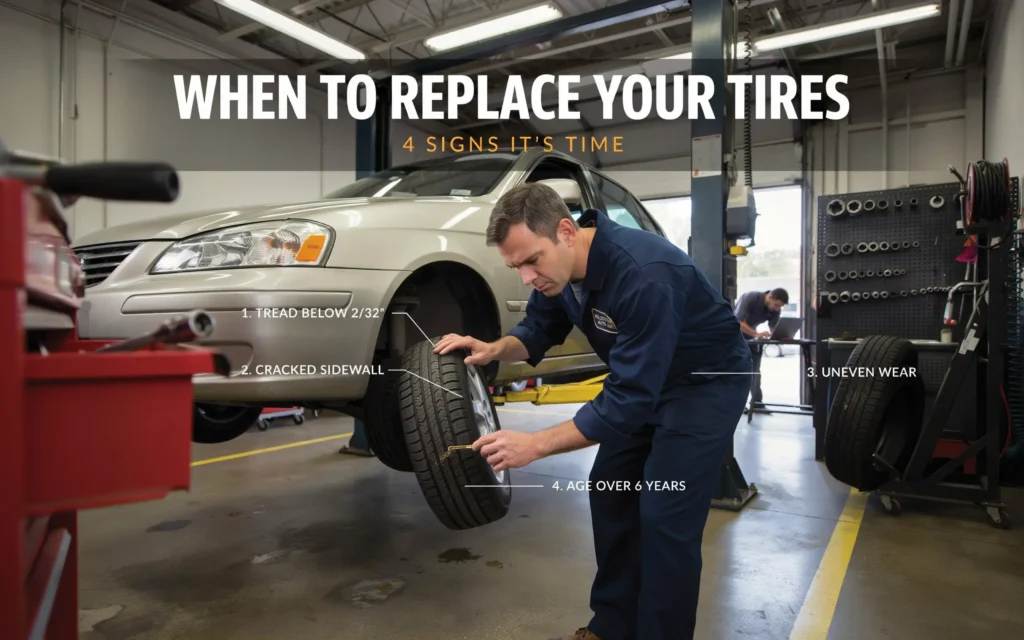
Never try to drive far on a bulging tire. Even a short trip is risky. The tire could blow out at highway speeds, causing loss of control. As soon as you see a bulge, you should replace car tires. In fact, put on your spare and drive straight to a tire shop.
4. Constant Vibration While Driving
A little vibration sometimes happens after hitting a pothole. But if your car shakes all the time, even after wheel balancing, the tires might be the problem. Internal belt separation is a common cause. The steel belts inside the tire shift or break, creating an unbalanced feel.
You might also feel a thumping sound that gets faster as you speed up. That is another sign of internal damage. Do not ignore it. Have a mechanic inspect the tires. If the problem comes from inside the tire, you must replace car tires. Driving on separated belts can lead to tread separation, which is extremely dangerous.
5. Frequent Air Pressure Loss
Good tires hold air for weeks without major loss. If you find yourself adding air every few days, something is wrong. There could be a slow leak from a nail or screw. That can often be repaired if the puncture is in the tread area. But if the leak comes from the sidewall, or if the tire has multiple patches, repair may not be safe.
Also, check for leaks around the valve stem or the wheel rim. Sometimes the rubber valve stem cracks with age. That is a cheap fix. But if the tire itself keeps losing air and no visible puncture exists, the rubber may be porous from old age. In that case, you need to replace car tires to avoid a sudden flat on the road.
6. Tire Age Over 6 Years
Many drivers forget that tires expire. Even if they look brand new with full tread, old rubber gets brittle. The tire industry agrees on a six-year replacement guideline from the date of manufacture. Some manufacturers say ten years with annual inspections after five years, but six is the safer bet.
How do you check tire age? Look for the DOT number on the sidewall. It ends with a four-digit code. The first two digits are the week, and the last two are the year. For example, “3521” means the 35th week of 2021. If that number is more than six years ago, you should replace car tires regardless of tread depth.
“Tires are the most critical safety component on your vehicle. Check them monthly.” – Mike Allen, Popular Mechanics
7. Uneven Wear Patterns
Take a good look at your tire tread. Does it wear evenly across the whole surface? Or do you see more wear on the edges, the center, or just one side? Different wear patterns tell you different stories.
Here is a quick guide to uneven wear and what it means:
| Wear Pattern | Likely Cause | Action Needed |
|---|---|---|
| Both edges worn, center okay | Underinflation | Inflate properly, but if wear is severe, replace car tires |
| Center worn, edges okay | Overinflation | Adjust pressure, check for wear damage |
| One side worn more | Misalignment | Get alignment, then rotate or replace tires |
| Cupping or scalloped dips | Bad shocks or struts | Fix suspension, then replace tires |
| Patches of wear | Unbalanced tire | Balance or replace if cords show |
If you see any uneven wear, first fix the root cause. Then inspect the tire. Once the wear reaches the tread wear indicators or the cords show through, you must replace car tires. Driving on unevenly worn tires reduces grip and can cause vibration.
How to Check Your Tires at Home
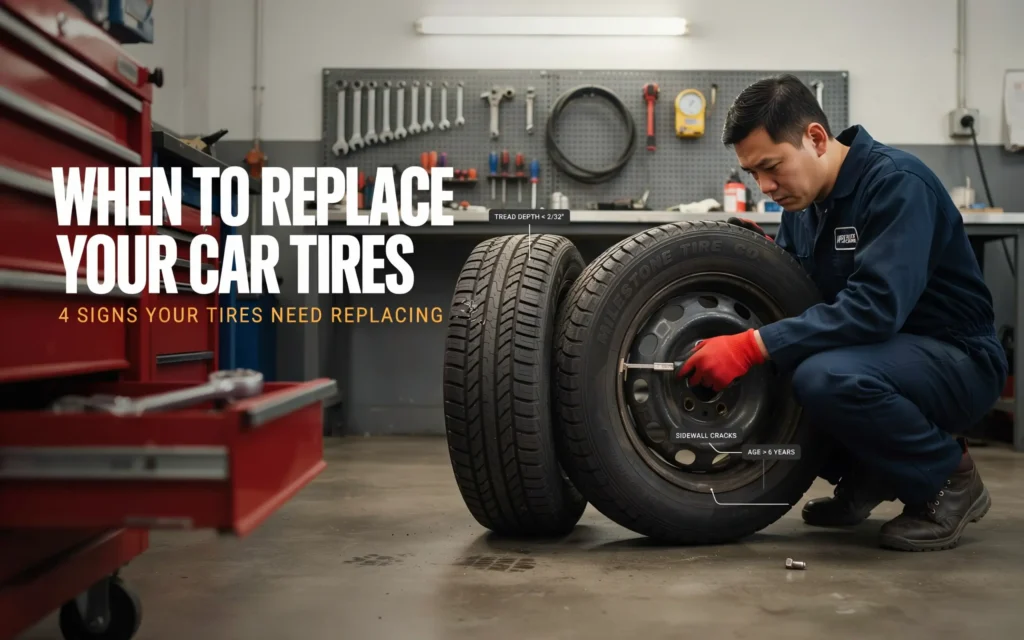
You do not need special tools or a mechanic to check your tires. Here are three easy methods you can do in your driveway.
The Penny Test for Tread Depth
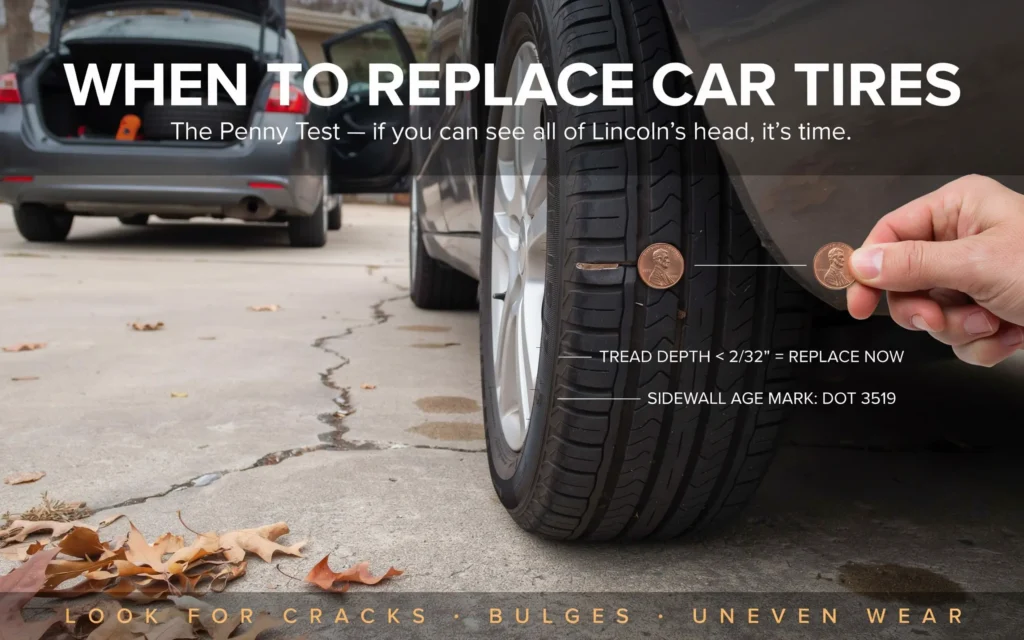
Take a penny and hold it with Lincoln’s head pointing down. Insert the penny into the tread groove. If you can see the top of Lincoln’s head, your tread is below 2/32 of an inch. That means you need to replace car tires very soon. For better safety, use a quarter instead. Insert the quarter with Washington’s head down. If you see the top of his head, you are at 4/32 of an inch, which is a good time to start shopping for new tires.
The Visual Inspection
Walk around your car and look at each tire. Check the sidewalls for cracks, cuts, or bulges. Look between the tread blocks for stones, nails, or embedded objects. Run your palm lightly over the tread to feel for uneven wear or separated belts. Do this once a month and before long trips.
The Pressure Check
Buy a simple tire pressure gauge for a few dollars. Check pressure when tires are cold (before driving). Compare to the number on the sticker inside your driver’s door frame. Low pressure causes heat buildup and poor handling. If you are adding air weekly, you may have a slow leak that signals it is time to replace car tires.
Why Driving on Old Tires Is Risky
Some people think they can squeeze a few more months out of old tires. But the risks are serious. First, braking distance increases dramatically on worn tires. At 60 mph, a car with new tires might stop in 120 feet. With tires at 2/32 tread, that distance can grow to 170 feet or more. That extra 50 feet could be the difference between stopping safely and hitting a child or another car.
Second, hydroplaning becomes much more likely. Tires cannot push water out when tread is shallow. Even a small puddle can send you sliding. Third, blowouts happen more often on old or damaged tires. A blowout at highway speeds often causes rollovers, especially in SUVs and trucks.
Fourth, you could get a ticket. Many states have laws against driving on tires below 2/32 tread. Police can pull you over and fine you. And if you cause an accident with bald tires, your insurance may not fully cover the damages.
So the smart choice is to replace car tires before they become dangerous. Think of tires as safety gear, not just rubber that keeps you moving.
Frequently Asked Questions (FAQ)
Q1: Can I replace just one tire or do I need all four?
You can sometimes replace just one tire if the others are nearly new with similar tread depth. But if the other tires are half worn, a single new tire will have a different diameter. This can confuse your car’s ABS and traction control systems. For best handling, replace tires in pairs (both front or both rear) or all four. All-wheel-drive vehicles usually need all four replaced at the same time.
Q2: How often should I rotate my tires?
Rotate your tires every 5,000 to 8,000 miles. Regular rotation helps tread wear evenly and makes all four tires last longer. Check your car’s owner manual for the exact schedule. Most oil change shops will rotate tires for free or for a small fee.
Q3: Is it safe to drive on a tire with a plug or patch?
A professional patch or plug in the tread area is safe for the life of the tire. But you cannot repair sidewall damage, large holes, or tires with multiple punctures close together. Also, if the tire is already worn or old, it is better to replace car tires than to repair them.
Q4: What is the difference between summer and all-season tires for lifespan?
Summer tires use softer rubber for grip in warm weather. They wear faster, often lasting only 20,000 to 30,000 miles. All-season tires are harder and last longer, usually 40,000 to 60,000 miles. But do not use summer tires in cold temperatures because the rubber hardens and cracks.
Q5: Can weather affect how soon I need to replace car tires?
Yes. Hot climates speed up rubber aging and dry rot. Cold climates make tires harder and more prone to cracking. If you live in a place with extreme heat or lots of sun, check your tires more often. Parking in a garage or using tire covers can help extend tire life.
Q6: How do I know if a tire is too old to use?
Look at the DOT date code. If the tire is more than six years old, replace it. Even if it has never been used, a spare tire older than six years should be replaced. Many car owners forget about the spare. Check that one too.
Q7: Do expensive tires last longer than cheap ones?
Not always. Price often reflects performance, handling, or warranty length. Some mid-priced tires have very good tread life. Check the UTQG rating (Uniform Tire Quality Grading). Look for a high treadwear number (400 or above) for longer life. But always balance cost with safety. Never buy tires so cheap that they lack good wet traction.
Q8: What happens if I wait too long to replace car tires?
You risk a blowout, a crash, or getting stranded. You also risk damaging your wheels if a tire fails at speed. And you could face fines or higher insurance rates after an accident. Waiting usually costs more in the long run.
Conclusion
Knowing when to replace car tires is one of the most important skills for any driver. It does not require special training or expensive tools. You just need to check three things regularly: tread depth, visible damage, and age. Use the penny test for tread. Look for cracks, bulges, or cuts. Read the DOT date code on the sidewall. And pay attention to how your car feels. Vibration, pulling, or frequent air loss are all signals.
Do not wait until you see metal cords or experience a blowout. Plan ahead. When your tires show any of the seven signs we discussed, start shopping for replacements. Compare prices, read reviews, and choose tires that fit your driving needs. Then have them professionally installed and balanced.
Your tires keep you connected to the road. They help you stop, turn, and drive safely in bad weather. Give them the attention they deserve. Set a reminder to check your tires once a month. Mark your calendar for tire rotation every 5,000 miles. And when in doubt, have a trusted mechanic look at them.
Driving on safe, healthy tires gives you peace of mind. You protect yourself, your passengers, and everyone sharing the road. So take ten minutes this weekend to inspect your tires. You might just save a life. And that life could be your own.
Related posts
 2026 Torque Wrench Reviews: Choosing the Right Tool for Precision Fastening
Explore our 2026 torque wrench reviews to find the right tool for your automotive, bike, or gunsmithing projects. Compare top models for accuracy and value. Finding…
 Top Automotive Tools for Beginners: Essential Gear for 2026
Discover the top automotive tools for beginners in 2026. Compare essential pry kits, wrench sets, and repair gear to start your DIY car maintenance journey. Starting…
 Top Rated Mechanic Tool Brands for 2026
Explore top rated mechanic tool brands for 2026. Compare reliable socket sets and hand tools to find the right equipment for your home garage or auto…