
Evolution Of Car Repair Tools
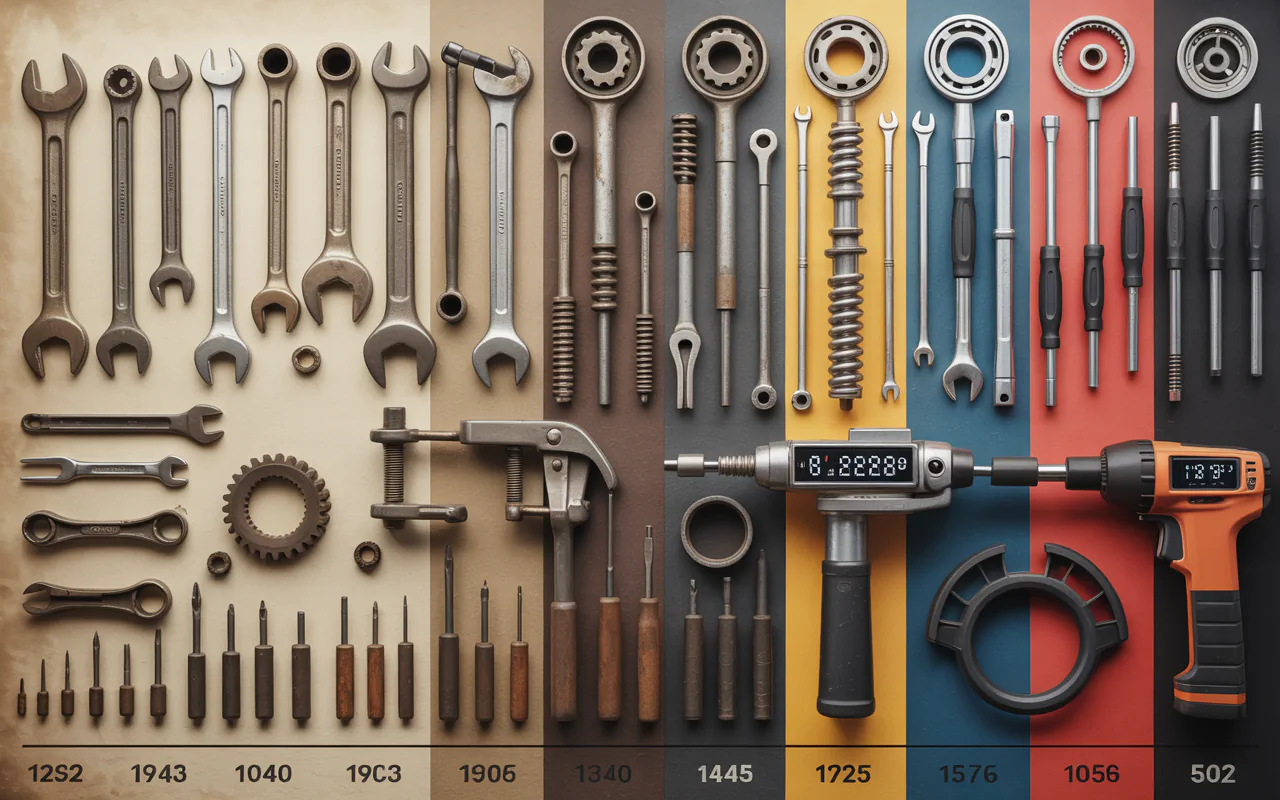
Learn how the evolution of car repair tools changed auto work from simple wrenches to smart scanners. This guide shows key steps, old and new tools, and future trends for every car owner.
Have you ever opened a toolbox from the 1920s? It looks very different from what mechanics use today. The evolution of car repair tools tells a great story about human cleverness. Cars got more complex. So did the tools to fix them. This article takes you through that whole history. You will learn about simple hand tools, then power tools, then computer scanners. We will also look ahead at what is coming next. Grab a cup of coffee and let us take a trip back in time.
“The tools we use have a profound and direct effect on our thinking.”
— Don Norman
The Very First Car Repair Tools
In the early 1900s, cars were new and strange. The first mechanics were often bicycle repairers or blacksmiths. They had to make their own tools sometimes. The evolution of car repair tools began with very basic items. Wrenches, hammers, screwdrivers, and pliers were the main helpers. Most tools were made of carbon steel. They worked, but they broke easily.
Basic Hand Tools in the Early Days
Think about fixing a Model T Ford. You needed a set of open end wrenches. Many sizes were different from today. You also used a tire iron because tires got flat a lot. A grease gun was important too. Old cars needed grease in many moving parts. Mechanics used oil cans with long spouts. There were no lifts. You crawled under the car on a cold floor. Jacks were simple screw type jacks. They took many turns to lift a car just a few inches.
The evolution of car repair tools was slow at first. Each car maker used different bolt sizes. That meant mechanics carried many custom wrenches. Some tool companies started making adjustable wrenches. These were a big help. Still, the work was hard and dirty. But people loved their cars. They found a way to fix them.
Table 1: Common Hand Tools Then vs. Now
| Early 1900s Tools | Modern Equivalent |
|---|---|
| Open end wrench set | Ratcheting combination wrench set |
| Screw jack with handle | Hydraulic floor jack and jack stands |
| Hand crank grease gun | Pneumatic grease gun |
| Carbon steel pliers | Chrome vanadium pliers with ergonomic grips |
| Tire iron (for clincher tires) | Breaker bar and impact wrench |
How the Industrial Age Changed Tool Making
Factories grew bigger after World War I. Steel became stronger and cheaper. The evolution of car repair tools sped up during this time. Companies like Snap on, Craftsman, and Mac Tools started. They made tools that lasted longer. They also made tools that fit better.
Mass Production and Better Steel
Chrome vanadium steel changed everything. This metal did not rust as fast. It also did not break under pressure. Mechanics could now use thinner wrenches in tight spots. Ratchets appeared in the 1920s. A ratchet let you turn a bolt without removing the wrench. That saved so much time. Socket sets became popular too. You could change the size of the socket quickly.
Another big step was the torque wrench. This tool measured how tight a bolt was. Before torque wrenches, people guessed. They often broke bolts or left them too loose. The torque wrench made repairs safer. Engines stayed together better. The evolution of car repair tools now included precision measurement.
Cars got more powerful. Brakes got better. Mechanics needed pullers to remove gears and bearings. They needed valve spring compressors for engine work. Each new car part brought a new tool. Tool trucks started visiting garages every week. Mechanics could buy tools on credit. That was a great help for small shop owners.
“Give me a lever long enough and a fulcrum on which to place it, and I shall move the world.”
— Archimedes
The Rise of Power Tools in Auto Shops
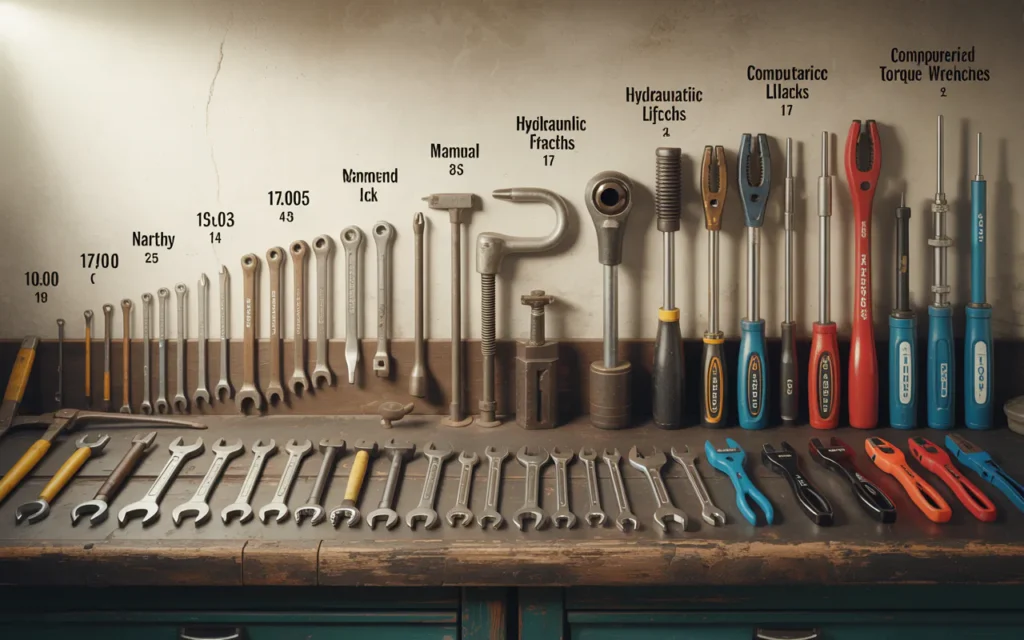
Air power came to garages in the 1950s. Pneumatic tools ran on compressed air. They were strong and fast. The evolution of car repair tools took a big jump forward. Impact wrenches replaced manual ratchets for removing lug nuts. Air ratchets fit into small engine bays. Die grinders smoothed rough metal. Air hammers cut through rusted parts.
Pneumatic Tools Arrive
An air compressor became the heart of every shop. Mechanics ran air lines to each work bay. They hung reels for air hoses. The impact wrench was a miracle. You could remove a wheel in seconds instead of minutes. But air tools were loud. They also needed oiling. Still, every mechanic loved them. Work got done faster. That meant more cars repaired each day.
The evolution of car repair tools also gave us the air jack. Heavy trucks could be lifted quickly. Car lifts became common too. No more lying on the floor. A two post lift raised a car to standing height. Back pain decreased. Repair quality improved because mechanics could see better.
Electric Wrenches and Drills
Not every shop had a big air compressor. Electric tools offered a choice. The first electric drills were heavy and under powered. But they got better. By the 1980s, corded electric impact wrenches were common. They were good for roadside repairs. Then came cordless tools. Ni Cad batteries were weak. But they still worked. Mechanics could now walk around a car without dragging a hose or cord.
Today, cordless tools use lithium ion batteries. They are powerful enough for almost any job. The evolution of car repair tools made cordless impacts as strong as air tools. Many mechanics now prefer cordless. No noisy compressor. No air hoses to trip over. Just grab a tool and work.
Electronic Diagnostics and Computer Tools
Cars started using computers in the 1980s. That changed everything. The evolution of car repair tools now included electronics. A simple wrench could not fix a check engine light. Mechanics had to learn new skills. They bought scan tools and multimeters.
OBD Scanners and Code Readers
On Board Diagnostics (OBD) started simple. The first systems flashed a light on the dashboard. You counted flashes to get a code. Then OBD II became standard in 1996. All cars used the same connector and codes. That was a big help. A basic code reader could cost 50 dollars. It told you which sensor had a problem. But it did not tell you how to fix it.
Professional scan tools cost more. They showed live data from the engine. You could see fuel trim, oxygen sensor voltage, and coolant temperature. That helped you find the real problem. The evolution of car repair tools turned mechanics into electricians too. They had to understand voltage, resistance, and signals.
Multimeters became standard in every box. You used them to check for broken wires. You tested sensors and actuators. A bad ground wire could stop a car from starting. A multimeter found that quickly. Then came oscilloscopes. They showed sensor signals as waves on a screen. That helped find intermittent problems. A part might fail only when hot. An oscilloscope could catch that.
| Tool Type | What It Does | When It Became Common |
|---|---|---|
| OBD I code reader | Reads flashing check engine codes | 1980s |
| OBD II scan tool | Shows codes and live data | 1996 |
| Digital multimeter | Measures voltage, resistance, current | 1990s |
| Lab scope | Displays sensor waveforms | 2000s |
| Smoke machine | Finds vacuum and EVAP leaks | 2010s |
Another key tool was the smoke machine. You pumped smoke into a vacuum line or fuel tank. Smoke came out of any leak. That was fast and easy. Before smoke machines, mechanics sprayed soapy water or used a stethoscope. Those methods worked but took longer. The evolution of car repair tools made diagnostics faster and more certain.
“Technology is a useful servant but a dangerous master.”
— Christian Lous Lange
Modern Tool Technology: Smart and Connected
We are now in the age of smart tools. The evolution of car repair tools continues with Bluetooth and apps. You can connect your phone to a tool. The tool tells you exactly what to do. This is not science fiction. It is happening right now.
Digital Torque Wrenches
A digital torque wrench shows the exact torque on a screen. It beeps when you reach the right number. Some models record the torque for each bolt. That is great for engine assembly. You can prove that you tightened every bolt correctly. The wrench also stores data. You can look back at past jobs. This helps with warranties and safety.
Digital torque wrenches are not cheap. But many shops now require them. The evolution of car repair tools brought precision to every fastener. No more guessing. No more stripped threads. Just clean, accurate work.
Augmented Reality Guides
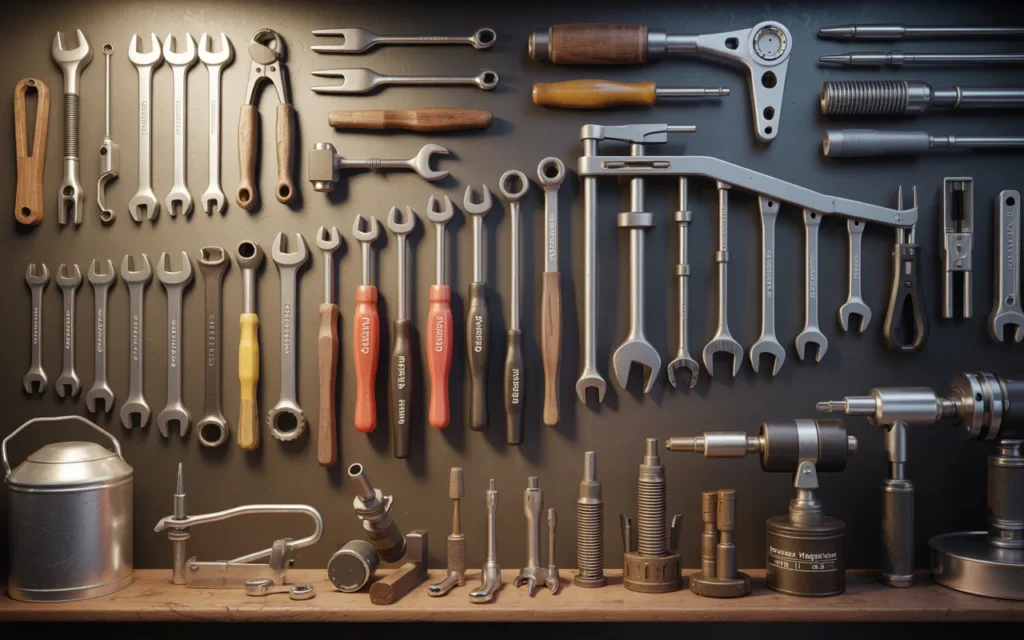
Augmented reality (AR) is new to auto repair. You wear special glasses or look through a tablet. The AR system shows step by step instructions over the real engine. Arrows point to the bolt you need to remove. Text appears saying “use a 10mm socket.” Some systems even show how parts come apart in 3D.
This is a huge change. New mechanics learn faster. Expert techs work with fewer mistakes. The evolution of car repair tools now includes software and cameras. A tool is no longer just metal. It is metal plus code plus data.
Other modern tools include thermal cameras. You can point one at an engine and see which cylinder is cold. That tells you the problem instantly. Borescopes with high resolution cameras fit into spark plug holes. You see cylinder walls and pistons without taking the engine apart.
What Will Car Repair Tools Look Like Tomorrow?
We can see the future based on today’s trends. The evolution of car repair tools will keep going. Electric cars and self driving cars will bring new needs. Repair shops will change again.
AI and Predictive Maintenance
Artificial intelligence will help diagnose problems. You will plug a scanner into the car. The AI reads the data. It compares the data to millions of other cars. Then it tells you the most likely fix. This already exists in basic form. But it will get much better. The AI will also predict failures. It might say “your water pump will fail in 500 miles.” That gives you time to plan the repair.
3D printing is another future tool. Shops will print plastic parts like clips and housings. They might print custom tool adapters for unusual jobs. The evolution of car repair tools will include a 3D printer in every large garage. No more waiting for a special tool to ship. Just design and print it.
Smart glasses will become common. You will look at a car and see its repair history. You will see step by step video instructions. Your hands stay free to work. The glasses can also call a remote expert. That expert sees what you see. They can draw arrows on your view to guide you. This is not fantasy. It is being tested now.
We will also see more wireless power tools. They will charge without cords. Just set them on a charging pad. Batteries will last for days of heavy use. The tools will talk to each other. An impact wrench might tell your phone that a bolt is loose. Your phone saves that torque value for later.
The evolution of car repair tools will not stop. As long as people drive cars, they will need tools to fix them. The tools will change. But the goal stays the same. Help people repair cars safely and correctly.
Frequently Asked Questions
What is the most important change in the evolution of car repair tools?
The shift from simple hand tools to computer diagnostics is the biggest change. OBD scanners changed how mechanics find problems. Before scanners, you had to guess or test each part. Now you get a code that points you in the right direction.
Are old tools still useful today?
Yes, many old hand tools work fine on older cars. But modern cars need modern tools. You cannot fix a Tesla with a 1920s wrench set. The evolution of car repair tools means you need different tools for different cars. Many mechanics keep a mix of old and new.
Do I need expensive tools as a home mechanic?
Not at first. Start with a basic socket set, a torque wrench, a multimeter, and an OBD code reader. Those four items handle many jobs. Add tools as you need them. The evolution of car repair tools has made some cheap tools pretty good. But avoid the very cheapest ones. They break and can hurt you.
How often should I replace my tools?
Quality hand tools can last a lifetime. Power tools wear out after 5 to 10 years of heavy use. Diagnostic tools become outdated faster. A 10 year old scan tool might not work on new cars. The evolution of car repair tools is fastest in electronics. Plan to update your scanner every 3 to 5 years.
What future tool am I most likely to buy?
A bidirectional scan tool. It not only reads codes but also commands parts to turn on. You can test a radiator fan or a fuel pump with a button press. These tools used to cost thousands. Now good ones are under 500 dollars. The evolution of car repair tools is making pro level gear affordable for home use.
Where can I learn to use modern repair tools?
YouTube is a great free resource. Many tool companies also offer online classes. Community colleges have auto repair courses. The best way is to practice. Start with small jobs on an old car. The evolution of car repair tools has made learning easier than ever. You can find a video for almost any repair.
Conclusion
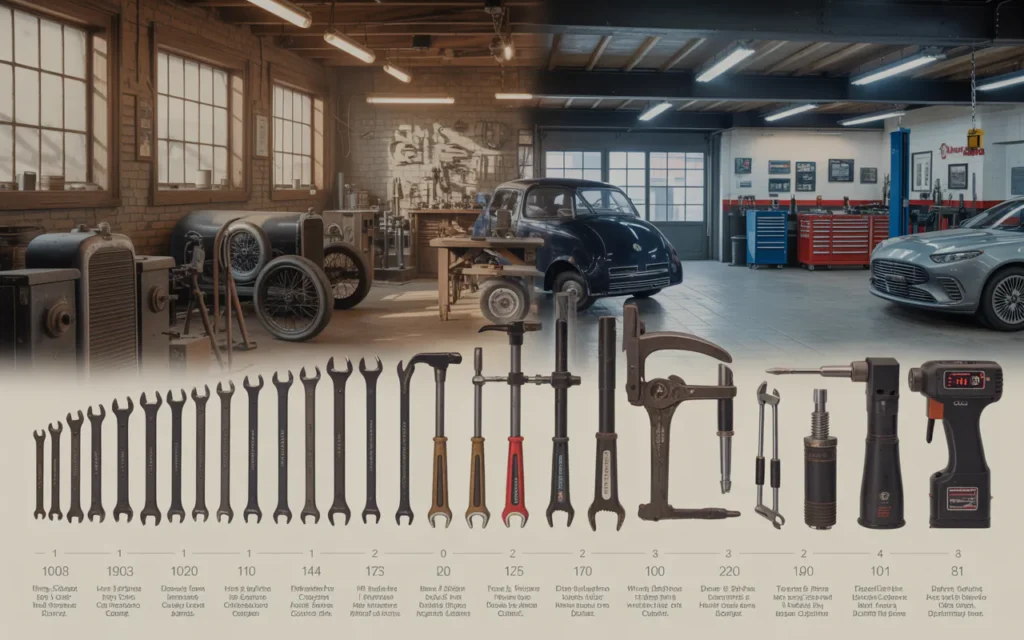
The evolution of car repair tools shows us one clear fact. Tools change because cars change. Early mechanics used basic wrenches and a lot of muscle. Then came power tools that made work faster and easier. After that, computers arrived. Mechanics had to learn electronics and software. Now we have smart tools that guide our hands and track our work.
What will come next? AI, 3D printing, and augmented reality are already here. They will grow more common. But the heart of car repair stays the same. A good mechanic wants to fix a car and send the owner safely down the road. Tools are just helpers. They are important helpers, no doubt. A broken car is frustrating. The right tool makes that frustration go away.
Whether you fix cars for a living or just on weekends, pay attention to new tools. You do not need every new gadget. But a smart purchase can save you hours of work. Respect the old tools too. They built the auto industry. And stay curious. The next great tool is probably being designed right now. Keep learning. Keep fixing. And enjoy the ride.
Thank you for reading this guide on the evolution of car repair tools. Share it with a friend who loves cars.
Related posts
 Best Wire Crimping Tool for Automotive Wiring in 2026
Find the best wire crimping tool for automotive wiring. We compare five top-rated hand tools to help you choose the right fit for your vehicle projects.…
 Best Budget Automotive Tools for 2026 DIY Maintenance
Discover the best budget automotive tools for 2026. We compare essential diagnostic scanners, trim kits, and pliers to help you save on car repairs. Maintaining your…
 Best Automotive Work Light Options for 2026
Find the best automotive work light for your garage or roadside repairs. We compare top-rated hands-free, magnetic, and heavy-duty lighting solutions for 2026. Finding the best…