
How Do You Fix Car Battery Corrosion
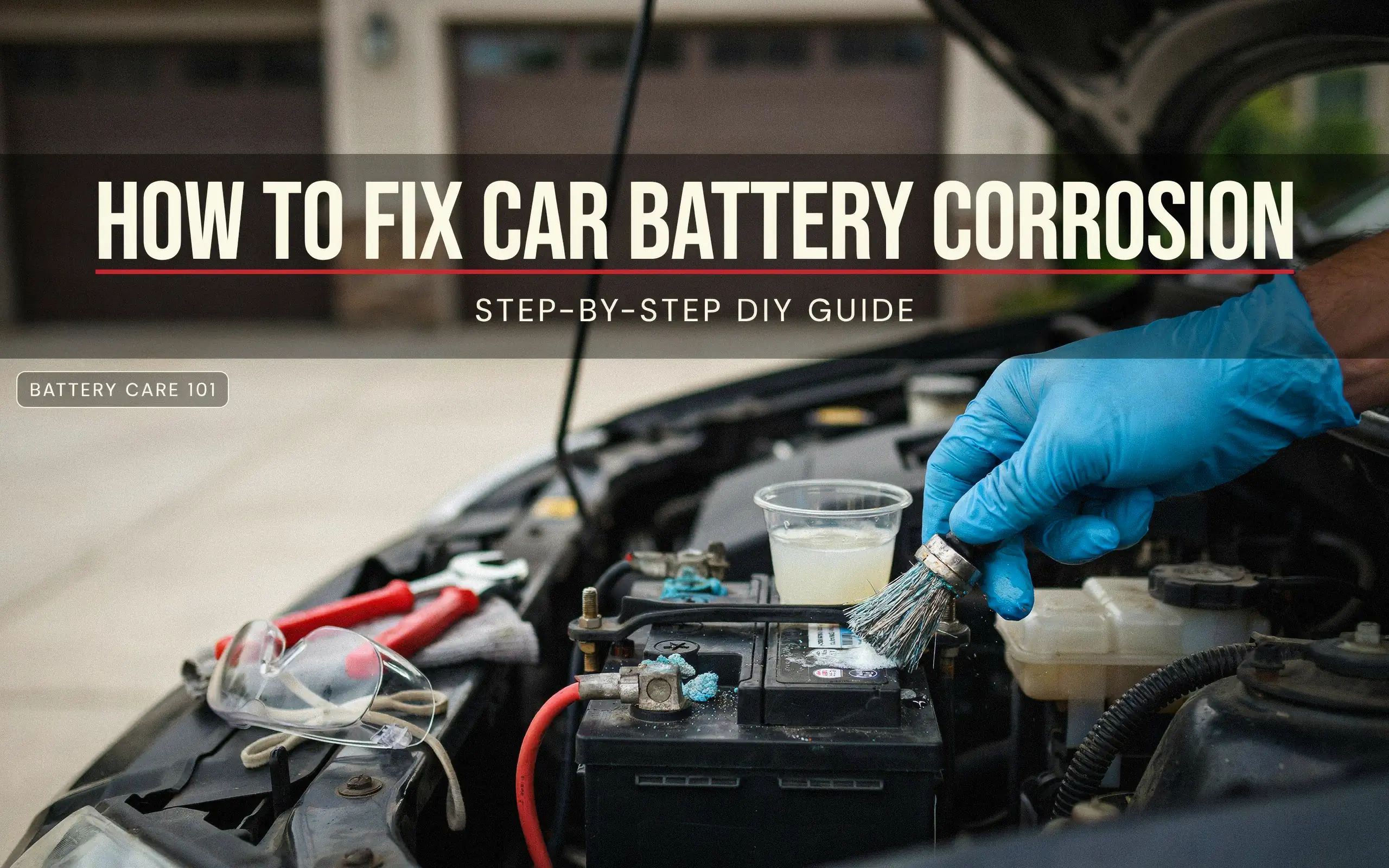
This guide shows you how to fix car battery corrosion with simple tools and safety steps. Learn to clean, prevent, and handle buildup for a reliable car start every time.
There is nothing more annoying than turning your car key and hearing that slow, heavy click. You know the sound. It is the sound of a battery that does not have enough power to start the engine. Often, the root of this problem is not the battery itself but a fuzzy, crusty buildup on the terminals. That white, blue, or green powder is corrosion, and it is a common enemy of car owners everywhere.
Many people think a dead battery means they need to buy a new one immediately. But that is not always true. In many cases, you just need to fix car battery corrosion. It is a simple task that can save you a trip to the mechanic and a lot of money. This guide will walk you through everything you need to know. We will cover what corrosion is, why it happens, and the exact steps to clean it safely. We will also discuss how to stop it from coming back so you can avoid this problem in the future.
What is Car Battery Corrosion and Why Does It Happen?
When you open your car hood, you might see a white, ashy substance around the metal posts. This is battery corrosion. It is a chemical reaction between the battery acid, the metal terminals, and the air around it. The acid inside a lead-acid battery creates hydrogen gas. This gas mixes with the air and causes a reaction with the copper or lead terminals. The result is that powdery crust we all hate.
The Main Reasons for Corrosion
- Gas Leakage: Batteries naturally release hydrogen gas. This gas reacts with the terminal metal.
- Electrolyte Spill: If the battery case has a small crack or if you overfill the cells, acid can leak out.
- Heat and Moisture: Hot weather makes the chemical reaction faster. Moisture in the air can also help the acid travel.
Is It Dangerous?
Yes, it can be. The powder is acidic and can irritate your skin and eyes. It can also damage your clothes and the car’s paint. But with the right safety steps, it is simple to handle. The good news is that you can fix car battery corrosion without calling a professional. It is a basic skill every car owner should know.
Tools and Materials You Need
Before you start, gather your supplies. You do not need fancy tools for this job. Most of these items are in your kitchen or garage.
| Tools | Materials |
|---|---|
| Safety Glasses | Baking Soda |
| Rubber Gloves | Water |
| Wire Brush (or old toothbrush) | Petroleum Jelly |
| Wrench (usually 10mm) | Distilled Water |
| Old Rags or Paper Towels | Terminal Cleaner Spray (optional) |
Safety First
Always protect your eyes and hands. Corrosion can flake off and fly into your eyes. The acid can burn your skin. Wear long sleeves to protect your arms as well. Work in a place with good airflow. Do not do this in a closed garage.
Step-by-Step: How to Fix Car Battery Corrosion
This section is the heart of the guide. Follow these steps in order to do the job safely and well.
Step 1: Safety Check and Disconnection
Park your car on a flat surface. Put the parking brake on. Turn off the engine and remove the keys.
Pro Tip: Identify the positive (+) and negative (-) terminals. The positive cable is usually red. The negative is usually black.
Remove the Negative Cable First
This is the most important rule. Why? If your wrench touches the car body while you loosen the positive terminal, it creates a spark. This could cause a fire or damage the car’s electronics. Always remove the negative (-) cable first to break the circuit. Then, remove the positive (+) cable. If you are unsure which is which, the positive post is usually larger than the negative one.
Step 2: Inspect the Battery Condition
Look at the battery case. Is it swollen or cracked? If yes, do not try to clean it. A swollen case means the battery is failing and is dangerous to handle. You will likely need a new battery. If the case is intact but covered in crust, proceed to the next step.
Step 3: Prepare the Cleaning Solution
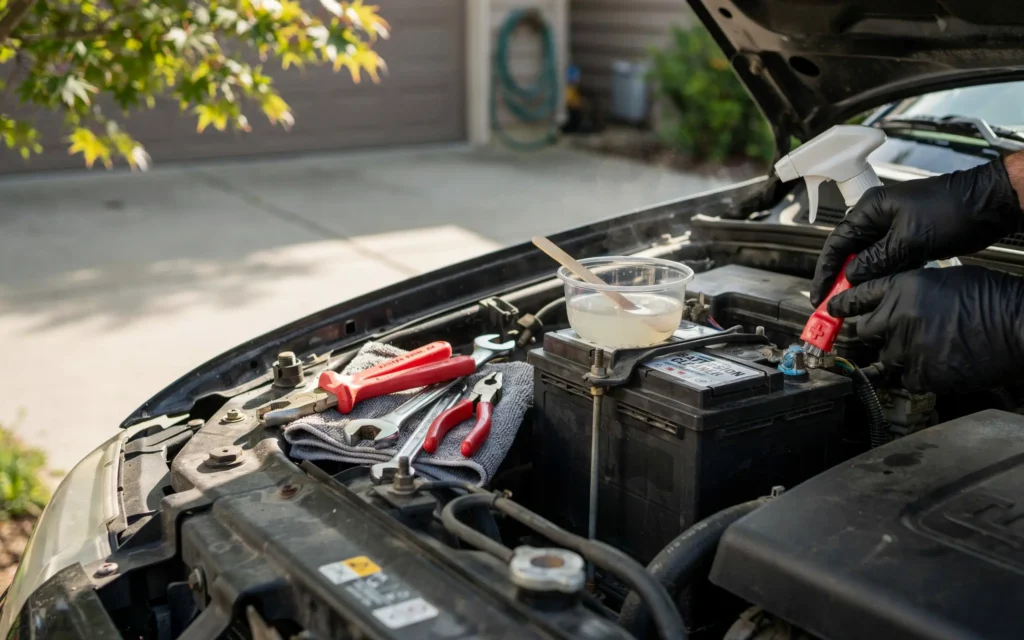
This is the classic method. Mix about two tablespoons of baking soda with a small amount of water to make a thick paste. The paste is thicker than pancake batter and stays on the terminals. Baking soda neutralizes the acid in the corrosion. This makes it safe to touch and removes the buildup easily.
Step 4: Apply the Paste and Scrub
Use an old toothbrush to apply the paste over all the corroded areas. Let it sit for 3 to 5 minutes. You will see it fizz. That is the acid being neutralized. Scrub the terminals and cable ends hard. The paste will turn brown as it lifts the dirt and rust. If the corrosion is heavy, you may need to apply a second round of paste.
Step 5: Rinse and Dry
Use a spray bottle filled with clean water to rinse away the paste. Do not let the water flood the battery top. Just spray enough to wash the residue away. Wipe everything dry with your old rags. Make sure no moisture is left on the posts.
Step 6: Clean the Cable Ends
Do not forget the inside of the cable clamps. They often have a hidden layer of corrosion. Use your wire brush to scrub the inside of the ring until it is shiny metal. You want a clean metal surface for a good connection.
Step 7: Reconnect the Battery
Connect the positive cable first this time. Then, connect the negative cable. Tighten them snugly. Do not overtighten, or you might break the battery post. Give each cable a small tug to ensure it is tight. A loose connection will cause the car to lose power.
Expert Quote: “The biggest mistake people make is reconnecting the battery in the wrong order. Negative off first. Negative on last. Follow that rule and you avoid a ton of car electrical problems.” – Mike Sanders, ASE Certified Mechanic.
Step 8: Apply a Protective Coating
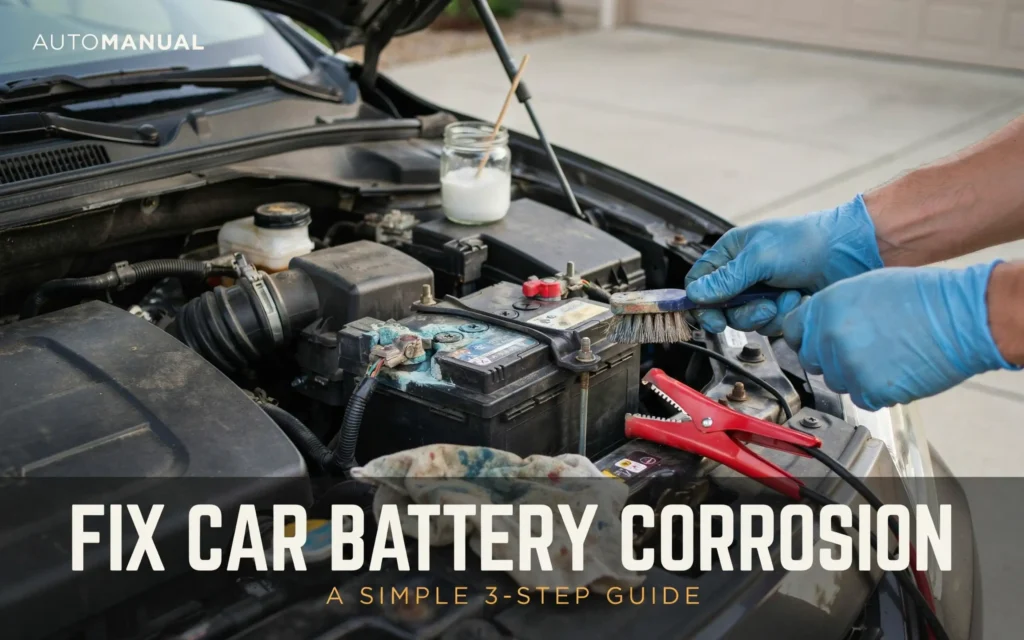
This is the secret to stopping the problem from returning. You can buy a special battery terminal spray. Or, you can just use petroleum jelly. Smear a thin layer of jelly on the clean posts and the cable ends. This creates a barrier against air and moisture. It stops the acid from reacting with the metal. This simple step means you will not have to fix car battery corrosion again for a long time.
How to Fix Car Battery Corrosion: Alternative Methods
Sometimes you do not have baking soda handy. Or, the corrosion is very light. Here are a few other ways to tackle the problem.
Using Coca-Cola
Yes, you can use soda. The acid in the soda can eat away at the rust. Pour a small amount over the posts. It will bubble and clean the surface. However, the sugar in the soda leaves a sticky mess. You must rinse it thoroughly with water. For me, baking soda is better because it is cheaper and less sticky.
Using a Battery Terminal Cleaner Tool
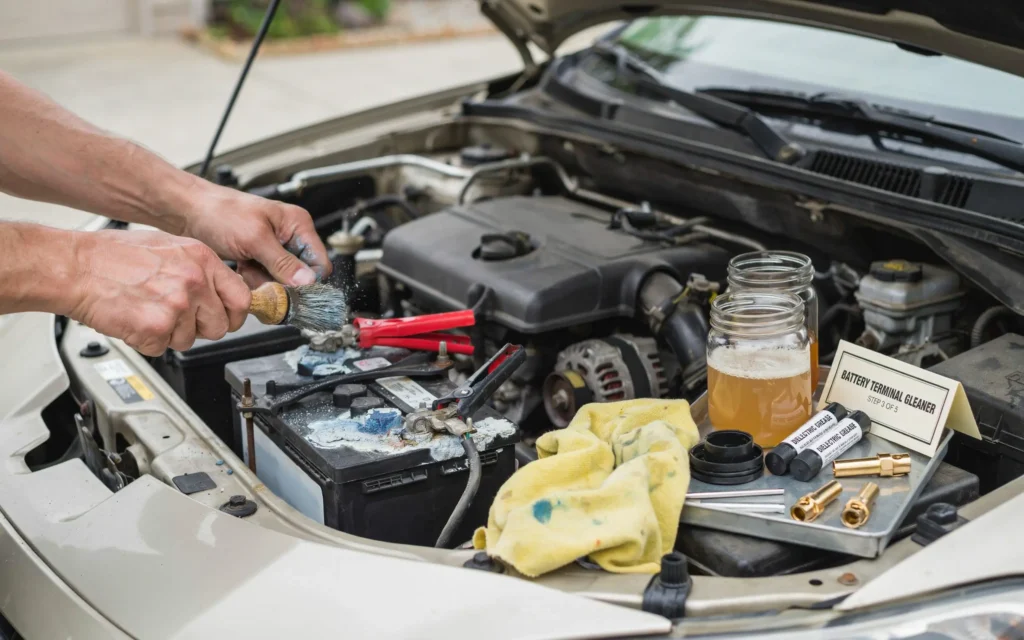
This is a special tool that looks like a pair of pliers. It has brushes on the inside to clean both the post and the inside of the cable clamp. It is very fast and does not require a paste. You just put the tool on the post and twist it.
Expert Quote: “A poor connection is often the only problem. Before you buy a new battery, take 10 minutes to clean the terminals. I see this solve 30% of my ‘dead battery’ calls.” – Laura Chen, Owner of Mobile Auto Rescue.
Using a Wire Brush and Sandpaper
If you do not have baking soda, you can scrub the terminals with sandpaper or a wire brush. This is more work and creates a lot of dust. You must wear a mask if you do this, as you do not want to breathe in the dust.
Preventing Corrosion for the Future
Now that you have a clean battery, you want to keep it that way. Prevention is easier than a cure. Here is a simple table to help you understand your options.
| Prevention Method | How It Works |
|---|---|
| Petroleum Jelly | Creates a barrier that stops air and acid from touching the metal. |
| Anti-Corrosion Washers | These are felt pads that absorb acid and prevent it from reaching the post. |
| Battery Terminal Spray | A professional spray that dries to a hard, protective coating. |
| Regular Cleaning | Checking the battery every 3 months and wiping it clean prevents big buildups. |
The Importance of Clean Battery Terminals
Clean terminals are not just about starting your car. They affect your alternator, lights, and radio. If you fix car battery corrosion, you improve the flow of electricity to the entire car. A clean connection helps your alternator work less hard, which can save fuel. It also protects the car’s computer from voltage spikes.
What If the Corrosion Returns Quickly?
Sometimes you clean the battery, and it is crusty again in a week. This is a sign of a bigger problem. If this happens, it is not just a surface issue.
Check the Battery Case
Look closely at the base of the battery posts. If there is a small crack, acid will leak out and cause rapid corrosion. This is called “creeping” corrosion. You cannot fix this with cleaning. You will need to replace the battery. A leaking battery is also a safety risk. The acid can eat through the metal tray under the battery.
Check the Voltage Regulator
The alternator has a part called a voltage regulator. If it fails, it can overcharge the battery. Overcharging makes the battery boil. This releases more gas and acid. This leads to fast corrosion. If your headlights are dim, then bright, or if your battery is always wet on top, get your charging system checked.
Expert Quote: “Modern cars are sensitive to voltage. If your battery is clean but you still have issues, test the battery health. An old battery can build up internal resistance, which causes it to overheat and leak.” – David Ford, Electrical Systems Engineer.
Inspect the Cable Condition
The cables themselves can wear out. Look at the insulation. Is it cracked or missing? If the wire is exposed, moisture can get in. This causes corrosion inside the cable, not just at the terminal. If the cable is frayed, you should replace it. Bad cables can cause a voltage drop. This means your starter does not get the power it needs, even if the battery is good.
Understanding Battery Types
Different batteries have different needs. Most cars use a standard lead-acid battery. These need water sometimes.
Standard Lead-Acid Batteries
These are the most common. They have caps on top that you can remove. You can add distilled water to them if the level is low. Low water levels cause the battery to work too hard. This produces more acid fumes and corrosion. Checking the water is a great way to prevent corrosion.
Maintenance-Free Batteries
These do not have caps. You cannot add water to them. They are sealed. They still corrode, but they usually last longer. The corrosion on these is often due to the connection getting loose. If you fix car battery corrosion on these, make sure to use the protective jelly, as it is your main defense.
The Role of the Ground Connection
We often forget about the other end of the cable. The negative cable connects to the car body or the engine. This is the ground connection. If this connection is dirty or loose, it can cause the same symptoms as a bad battery. The car will start slow, and the lights will flicker. Look at the grounding point where the cable meets the metal. Clean that metal too. Scrape away any paint or rust. Tighten the bolt securely.
When to Call a Professional
While cleaning terminals is a good DIY project, some jobs are for the pros. You should call a mechanic if you see:
- A cracked battery case.
- Bulging sides on the battery.
- A very strong smell of rotten eggs (sulfur).
- The battery is more than 5 years old and keeps dying.
- You try to fix car battery corrosion, but the car still refuses to start.
These signs often mean the battery is failing internally. You cannot fix a bad cell. You will need a replacement.
Frequently Asked Questions
1. Can I use WD-40 to clean battery terminals?
Yes, you can. WD-40 can dissolve corrosion and act as a barrier against moisture. Spray it on, let it sit, and scrub. However, it is not as good at neutralizing acid as baking soda. The baking soda method is safer for cleaning, but WD-40 is okay for a temporary fix.
2. How often should I check my car battery?
You should check your battery at least twice a year. Do it before summer and before winter. Extreme heat and cold are hard on batteries. A quick visual check of the terminals is always a good idea.
3. Why is there blue powder on my car battery?
Blue powder is a type of copper sulfate. It forms when the copper in the cable clamps reacts with the battery acid. It is a sign of a leak or too much gas escaping. It is the same as white corrosion, just with a different color due to the copper.
4. Is it safe to pour hot water on a battery to clean it?
Some people do this to melt the corrosion. But hot water can cause the battery case to warp or crack due to rapid temperature change. It is better to use water at room temperature to rinse the baking soda paste.
5. Will fixing corrosion make my battery new again?
No. It only cleans the connections. A battery has a limited lifespan of 3 to 5 years. If the battery is old, cleaning will help temporarily, but you will need a new one soon. Good connections help the battery deliver its full power to the starter.
6. Do electric cars get battery corrosion?
Electric cars have high-voltage batteries that do not corrode like this. However, they still have a 12-volt battery for the lights and computers. This battery is the same as a normal car battery. So, yes, your EV’s 12-volt battery can corrode the same way.
Conclusion
Fixing a corroded car battery is a valuable skill. It saves you time, money, and the stress of being stuck. You do not need a mechanic for this. With a little baking soda, some water, and about 15 minutes, you can do it yourself. The process is simple: disconnect safely, clean the terminals, dry them, and reconnect. Do not forget the protective coating to prevent future problems.
Remember, a clean battery is a happy battery. It keeps your car reliable and your day moving. By taking a few minutes to fix car battery corrosion, you are taking good care of your car. This simple maintenance task extends the life of your battery and prevents emergency calls. So, next time you pop the hood, take a look. If you see that fuzzy white stuff, you now know exactly what to do. Stay safe, and happy driving.
Related posts
 How to Strengthen Weak Nails: A Practical Guide to Daily Care
Learn how to strengthen weak nails with simple daily habits, protective care, and targeted hydration. Restore your natural nail strength today. Weak, peeling, or brittle nails…
 What Sounds Do Cats Dislike? 7 Noises That Stress Your Pet
Discover what sounds do cats dislike and why. Learn how to protect your cat’s sensitive hearing from stressful household noises and high-frequency hums. Cats dislike sounds…
 Restoring Faded Black Clothing: Practical Methods and Reality Checks
Can you restore faded black clothing? Learn the difference between temporary color revival and permanent redyeing, plus how to prevent future fading. You can restore the…