
Why Does My Car Battery Keep Dying
If you keep asking “why does my car battery keep dying”, the short answer is often a bad alternator, parasitic drain, old age, or loose cables. Read on for simple checks and fixes that stop the problem for good.
You turn the key. Nothing happens. Maybe you hear a slow crank or just a click. Then that sinking feeling hits again. Your car battery is dead. Again.
If this sounds familiar, you are not alone. Many drivers deal with a battery that keeps going flat. The question “why does my car battery keep dying” is one of the most common car complaints I hear from friends and family.
I have helped dozens of people fix this exact issue. Most causes are simple. You do not need to be a mechanic to find the problem. Let me walk you through the real reasons your battery keeps failing. By the end, you will know exactly what to check and how to stop it from happening again.
“Most battery problems come from three things: age, heat, or leaving something on. Fix those and you fix 90% of no-start issues.” – Mark Henderson, ASE Certified Master Technician
7 Common Reasons Your Car Battery Keeps Dying
Let me break down the most likely culprits. One of these is probably causing your headache.
Quick Overview of Battery Drain Causes
| Cause | How Common? | Easy to Fix? |
|---|---|---|
| Lights left on | Very common | Very easy |
| Parasitic drain | Common | Medium |
| Bad alternator | Common | Hard (needs shop) |
| Old battery | Very common | Easy (replace) |
| Loose/corroded cables | Common | Easy |
| Extreme weather | Moderate | Prevention only |
| Short trips | Very common | Very easy |
Now let me explain each one in plain English.
1. You Left Lights or Accessories On
This is the number one answer to “why does my car battery keep dying”. Interior lights, headlights, or even a glove box light can stay on overnight. By morning, your battery is empty.
I have done this myself. You get out in a hurry and forget to flip the headlight switch. Some older cars do not have automatic off lights. The dome light might stay on because a door did not close fully. Even a trunk light can drain your battery over a few hours.
Check all lights before you leave the car. Make it a habit. If your battery dies often, look for a light that stays on when it should not.
2. A Parasitic Drain Is Sneaking Power
Parasitic drain sounds scary. But it just means something electrical is running when the car is off. Your clock and radio memory use a tiny amount. That is normal. But a faulty component can use much more.
Common drains include a bad glove box light, a stuck relay, or an aftermarket radio installed wrong. Phone chargers left plugged in can also pull power. Even a faulty door lock actuator can keep trying to move and kill your battery.
To find a parasitic drain, a mechanic uses a multimeter. But you can try this first: pull one fuse at a time and see if the drain stops. If you are not comfortable with that, any shop can check it for a small fee.
3. Your Alternator Is Failing
The alternator charges your battery while you drive. If it fails, your battery runs on stored power only. Once that power is gone, the car dies. You might jump start the car and drive for 20 minutes, then it dies again. That is a classic sign of a bad alternator.
Other signs include dim headlights that get brighter when you rev the engine. Or you might see a battery warning light on your dash. A failing alternator means your battery never gets a full charge. So every time you stop, you have less power to start again.
“A weak alternator is like a leaky bucket. You pour water in, but it drains out before you can use it. Your battery never gets ahead.” – Sarah Kline, Auto Electrical Systems Instructor
4. The Battery Is Old and Worn Out
Car batteries do not last forever. Most last three to five years. After that, they struggle to hold a charge. You might charge it fully, but a day later it is dead again.
Look for a sticker on the battery with a date. Or look for the letters and numbers stamped on the case. For example, “F22” means June 2022. If your battery is four years old or more, it is likely time to replace it.
Cold weather makes old batteries fail faster. But heat is actually worse for long-term battery life. Hot summers cook the insides. Then winter kills what is left.
5. Loose or Corroded Battery Cables
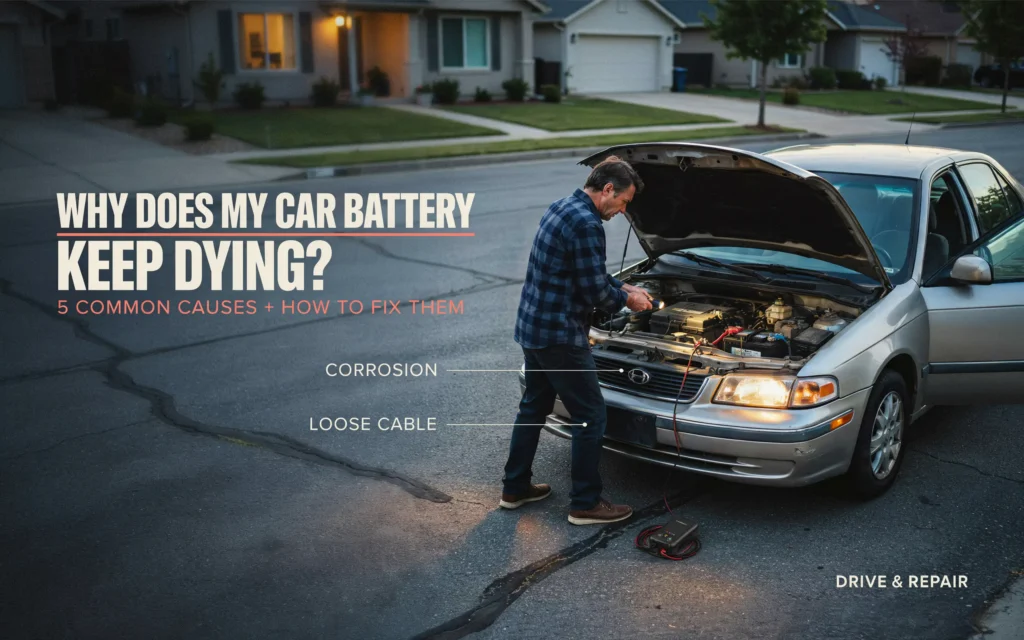
This is an easy fix that many people miss. The cables attached to your battery posts must be tight and clean. If they wiggle at all, electricity cannot flow properly. Your battery might have plenty of power, but it cannot reach the starter.
Corrosion looks like white or blue fuzzy powder on the metal posts. This acts like an insulator. It blocks the current. You can clean it off with a wire brush and a mix of baking soda and water. Wear gloves. The powder is acidic.
After cleaning, tighten the clamps so they do not move. This simple step has saved many people from buying a new battery they did not need.
6. Extreme Weather Conditions
Very hot or very cold weather puts stress on your battery. In winter, cold temperatures slow down the chemical reaction inside. The battery produces less power. At the same time, your engine oil is thicker and harder to turn over. That double hit can kill an already weak battery.
Summer heat is actually harder on battery life. High temperatures cause fluid to evaporate inside. It speeds up corrosion of the internal plates. A battery that survives a hot summer often dies the first cold morning.
If you live in a place with harsh weather, check your battery more often. Consider a battery with higher cold cranking amps (CCA) for winter.
7. Short Trips Don’t Let the Battery Recharge
This is a very common answer to “why does my car battery keep dying”. You drive to the store, then home. That is three minutes each way. Your starter uses a big burst of power to start the engine. Then you drive a short distance. The alternator does not have enough time to put that power back.
Do this several days in a row, and your battery slowly loses charge. Eventually, it cannot start the car. If most of your drives are under 10 minutes, your battery never fully recharges.
Take a longer drive once a week. Go 20 minutes or more on a highway or faster road. That gives the alternator time to top off the battery.
“Short trips are a silent battery killer. People blame the battery, but the real problem is their driving habits.” – Raymond Torres, Fleet Maintenance Supervisor
How to Diagnose the Problem Yourself
You do not need expensive tools to figure out why your car battery keeps dying. Here is a simple step-by-step plan.
DIY Diagnosis Steps
| Step | What to Do | What It Tells You |
|---|---|---|
| 1 | Look at the battery age sticker | If over 4 years, replace it |
| 2 | Check cables for corrosion or looseness | Clean and tighten if needed |
| 3 | After a full charge, let car sit overnight | If dead in morning, look for drain or bad battery |
| 4 | Jump start and drive 30 minutes | If dies again after stopping, alternator likely bad |
| 5 | Turn off car, remove negative cable (safely) | If engine stops right away, alternator is dead |
Important safety note: Car batteries contain acid and produce explosive gas. Wear eye protection. Do not smoke near a battery. If you are unsure, ask a friend who knows cars or call a shop.
Use a Multimeter to Test Voltage
A basic multimeter costs $15 to $25. It is a great tool for any car owner. Here are the numbers you want to see:
- Engine off, rested battery: 12.4 to 12.7 volts
- Engine running: 13.7 to 14.7 volts
- Below 12.0 volts after charging: battery is weak or dead
If you see 12.5 volts with the car off but only 12.8 volts with the engine running, your alternator is not charging enough. It should jump to at least 13.5 volts.
Do the Headlight Test
This is simple. With the engine off, turn on your headlights. Are they bright or dim? Now have someone start the car. Do the lights go very dim or turn off completely when you crank? If yes, your battery is very weak.
Then with the engine running, turn the headlights on. Rev the engine a little. If the lights get brighter, your alternator might be working but poorly. If they stay the same brightness, that is normal.
When to Replace vs. Recharge Your Battery
Not every dead battery needs replacement. Sometimes you just need a recharge. But knowing the difference saves money and frustration.
Recharge if:
- You left lights on overnight once
- The battery is less than three years old
- After a full charge, it starts the car fine for weeks
Replace if:
- The battery is over four years old
- It dies again within a week of charging
- You see cracks, bulges, or leaks on the battery case
- A load test at a shop says it is bad
Most auto parts stores test batteries for free. They put a small load on the battery and see how it holds up. Take advantage of this service. It takes five minutes.
If you need a new battery, buy one with a good warranty. Three years free replacement is common. Five years is better. Spend a little more for a known brand like Interstate, DieHard, or Optima. Cheap batteries fail faster.
Preventing Future Battery Deaths
Here is how to stop asking “why does my car battery keep dying” forever.
- Turn off all lights and accessories before exiting. Make it a routine.
- Unplug phone chargers and USB devices when parked.
- Drive longer than 10 minutes at least twice a week.
- Clean battery terminals every oil change.
- Have your charging system checked once a year.
- If you leave your car for a week or more, use a battery maintainer (trickle charger). These cost $20 and keep your battery full without overcharging.
- Park in a garage or shade when possible to reduce heat damage.
Frequently Asked Questions (FAQ)
How many times can a car battery die before it needs replacement?
A healthy battery can be jump started and recharged many times. But each deep discharge causes some damage. If your battery has died more than five times, it is worth testing. It may be permanently weakened.
Can a bad alternator drain a battery when the car is off?
No. A bad alternator fails to charge while driving. But it usually does not drain power when the car is off. However, a faulty diode inside the alternator can create a small drain. That is rare but possible.
Why does my car battery keep dying after a jump start?
If you jump start and then the car dies again after 20 minutes of driving, your alternator is likely bad. The alternator should keep the car running even with a dead battery. If the engine stops, the alternator is not providing power.
Will disconnecting the battery stop it from dying?
Yes, but that is not practical for daily driving. If you leave your car for a long time, disconnecting the negative cable stops all drains. The battery will hold its charge for months. For daily use, you need to fix the real cause.
How long should a car battery hold a charge without driving?
A good battery in a healthy car should hold a charge for two to three months without starting. If your battery dies after one week, you have a drain problem or a bad battery.
Can cold weather kill a new battery?
Cold does not kill a good new battery. It only makes a weak battery fail. If your new battery dies in cold weather, you have another issue like a bad alternator or a parasitic drain.
Conclusion
Now you know the main reasons why your car battery keeps dying. Most of the time, it is something simple. Left lights on. Short trips. Old age. Loose cables.
Start with the easy checks. Look at the battery age. Clean the terminals. Make sure nothing is left on. Take a longer drive. If the problem continues, test with a multimeter or have a shop check your alternator and look for parasitic drains.
You do not need to live with a car that fails to start. Most fixes are cheap or free. And a new battery costs far less than a tow truck or a missed day of work. The next time your car won’t start, you will know exactly what to look for. Stay calm, run through these checks, and you will be back on the road.
Related posts
 2026 Torque Wrench Reviews: Choosing the Right Tool for Precision Fastening
Explore our 2026 torque wrench reviews to find the right tool for your automotive, bike, or gunsmithing projects. Compare top models for accuracy and value. Finding…
 Top Automotive Tools for Beginners: Essential Gear for 2026
Discover the top automotive tools for beginners in 2026. Compare essential pry kits, wrench sets, and repair gear to start your DIY car maintenance journey. Starting…
 Top Rated Mechanic Tool Brands for 2026
Explore top rated mechanic tool brands for 2026. Compare reliable socket sets and hand tools to find the right equipment for your home garage or auto…