
How to Increase Workout Intensity Safely: A Practical Progression Guide

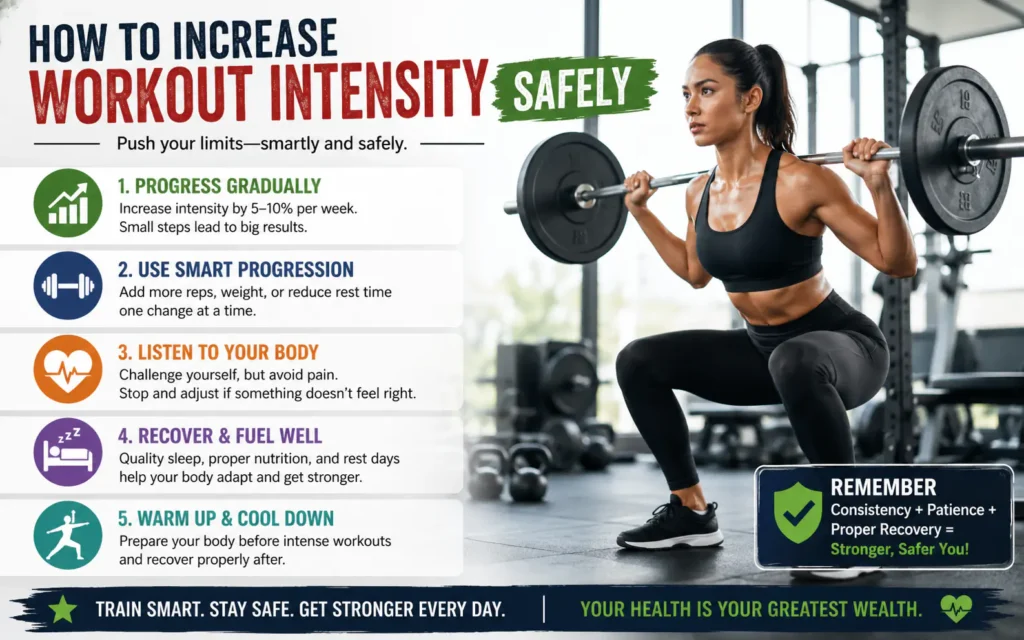
To increase workout intensity safely, you must apply the principle of progressive overload by changing only one training variable at a time. This means gradually increasing your weight, adding repetitions, shortening your rest periods, or slowing down your movement tempo. Rushing into multiple changes at once is the fastest path to joint strain, muscle tears, and systemic fatigue.
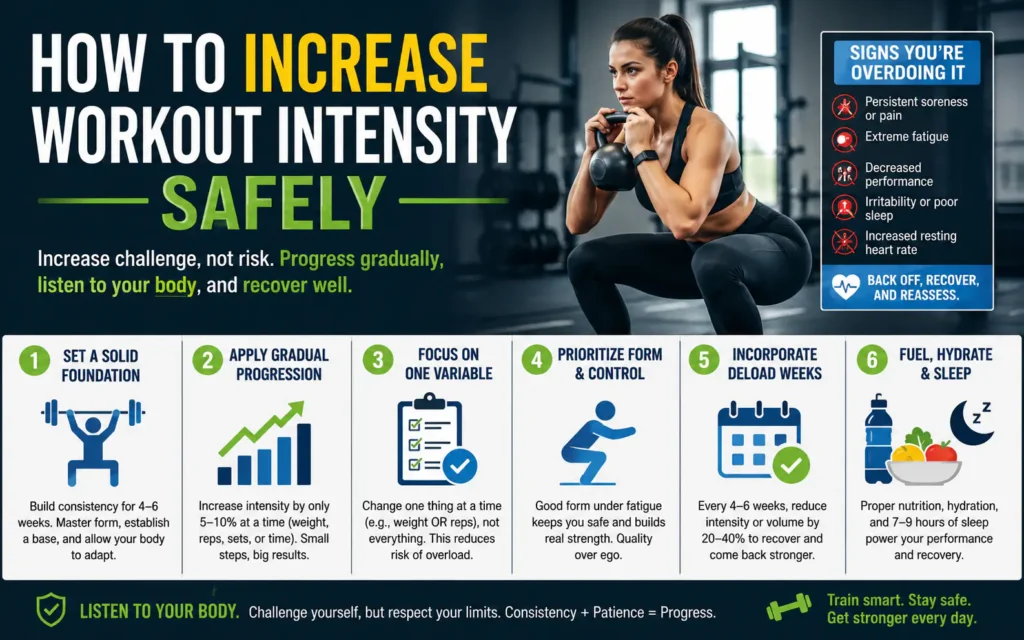
The safest starting point is the 10% rule: limit any weekly increase in weight, volume, or duration to no more than 10 percent. By keeping changes small and controlled, you give your muscles, tendons, and nervous system adequate time to adapt. Always prioritize maintaining perfect form over hitting a higher number on the dumbbell rack.
Safety checks
- Increase only one training variable at a time to isolate physical stress.
- Prioritize perfect exercise form before adding weight or speed.
- Use the RPE scale to match your daily workout intensity to your actual recovery levels.
- Incorporate structured rest and deload weeks to allow connective tissues to adapt.
| Topic | When it helps | What to keep in mind |
|---|---|---|
| Method 1 | Cardiovascular conditioning and muscular endurance goals. | Shortening rest too much can cause your form to break down on subsequent sets due to lingering fatigue. |
| Method 2 | Hypertrophy, joint safety, and mastering exercise form. | Slowing down movements causes deep muscle soreness that may require extra recovery time. |
| Method 3 | Beginners and those returning from a training hiatus. | Adding too many sets can lead to junk volume, where you are too tired to maintain quality movement. |
| Method 4 | Breaking through plateaus and maximizing short workout windows. | Highly demanding on the central nervous system; can cause rapid fatigue. |
Focus on progressive overload training
Method 1. Reduce Rest Intervals Between Sets
How to Increase Workout Intensity Safely. Shortening the time you rest between sets forces your body to recover faster, improving cardiovascular efficiency and muscular endurance without changing the weight on the bar.
- Cardiovascular conditioning and muscular endurance goals.
- Shortening rest too much can cause your form to break down on subsequent sets due to lingering fatigue.
- If you currently rest for 90 seconds between sets, try dropping to 75 seconds next week while keeping your weight and reps identical.
- Primary Benefit – Saves time, boosts heart rate
- Difficulty Level – Moderate
- Risk of Injury – Low
Method 2. Increase Time Under Tension (TUT)
Slowing down the eccentric (lowering) phase of an exercise forces your muscles to work harder throughout the entire range of motion, stimulating muscle growth without adding joint-stressing weight.
- Hypertrophy, joint safety, and mastering exercise form.
- Slowing down movements causes deep muscle soreness that may require extra recovery time.
- Take a full 3 to 4 seconds to lower the weight during a squat or bicep curl, then explode upward in 1 second.
- Primary Benefit – Protects joints, builds control
- Difficulty Level – High
- Risk of Injury – Very Low
Method 3. Add Repetitions or Sets (Volume)
Before you reach for heavier weights, focus on mastering your current weight by increasing the total volume of your workout. This builds a solid foundation of tissue tolerance.
- Beginners and those returning from a training hiatus.
- Adding too many sets can lead to junk volume, where you are too tired to maintain quality movement.
- If you can perform 3 sets of 10 reps with perfect form, aim for 3 sets of 12 reps before increasing the weight.
- Primary Benefit – Builds structural stamina
- Difficulty Level – Medium
- Risk of Injury – Low
Method 4. Incorporate Supersets and Compound Sets
Perform two exercises back-to-back with minimal rest. A superset pairs opposing muscle groups (like chest and back), while a compound set pairs the same muscle group to push it to its limit.
- Breaking through plateaus and maximizing short workout windows.
- Highly demanding on the central nervous system; can cause rapid fatigue.
- Pair a dumbbell bench press immediately with a dumbbell row, then take your standard rest break.
- Primary Benefit – High caloric burn, time efficient
- Difficulty Level – Advanced
- Risk of Injury – Moderate
How to Measure Your Current Workout Intensity
To increase your intensity safely, you first need to know where you are starting. Guessing your effort level often leads to overexertion or undertraining. Two of the most reliable, low-tech ways to measure intensity are the Rate of Perceived Exertion (RPE) scale and the Talk Test.
The RPE scale runs from 1 to 10, where 1 is sitting on a couch and 10 is an all-out sprint that you can only sustain for a few seconds. For safe, effective workouts, most of your training should fall between an RPE of 6 and 8. This ensures you are challenging your body without pushing it to failure on every set.
If you are running on a treadmill and can easily sing a song, your intensity is low. If you can only gasp out two-word answers, you are in a high-intensity zone.
Relying solely on fitness trackers to calculate calorie burn, which can be highly inaccurate and lead to overtraining.
- RPE 5-6: Moderate activity. You can talk comfortably but cannot sing.
- RPE 7-8: Vigorous activity. You can speak in short sentences but need to pause for breath.
- RPE 9: Very hard activity. You can only speak one or two words at a time.
- RPE 10: Maximum effort. Completely breathless, unsustainable.
| Intensity Level | RPE Range | Target Heart Rate % | Talk Test Status |
|---|---|---|---|
| Light | 1 – 4 | 50% – 60% | Can sing or speak continuously |
| Moderate | 5 – 6 | 60% – 70% | Can speak full sentences with effort |
| Vigorous | 7 – 8 | 70% – 85% | Can only speak short phrases |
| Maximum | 9 – 10 | 85%+ | Cannot speak more than a single word |
The Golden Rules of Safe Progression
Your muscles adapt to stress much faster than your tendons, ligaments, and joints. While your muscles might feel ready to lift heavier weights after a week, your connective tissues may need several weeks to build the structural density required to support that extra load safely.

To prevent overuse injuries like tendinitis, follow the rule of single-variable progression. Choose one element of your workout to change, test it for at least one to two weeks, and ensure your body tolerates the new stress before making another adjustment.
If you decide to increase your weekly running distance from 10 miles to 11 miles, do not also try to run those miles at a faster pace than usual.
Changing your exercises, increasing your weights, and cutting your rest times all in the same week.
- Master the movement: Never increase intensity on an exercise if you cannot perform it with perfect form.
- The 10% limit: Avoid increasing your total weekly volume, weight, or distance by more than 10 percent.
- Schedule deload weeks: Every 4 to 6 weeks, reduce your training volume by 30 to 50 percent to allow your body to fully repair.
- Warm up dynamically: Spend 5 to 10 minutes performing light cardio and mobility work specifically targeted at the joints you will be using.
Red Flags: When to Back Off Immediately
There is a distinct difference between the healthy discomfort of muscular fatigue and the warning signs of injury. Muscular fatigue feels like a warm burn or a heavy sensation in the target muscle group. It generally resolves quickly once you stop the exercise.
In contrast, joint pain, sharp sensations, or sudden shooting pains are clear indicators that something is wrong. Pushing through these sensations does not build strength; it simply damages tissue and can set your fitness goals back by months.
Feeling a deep, dull ache in your shoulder joint during a shoulder press is a sign to stop immediately, whereas a burning sensation in your shoulder muscles is simply normal fatigue.
Taking pain relievers before a workout to mask joint discomfort so you can push through a hard session.
- Sharp, localized pain in or around a joint.
- Dizziness, lightheadedness, or sudden nausea during exertion.
- Persistent, throbbing pain that lasts long after your workout is over.
- An inability to sleep or a sudden drop in daily energy levels, which indicates systemic overtraining.
FAQs
What is the 3-3-3 rule in the gym?
The 3-3-3 rule is a simple framework for workout consistency and progression. It suggests working out 3 days a week, focusing on 3 compound exercises per session, and sticking to that exact routine for 3 weeks before making any changes to your weight, reps, or intensity.
Is a 20-minute high-intensity workout enough?
Yes, a 20-minute high-intensity workout can be highly effective for cardiovascular health and fat loss, provided the effort level is genuinely high (RPE 8-9). However, because of the high physical demand, these sessions should only be done 2 to 3 times a week to allow for proper recovery.
Why do I feel so weak at the gym some days?
Fluctuations in strength are completely normal and are usually caused by temporary lifestyle factors. Poor sleep, inadequate hydration, under-eating, or high mental stress can drastically reduce your physical performance. On these days, it is best to lower your workout intensity to match your body’s current recovery state.
How do I know if my workout intensity is too high?
If you experience chronic fatigue, persistent muscle soreness that lasts more than 72 hours, trouble sleeping, or frequent joint pain, your workout intensity is likely too high. Your body is telling you that your recovery capacity cannot keep up with the physical stress you are applying.
Conclusion
Increasing your workout intensity is essential for making physical progress, but it must be done with patience and precision. By manipulating variables like rest times, tempo, and volume before simply adding more weight, you can challenge your body while keeping your joints safe and healthy.
Listen to your body’s feedback, track your progress in a simple training log, and never sacrifice your form for the sake of a harder workout. True fitness is built on consistency, and staying injury-free is the single best way to ensure you keep moving forward.
Related posts
 How to Strengthen Weak Nails: A Practical Guide to Daily Care
Learn how to strengthen weak nails with simple daily habits, protective care, and targeted hydration. Restore your natural nail strength today. Weak, peeling, or brittle nails…
 What Sounds Do Cats Dislike? 7 Noises That Stress Your Pet
Discover what sounds do cats dislike and why. Learn how to protect your cat’s sensitive hearing from stressful household noises and high-frequency hums. Cats dislike sounds…
 Restoring Faded Black Clothing: Practical Methods and Reality Checks
Can you restore faded black clothing? Learn the difference between temporary color revival and permanent redyeing, plus how to prevent future fading. You can restore the…