
How to Improve Exercise Form: Practical Techniques for Better Results

Improving your exercise form is about shifting your focus from the weight you are lifting to the quality of the movement itself. When you prioritize control over intensity, you naturally engage the correct muscle groups and reduce unnecessary strain on your joints.
To start, slow down your repetitions significantly. By removing momentum, you force your muscles to do the work throughout the entire range of motion. If you cannot maintain a steady, controlled pace, it is a clear signal that you should reduce the resistance until your technique stabilizes.
Safety checks
- Slow down movements to increase control.
- Prioritize full range of motion over heavy resistance.
- Use mirrors sparingly to develop internal body awareness.
- Stop a set when form begins to falter, not when you reach failure.
| Topic | When it helps | What to keep in mind |
|---|---|---|
| 1 | Beginners learning new movements. | Do not hold your breath during the pause. |
| 2 | Strength and mobility training. | Avoid locking out joints aggressively at the top of a movement. |
| 3 | Hypertrophy and isolation exercises. | Don’t overthink to the point of freezing. |
| 4 | Developing proprioception. | Only do this with light weights or bodyweight exercises. |
Focus on mechanical cues pacing
1. Master the Tempo
How to Improve Exercise Form. Use a 3-1-1 tempo: three seconds to lower the weight, one second pause, and one second to lift. This eliminates momentum and forces muscle control.
- Beginners learning new movements.
- Do not hold your breath during the pause.
- If you cannot control the descent, the weight is too heavy.
- Focus – Control
- Difficulty – Low
2. Full Range of Motion
Move through the complete path of the joint. Partial reps often lead to muscle imbalances and missed development.
- Strength and mobility training.
- Avoid locking out joints aggressively at the top of a movement.
- If you feel a sharp pinch, stop and shorten the range slightly.
- Focus – Joint health
- Difficulty – Moderate
3. Mind-Muscle Connection
Visualize the specific muscle contracting before you move. If you are doing a row, focus on squeezing your shoulder blades together rather than just pulling the handle.
- Hypertrophy and isolation exercises.
- Don’t overthink to the point of freezing.
- If you don’t feel the target muscle, adjust your grip or stance.
- Focus – Activation
- Difficulty – Moderate
4. The ‘Eyes-Closed’ Check
Perform a set with your eyes closed or looking straight ahead to rely on internal sensation rather than visual feedback from a mirror.
- Developing proprioception.
- Only do this with light weights or bodyweight exercises.
- Use this to identify if you are leaning or shifting weight unevenly.
- Focus – Proprioception
- Difficulty – Advanced
Core Principles of Proper Form
Good form starts with stability. Before you move a weight, your body must be in a position that supports your spine and joints. This usually involves engaging your core and ensuring your feet are planted firmly.
Consistency is the second pillar. Your movement pattern should look identical on the first rep as it does on the last. If your technique changes as you fatigue, you have reached the limit of your effective form.
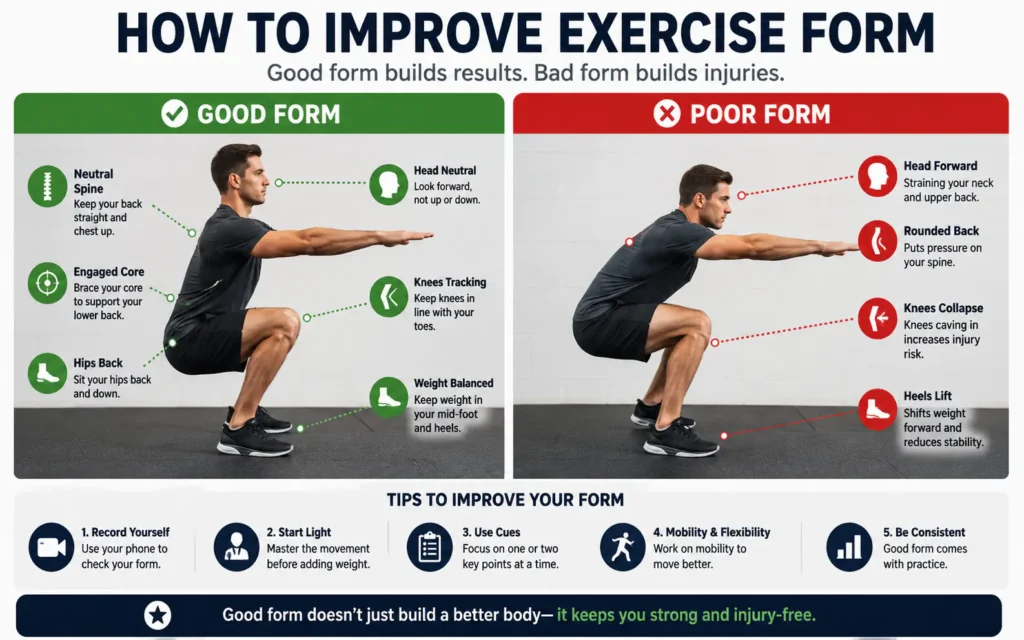
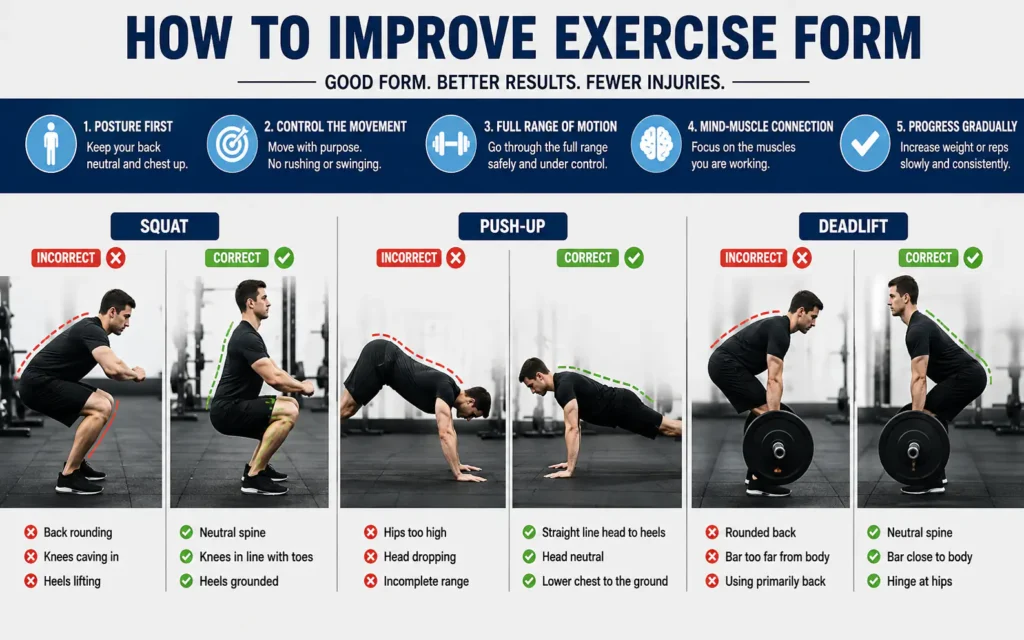
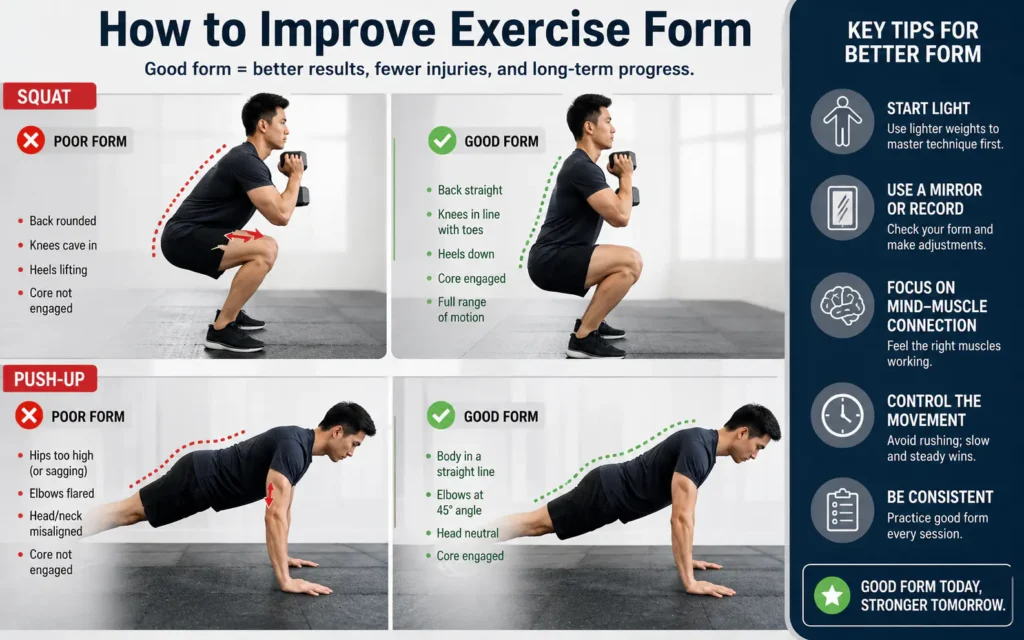
Imagine a squat: your core should feel braced as if you are about to be poked in the stomach, keeping your spine neutral.
Do not arch your lower back to compensate for tight hips.
- Maintain a neutral spine throughout the movement.
- Keep joints stacked to distribute load evenly.
- Ensure your breathing is rhythmic and not held.
- Keep your feet grounded to provide a stable base.
Common Form Mistakes to Avoid
Many exercisers fall into the trap of ‘ego lifting,’ where the desire to move more weight overrides the need for proper technique. This often leads to using momentum or secondary muscles to finish the rep.
Another common issue is rushing through the eccentric (lowering) phase of a lift. This phase is where much of the muscle-building work happens, and skipping it is a missed opportunity for growth.
If you notice your heels lifting during a squat, you are likely leaning too far forward, which shifts the load to your knees.
Ignoring discomfort in joints; pain is not the same as muscle fatigue.
| Common Mistake | Correction |
|---|---|
| Using momentum | Slow down the tempo |
| Arching the back | Brace your core |
| Shortening reps | Focus on full range |
| Holding breath | Exhale on exertion |
FAQs
How do I know if my form is actually good?
If you feel the target muscle working without sharp pain in your joints, your form is likely on the right track. You can also record yourself on video to compare your movement to instructional guides.
Should I use a mirror to check my form?
Mirrors are helpful for initial setup, but relying on them too much can prevent you from developing internal body awareness. Try to perform sets without looking at the mirror to improve your proprioception.
What should I do if I feel pain during an exercise?
Stop immediately. Adjust your range of motion or reduce the weight. If the pain persists, choose a different exercise that targets the same muscle group without causing discomfort.
Is it better to lift heavy with bad form or light with good form?
Always choose light with good form. Lifting heavy with poor technique increases injury risk and often fails to target the intended muscles effectively.
Conclusion
Improving your exercise form is a continuous process of refinement rather than a one-time fix. By slowing down your movements and focusing on the sensation of the target muscle, you build a foundation that supports long-term progress and injury prevention.
Start by applying these principles to just one or two exercises in your next session. Consistency in your technique will yield better results than any increase in weight ever could.
Related posts
 How to Strengthen Weak Nails: A Practical Guide to Daily Care
Learn how to strengthen weak nails with simple daily habits, protective care, and targeted hydration. Restore your natural nail strength today. Weak, peeling, or brittle nails…
 What Sounds Do Cats Dislike? 7 Noises That Stress Your Pet
Discover what sounds do cats dislike and why. Learn how to protect your cat’s sensitive hearing from stressful household noises and high-frequency hums. Cats dislike sounds…
 Restoring Faded Black Clothing: Practical Methods and Reality Checks
Can you restore faded black clothing? Learn the difference between temporary color revival and permanent redyeing, plus how to prevent future fading. You can restore the…