
What Is a Bidirectional Scan Tool? Understanding 2-Way Vehicle Diagnostics
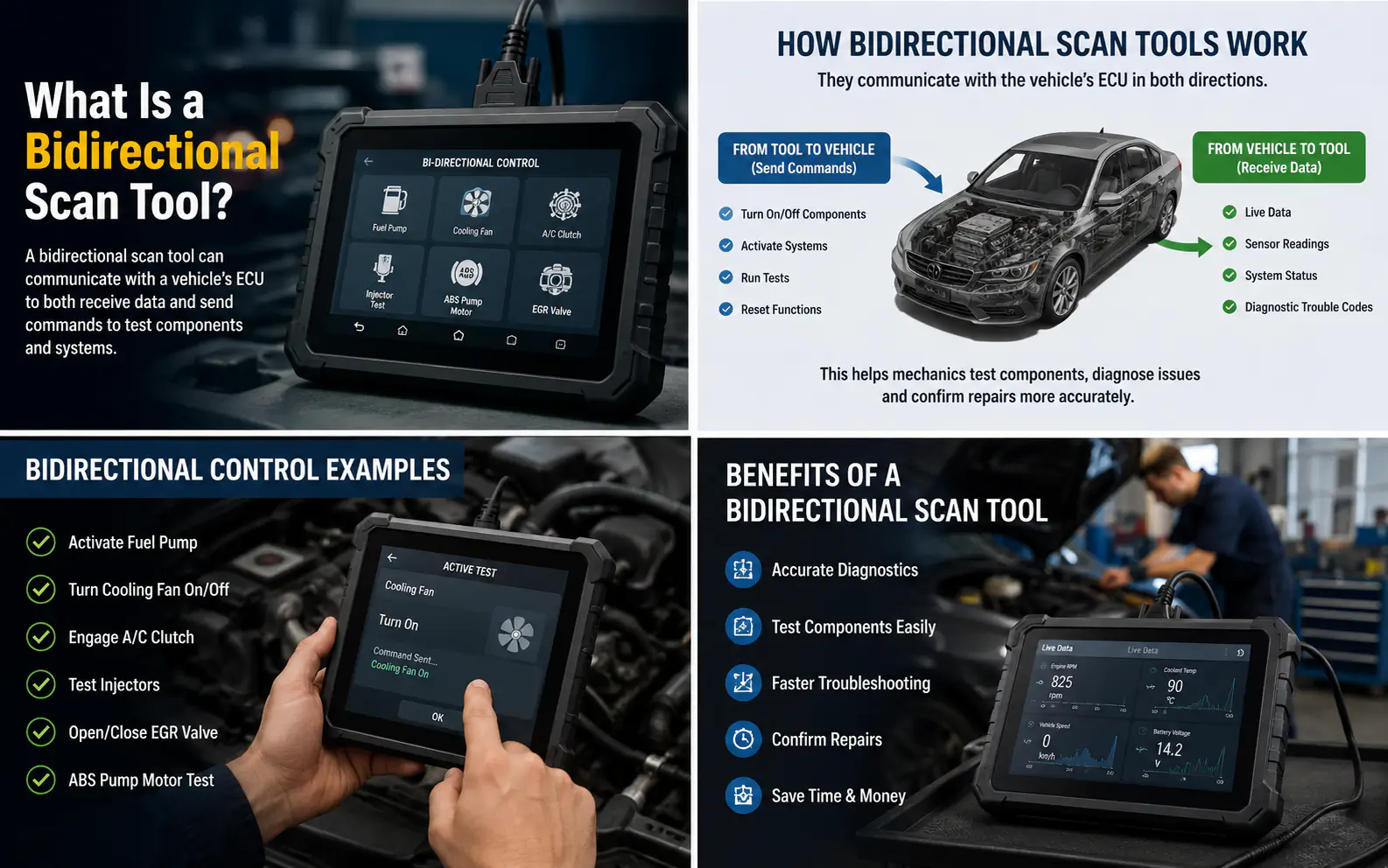
A bidirectional scan tool is a diagnostic device capable of both reading data from your vehicle’s computer and sending commands back to it. While a standard OBD2 scanner acts as a one-way street-only listening to the information the car provides-a bidirectional tool acts as a two-way highway.
This capability allows you to perform ‘active tests,’ where you can manually trigger specific vehicle components like fuel pumps, cooling fans, or door locks through the scanner. This is essential for pinpointing whether a problem lies with a failed part or a faulty electrical signal.
| Topic | When it helps | What to keep in mind |
|---|---|---|
| Active Testing | Isolating mechanical failures from electrical signal issues. | Running tests while the engine is under load can be dangerous. |
| System Calibration | After replacing parts that require software synchronization. | Incorrect calibration can cause poor engine performance or safety system errors. |
| Data Stream Analysis | Confirming that a command was successfully received and executed. | Data lag can sometimes make it look like a test failed when it actually succeeded. |
How Bidirectional Tools Differ from Standard Scanners
Most entry-level OBD2 scanners are passive. They query the Engine Control Unit (ECU) for stored trouble codes and live sensor data. They cannot influence the vehicle’s behavior.
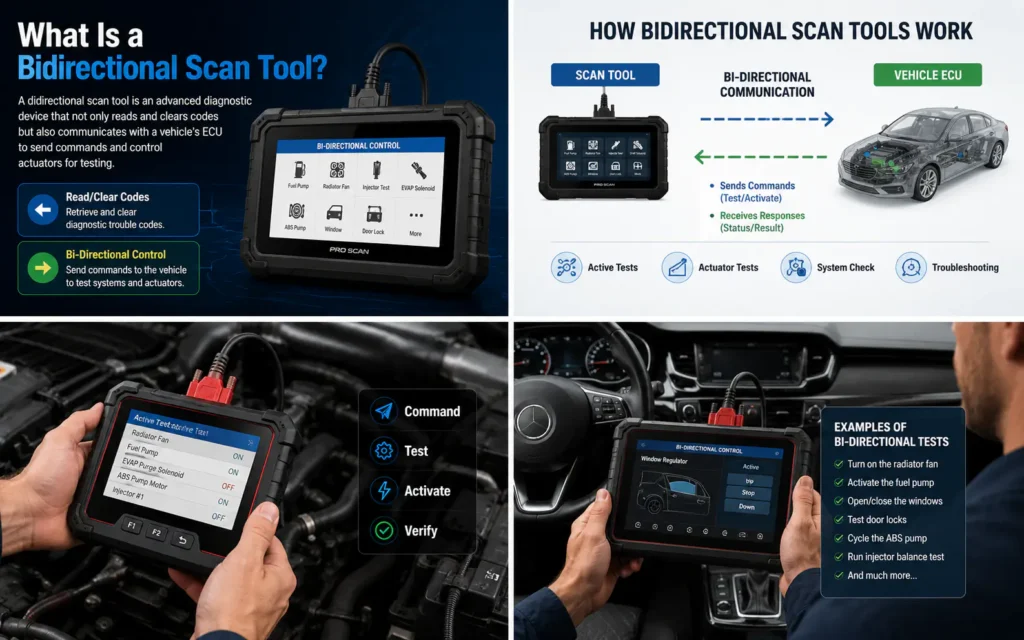
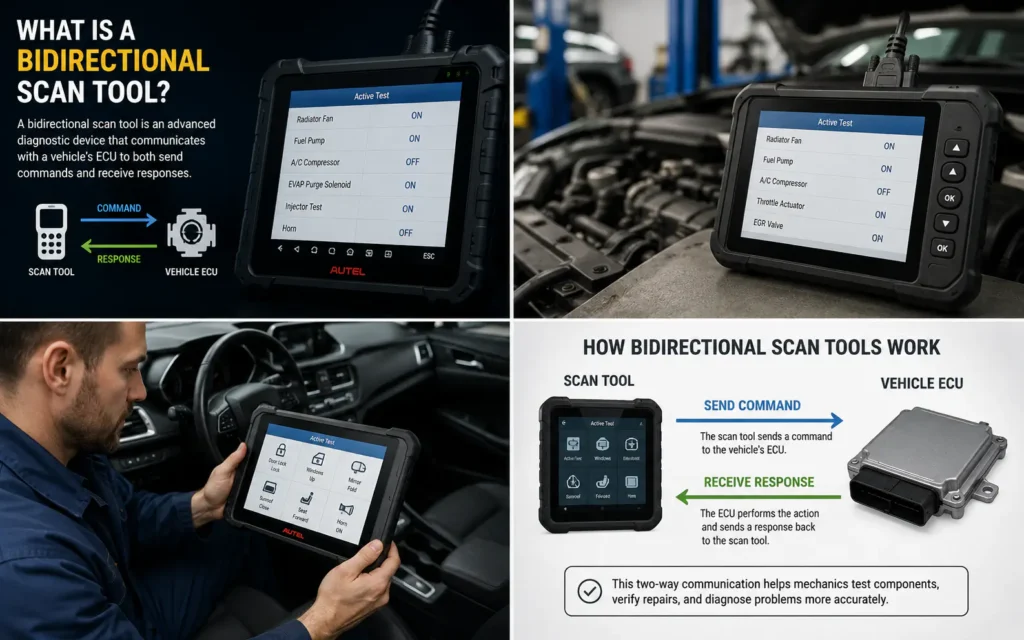
A bidirectional tool bridges this gap. It uses the same communication protocols as the factory diagnostic equipment used at dealerships. By sending specific data packets to the ECU, it forces the vehicle to perform actions that would normally only happen under specific driving conditions.
If your car has a check engine light for a cooling fan, a standard scanner tells you the code. A bidirectional tool lets you turn the fan on manually to see if the motor spins, bypassing the computer’s logic.
Assuming that ‘bidirectional’ means the tool can program any key or flash any ECU; these are often separate, higher-level functions.
| Feature | Standard Scanner | Bidirectional Tool |
|---|---|---|
| Read Trouble Codes | Yes | Yes |
| View Live Data | Yes | Yes |
| Send Commands | No | Yes |
| Active Tests | No | Yes |
Practical Applications of Active Tests
Active tests are the primary reason professionals invest in these tools. They allow you to isolate a component in seconds rather than hours of physical testing.
Common tests include cycling the fuel pump, operating individual fuel injectors, testing cooling fans, and moving electronic throttle bodies. These tests provide immediate feedback on whether a component is functional.
Testing a fuel pump: Instead of dropping the gas tank to test for power, you use the scanner to command the pump to turn on. If you hear it hum, you know the pump and wiring are likely fine.
Performing active tests on safety-critical systems like ABS or airbags without proper knowledge or safety precautions.
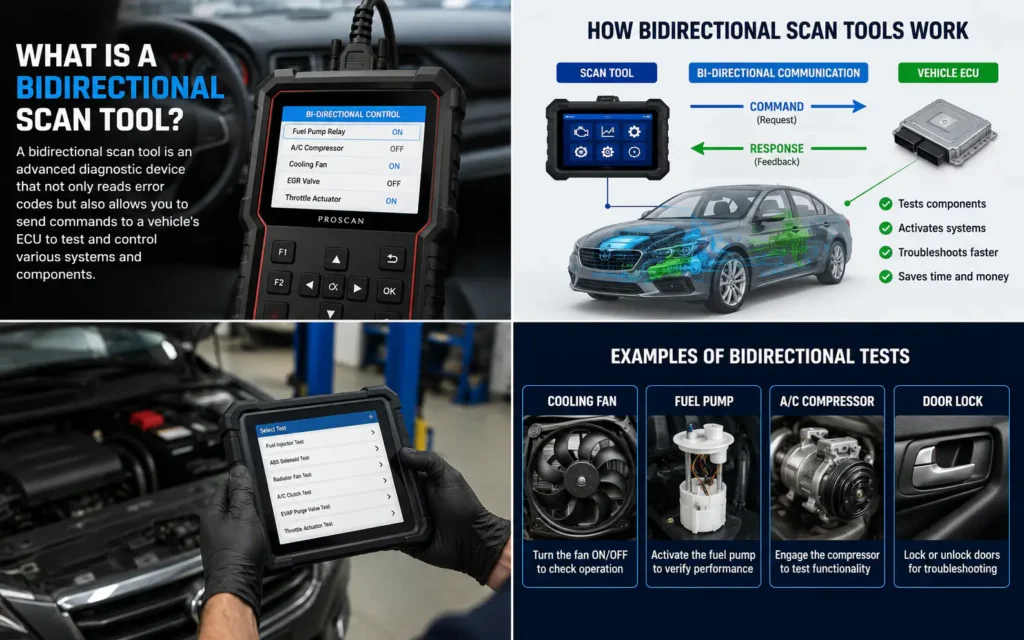
- Fuel System: Command the fuel pump on to check for pressure or leaks.
- Cooling System: Force cooling fans to high speed to test for relay or motor failure.
- Body Electronics: Test door locks, window motors, and interior lighting.
- Transmission: Perform gear shift tests to check solenoid functionality.
Limitations and Compatibility Factors
A bidirectional tool is only as good as the software support for your specific vehicle. Just because a tool is bidirectional doesn’t mean it has the ‘map’ to talk to every system in your car.
Furthermore, modern vehicle security is a major hurdle. Manufacturers are increasingly locking down their ECUs to prevent unauthorized access. If you are working on a newer vehicle, ensure your scanner supports the necessary security bypass protocols.
Many modern vehicles (especially Chrysler/Dodge/Jeep) have a ‘Security Gateway’ module. If your scanner isn’t compatible with this gateway, it won’t be able to send any commands, even if it is a bidirectional tool.
Buying a tool without checking if it supports your specific vehicle’s protocol (e.g., CAN FD or DoIP).
- Security Gateways: Requires specific authorization or a bypass cable.
- Protocol Gaps: Older tools may not support newer communication standards like CAN FD.
- Software Updates: Frequent updates are necessary to keep up with new vehicle models.
- Manufacturer Coverage: Some brands are more ‘open’ to aftermarket tools than others.
Definition of bidirectional control
- Bidirectional tools send commands to vehicle components, not just read error codes.
- They are essential for verifying if a component is faulty or if the wiring/signal is the issue.
- Not all bidirectional tools are equal; software support and protocol compatibility matter most.
- Check for FCA or manufacturer-specific security gateway compatibility before purchasing.
Define the tool explain the
Active Testing. Triggering Components Manually
The tool sends a signal to a specific actuator, such as a fuel injector or window motor, to see if it responds.
- Isolating mechanical failures from electrical signal issues.
- Running tests while the engine is under load can be dangerous.
- Use this to rule out a bad part before buying expensive replacements.
- Function – Commanding
- Goal – Verification
System Calibration. Resetting and Relearning
The tool instructs the ECU to perform a relearn procedure for components like throttle bodies or steering angle sensors.
- After replacing parts that require software synchronization.
- Incorrect calibration can cause poor engine performance or safety system errors.
- Check if your vehicle requires a specific ‘relearn’ procedure after part installation.
- Function – Configuration
- Goal – Synchronization
Data Stream Analysis. Monitoring Real-Time Feedback
While sending a command, the tool monitors the live data stream to see if the system reacts as expected.
- Confirming that a command was successfully received and executed.
- Data lag can sometimes make it look like a test failed when it actually succeeded.
- Always watch the live data graph while triggering an active test.
- Function – Monitoring
- Goal – Validation
FAQs
Are bidirectional scanners worth the extra cost for a DIYer?
If you perform your own repairs and want to avoid ‘parts cannon’ troubleshooting-where you replace parts until the problem goes away-a bidirectional tool is highly valuable. It pays for itself by preventing unnecessary part purchases.
Can a bidirectional scanner program keys?
Some can, but not all. Key programming is a separate, advanced function that requires specific software and security access. Do not assume a bidirectional tool includes this feature unless it is explicitly listed.
What is the best bidirectional scan tool for the money?
The ‘best’ tool depends on your vehicle make and the specific systems you need to access. Look for tools that offer frequent software updates and have a proven track record of supporting your vehicle’s specific security gateway.
Do I need a subscription for a bidirectional scan tool?
Many modern bidirectional tools use a subscription model for software updates. While the tool may work without a subscription, you will eventually lose access to the latest vehicle coverage and diagnostic databases.
Conclusion
A bidirectional scan tool is a powerful diagnostic asset that transforms your ability to troubleshoot vehicle issues. By moving beyond simple code reading and into active system commanding, you gain the ability to verify component health directly.
Before purchasing, prioritize compatibility with your specific vehicle’s security protocols and software updates. Understanding these limitations ensures you choose a tool that actually solves your diagnostic challenges rather than just adding another gadget to your toolbox.
Related posts
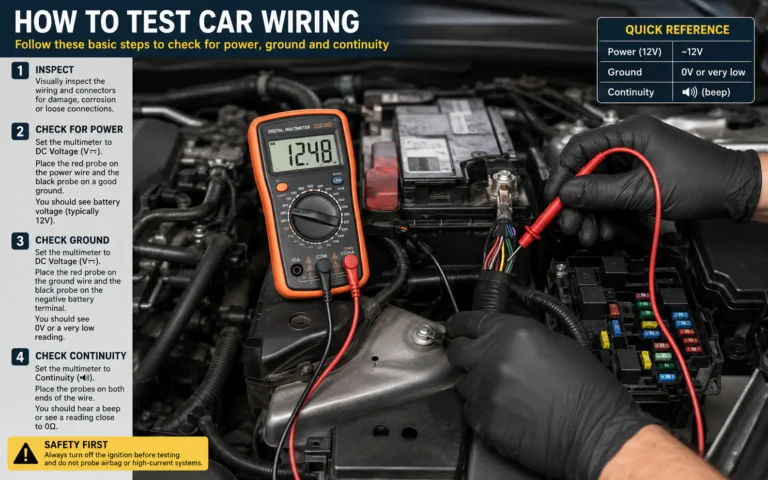 How to Test Car Wiring for Continuity Using a Multimeter
Learn how to test car wiring for continuity safely. Find broken automotive wires, check connector ports, and diagnose electrical issues with a multimeter. Testing car wiring…
 Why Organizing Space Reduces Stress: The Mental Clarity Connection
Discover why organizing space reduces stress. Learn how a tidy environment lowers cortisol, improves focus, and creates a sense of calm in your daily life. Organizing…
 Why Fresh Air Is Important in Your Home: Health and Comfort Benefits
Discover why fresh air is important in your home. Learn how proper ventilation dilutes indoor pollutants, controls humidity, and improves your daily health. Bringing fresh outdoor…