
What Is an Automotive Circuit Tester? Standard Types and Practical Uses

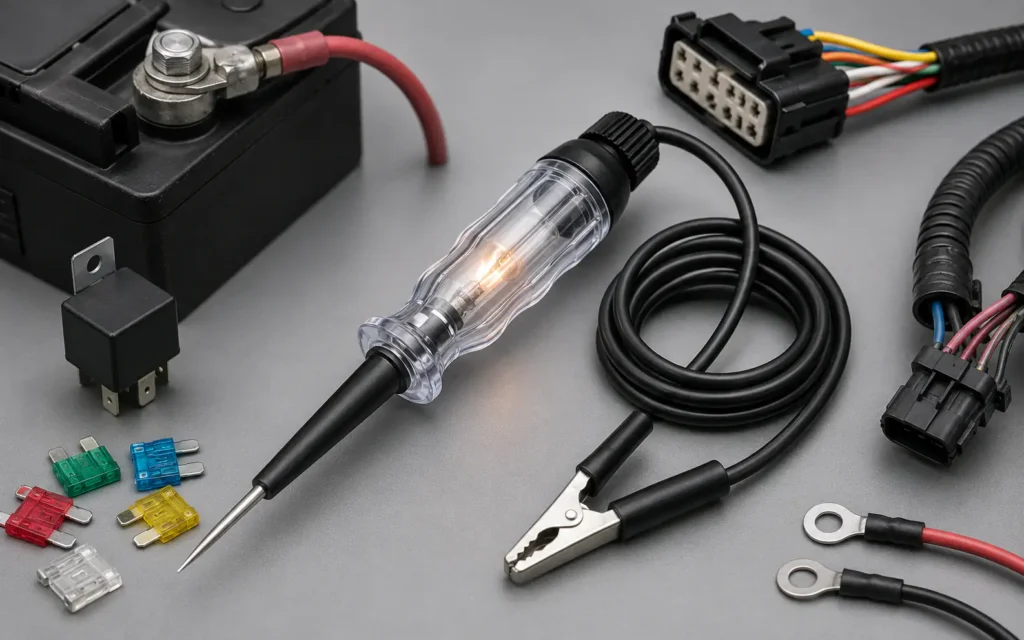
An automotive circuit tester, often called a test light, is a handheld diagnostic tool used to determine whether electrical power is reaching a specific component or wire in a vehicle. It consists of an insulated handle housing an indicator light or digital display, a sharp metal probe tip, and a flexible wire attached to an alligator clamp.
To use the tool, you attach the clamp to a known ground source, like bare frame metal or the negative battery post, and touch the probe to a wire pin or fuse terminal. If positive voltage is present, the indicator lights up or displays a voltage reading, confirming that power flows through that part of the circuit.
Vehicle electrical issues, such as a dead headlight, non-working power window, or blown fuse, are regularly diagnosed using this simple tool. It allows you to trace power step by step along a harness without cutting wires or removing major assemblies.
| Topic | When it helps | What to keep in mind |
|---|---|---|
| Type 1 | Quickly checking fuses, light sockets, and older vehicle circuits without complex electronics. | Can draw enough electric current to damage modern computer sensors or ECU outputs if probed directly. |
| Type 2 | Troubleshooting modern vehicles loaded with electronic control units, sensors, and delicate wiring. | A high-impedance LED can glow on ghost voltage even if the wire cannot carry a real electrical load. |
| Type 3 | Testing motors, relays, horns, and solenoids directly at the harness connection. | Applying battery power to the wrong signal pin can short out sensitive car computers or blow fuses instantly. |
How an Automotive Circuit Tester Functions in Vehicle Diagnostics
Automotive electrical systems rely on direct current (DC) that flows from the battery positive terminal through wires, fuses, and switches, through an electrical device, and back to the metal vehicle body as ground. An automotive circuit tester works by temporarily bridging itself into this path.
When you attach the clip lead to a metal grounding point and touch the stainless probe tip to a hot wire pin, electric current enters the probe shaft, flows through the internal indicator, travels down the wire, and exits into the vehicle ground. Completing this mini-circuit causes the light to illuminate.
You can also reverse this process to check for ground path integrity. By connecting the ground clip to the battery positive post, touching a ground wire pin with the probe tip will light up the tool if a clean ground connection exists.
When checking a taillight that does not turn on, attaching the ground clip to a clean trunk bolt and probing the bulb socket pin reveals if power is reaching the light fixture.
Attaching the ground clip to painted metal or plastic trim, which stops electrical flow and creates false negative test results.
- Attach clamp securely to clean, unpainted frame metal or battery negative.
- Touch probe tip to exposed wire connectors, back-probe terminal plugs, or fuse test points.
- Observe the handle indicator: light on means a complete circuit is present.
- No light indicates an open circuit, blown fuse, broken wire, or bad ground path.
Automotive Circuit Tester vs. Digital Multimeter
While both tools help locate automotive electrical issues, they perform different diagnostic tasks. An automotive circuit tester is a binary tool: it quickly tells you if power or ground is present or absent at a specific point.
A digital multimeter measures precise electrical quantities, including exact voltage levels, circuit resistance in ohms, and current draw in amps. For rapid troubleshooting under the dash or inside fuse boxes, a circuit tester is usually much faster to maneuver than connecting dual multimeter test leads.
The table below breaks down key operational differences between these essential garage tools.
A test light tells you immediately if a fuse has power on both sides, while a multimeter measures if that power is exactly 12.6 volts or dropping under load.
Assuming a lit test light means a component has full operating current when high wire resistance might still restrict performance.
| Feature / Capability | Automotive Circuit Tester | Digital Multimeter |
|---|---|---|
| Primary Function | Quick visual confirmation of power/ground | Measures exact voltage, resistance, and current |
| Speed of Setup | Extremely fast (single ground connection) | Moderate (requires two leads and mode selection) |
| Ease of Use | Beginner friendly | Requires understanding of electrical scales |
| ECU Safety | Safe only with LED / High-Impedance models | Safe (High input impedance) |
| Best Application | Tracing broken wires, testing relays and fuses | Measuring sensor outputs and battery health |
Safety Considerations and Best Practices for Testing Vehicle Circuits
Modern vehicles feature sensitive electronic control units (ECUs) and network buses that communicate using low-voltage signals. Using an old incandescent test light on these data lines can draw too much current through internal computer transistors, causing expensive module failures.
Always confirm that your circuit tester is high-impedance or LED-rated before checking circuits connected to the computer. When probing weather-sealed connectors under the hood, insert thin back-probe pins into the rear rubber wire seals rather than piercing the wire insulation.
If you must pierce insulation during an emergency roadside repair, always seal the small hole immediately afterward using liquid electrical tape or heat-shrink tubing to prevent corrosion.
Never use a sharp probe tip to puncture wire insulation outdoors where moisture can enter, corroding the internal copper wire over time.
Probing bright yellow wiring harnesses, which are dedicated to the vehicle supplemental restraint system (airbags).
- Avoid probing yellow wiring loom jackets or yellow connectors (Airbag / SRS system).
- Verify your ground clamp is securely clipped to bare metal to prevent false readings.
- Use computer-safe LED probes on modern vehicles made within the last 30 years.
- Never force a thick probe tip into delicate female harness pins, which stretches terminals open.
Safety checks
- An automotive circuit tester checks for power or ground present in direct current vehicle wiring.
- Standard test lights use a heavy probe, an internal bulb or LED, a wire lead, and an alligator clip.
- LED and digital circuit testers draw minimal current, making them safe for sensitive ECU connections.
- A circuit tester identifies active voltage quickly, but a multimeter is necessary to measure precise resistance or exact voltage levels.
Define the tool explain its
Type 1. Standard Incandescent Test Light
The traditional circuit tester featuring a clear handle containing a small incandescent light bulb. It lights up when touching positive voltage if the ground clamp is connected to negative ground.
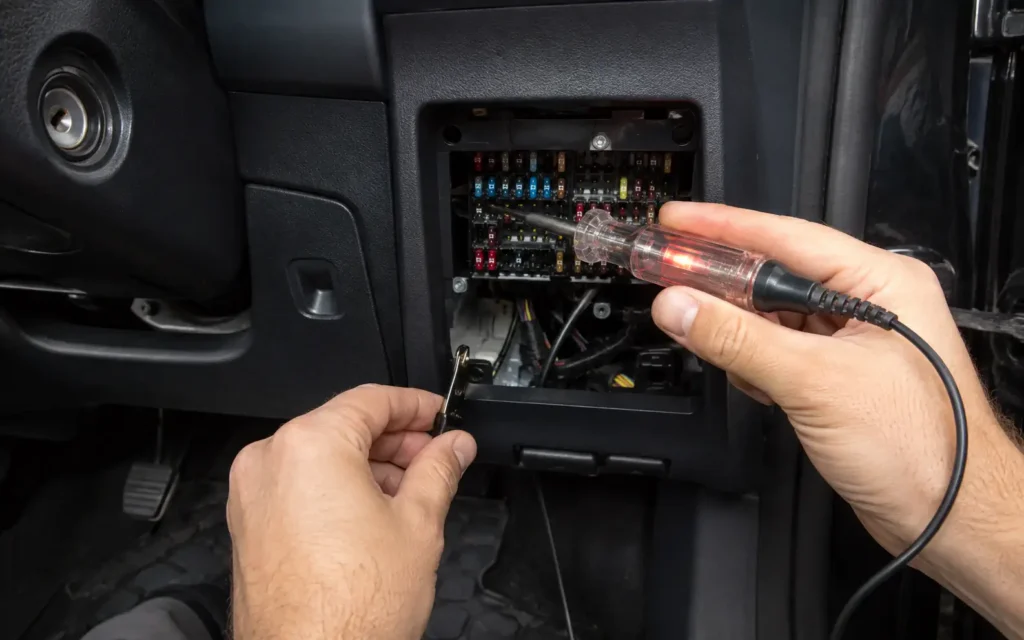
- Quickly checking fuses, light sockets, and older vehicle circuits without complex electronics.
- Can draw enough electric current to damage modern computer sensors or ECU outputs if probed directly.
- Use this on basic power feeds, such as headlamp sockets or relay power pins, on older classic vehicles.
- Visual Indicator – Incandescent Bulb
- Computer Safe – No
- Typical Voltage – 6V – 12V DC
Type 2. Digital LED Circuit Tester
A modern diagnostic probe equipped with dual-color LEDs or a LCD screen showing exact numeric voltage. It uses light-emitting diodes that require very low milliamp current to operate.
- Troubleshooting modern vehicles loaded with electronic control units, sensors, and delicate wiring.
- A high-impedance LED can glow on ghost voltage even if the wire cannot carry a real electrical load.
- Select an LED or digital display model for general maintenance on any car made after 1996.
- Visual Indicator – LED Light or LCD Screen
- Computer Safe – Yes
- Typical Voltage – 3V – 48V DC
Type 3. Power Circuit Probe
An active circuit testing tool connected directly to the vehicle battery terminals. It features built-in switches allowing you to apply battery positive power or ground directly to a component.
- Testing motors, relays, horns, and solenoids directly at the harness connection.
- Applying battery power to the wrong signal pin can short out sensitive car computers or blow fuses instantly.
- Ideal for advanced DIYers or technicians needing to power up components on a workbench or vehicle harness.
- Visual Indicator – Audible Tones and Display Screen
- Computer Safe – Selectable / Caution Required
- Typical Voltage – 12V – 24V DC
FAQs
What is the primary purpose of an automotive circuit tester?
An automotive circuit tester is used to quickly check if electric power or ground is active at a wire, fuse, switch, or socket in a vehicle direct-current system.
Can a standard circuit tester damage a car’s computer?
Yes, traditional incandescent bulb test lights can draw enough current to damage delicate ECU components. Always use a high-impedance LED digital circuit tester on computer-controlled circuits.
Where should I connect the ground clip on a circuit tester?
Clip the clamp to a clean, unpainted metal surface on the chassis, engine block, or directly to the negative battery terminal for an accurate test loop.
What is the difference between a test light and an automotive circuit tester?
They are terms for the same tool. ‘Test light’ usually refers to basic single-bulb styles, while ‘automotive circuit tester’ includes digital display and powered probe models.
How do I test a car fuse with a circuit tester?
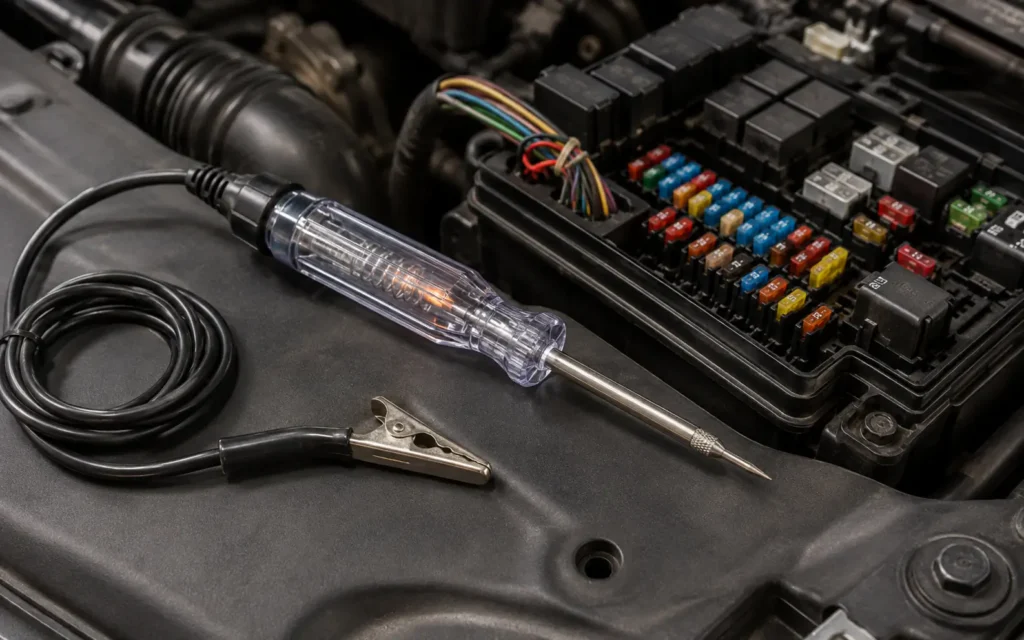
Attach the ground clip to bare metal, turn the ignition key to the run position, and touch the probe tip to both small metal pins on the back of the fuse. If power is only on one side, the fuse is blown.
Conclusion
An automotive circuit tester is an essential, easy-to-use tool for diagnosing everyday car electrical problems. By bridging power points and vehicle ground, it lets you check fuses, switches, relays, and light sockets in seconds.
For modern vehicles, choose an LED or digital model to safeguard sensitive computer circuits while troubleshooting. Keep your ground connection secure, avoid damaging wire seals, and use this lightweight probe to quickly track down electrical issues.
Related posts
 Why Pest Control Is Important at Home: Protecting Health and Property
Discover why pest control is important at home. Learn how regular pest management protects your family’s health, prevents property damage, and secures your food. Understanding why…
 How to Test a Car Ground Connection: Step-by-Step Multimeter Methods
Learn how to test a car ground connection using a digital multimeter. Follow our step-by-step guide to diagnose voltage drops, resistance, and bad grounds. A car…
 Why Do Dogs Stare at Walls? Common Causes and When to Worry
Wondering why do dogs stare at walls? Discover the sensory, behavioral, and medical reasons behind this behavior, and learn when to contact your veterinarian. When you…