
How To Lift A Car Safely With Jack Stands
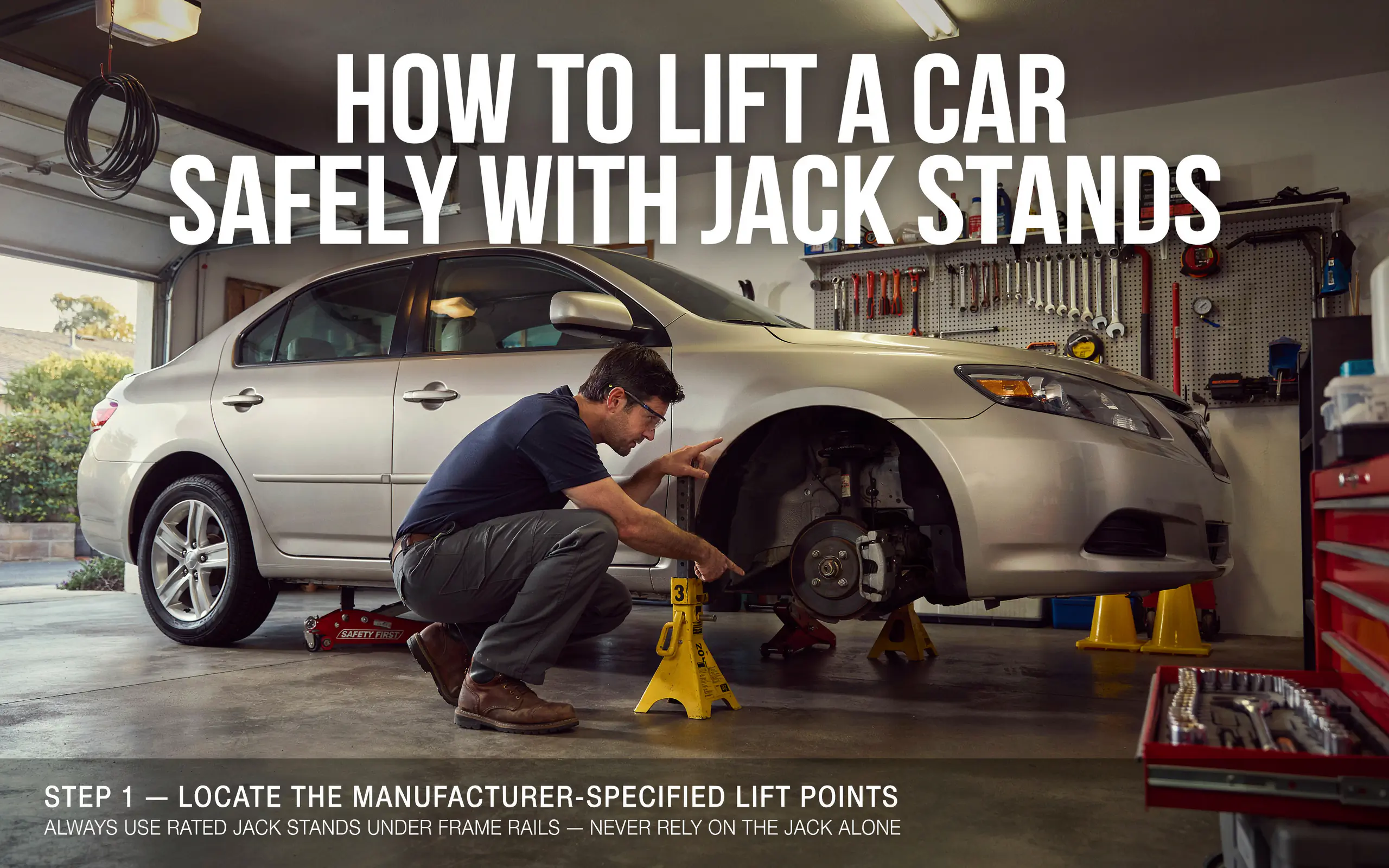
Learning how to lift a car safely with jack stands is the most important skill for any home mechanic. This guide covers choosing the right stands, finding jack points, step-by-step lifting, and essential safety checks to keep you protected every time you work under your vehicle.
Working on your own car is one of the most satisfying things you can do. There is a real sense of pride that comes from fixing a problem yourself or performing your own maintenance. But before you slide under that vehicle, you absolutely need to know how to lift a car safely with jack stands. This is not something to guess about or rush through.
I have spent many years in my garage working on everything from old trucks to modern sedans. I have seen people make dangerous choices because they were in a hurry. I have also made my own mistakes and learned from them. The truth is that a car falling off a jack can cause life-changing injuries. That is why I want to share what I know so you can avoid those risks.
This guide will walk you through every step of the process. We will talk about choosing the right equipment, preparing your workspace, finding the correct lifting points, and using jack stands the right way. By the time you finish reading, you will feel confident and prepared to lift a car safely with jack stands on your own.
Why You Must Never Rely on a Jack Alone
Many people think a floor jack is enough to hold a car up while they work. This is a dangerous mistake. A hydraulic jack is designed to lift a vehicle, not to support it for long periods. Hydraulic seals can fail. Pressure can slowly leak. Even a brand new jack can drop without warning.
Jack stands are purpose-built to hold heavy static loads. They provide an independent, fail-safe support for the vehicle. When you lift a car safely with jack stands, you are creating a solid mechanical support that does not rely on hydraulics or moving parts that can fail.
Veteran mechanic My Mobile Mechanic puts it bluntly: “If you’ve ever had a jack lose pressure and you witness the car drop on a stand, sometimes that stand will tilt, slide, move, etc. And then it’s coming down and killing you”. That is a sobering thought, but it is the reality of working under a car.
The rule is simple. Never go under a vehicle that is only held up by a jack. Always use jack stands. Even if you are just changing a tire, use a stand. It takes a few extra seconds and could save your life.
Choosing the Right Jack Stands for Your Vehicle
Before you can lift a car safely with jack stands, you need to have the right stands for the job. Not all jack stands are the same, and using the wrong ones can be just as dangerous as using none at all.
Weight Capacity Matters
The most important factor when choosing jack stands is their weight rating. Stands generally come in pairs, and the rating is what they can support together. For example, a set of 3-ton stands can hold 6,000 pounds total, with each stand holding 3,000 pounds.
A good rule of thumb is that each stand should be able to handle three-quarters of your car’s total weight. If your vehicle weighs 4,000 pounds, you would want stands rated for at least 3,000 pounds each. It is always better to round up. If you are not sure about your car’s weight, check the owner’s manual or the sticker inside the driver’s door frame.
Design and Construction
Modern jack stands typically use a ratcheting mechanism. This design has a post with teeth that slides up and locks into place. The ratchet allows you to raise the stand easily, and it locks securely when weight is applied. Some stands also have a secondary locking pin for extra safety.
Steel stands are common and affordable. Aluminum stands are lighter but still support significant weight. Whichever you choose, make sure the stands are certified to safety standards like ANSI/ASME PASE. This certification means they have been tested and meet strict safety requirements.
Height Range
Consider the minimum and maximum height of the stands. You need stands that are tall enough to give you working clearance but short enough to fit under the car when it is partially lifted. Most stands have an adjustable range, so check the specifications before buying.
Preparing Your Workspace
Proper preparation is half the battle when you lift a car safely with jack stands. Taking a few minutes to set up your workspace correctly can prevent many common accidents.
Find Level Ground
Always work on a solid, flat surface. A garage floor or concrete driveway is ideal. If there is more than a slight, barely noticeable slope, the vehicle could roll or shift out of place when the tires lift off the ground.
Avoid grass, dirt, gravel, or asphalt on a hot day. Soft surfaces can cause the stands to sink or shift. If you absolutely must work on asphalt, use a piece of plywood under each stand to distribute the weight and prevent sinking.
Clear the Area
Remove any tools, parts, or debris from the work area. You need a clear path to move around safely. Make sure there is enough space to position your floor jack and access all four corners of the vehicle if needed.
Have a Helper
While not required, having someone with you is a good idea. Even if they just hand you tools or keep an eye on things, an extra pair of hands can be helpful. “Even if it’s just your son/daughter or friend with little automotive experience, it always helps to have an extra pair of eyes or hands,” advises BendPak.
Step-by-Step: How to Lift a Car Safely with Jack Stands
Now we get to the main event. Follow these steps carefully to lift a car safely with jack stands every time.
Step 1: Park and Secure the Vehicle
Park the car on your level surface. If you have an automatic transmission, put it in Park. If you have a manual, put it in first gear. Pull the parking brake firmly.
Step 2: Place Wheel Chocks
Wheel chocks are essential. They are your last line of defense against rolling. Place chocks on both sides of the wheels that will stay on the ground.
If you are lifting the front, chock the rear wheels. If you are lifting the rear, chock the front wheels. If you are lifting the whole car, chock all four wheels. You can buy rubber or plastic chocks, or you can use heavy blocks of wood.
Step 3: Locate the Jack Points
This step is critical. You cannot just put a jack anywhere under a car. There are designated jack points with structural components that can hold the weight of your vehicle.
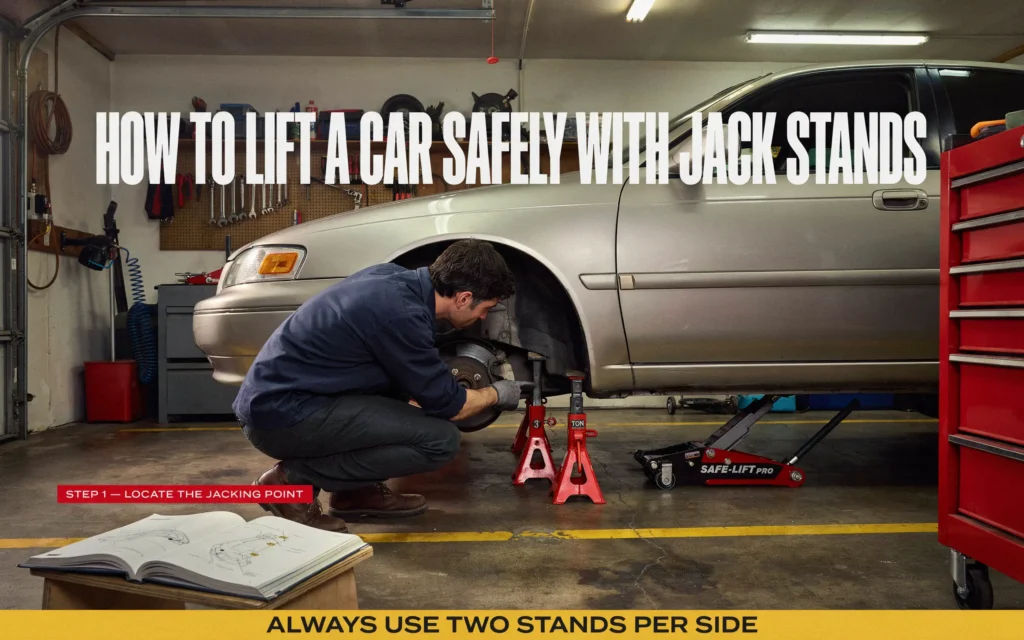
Check your owner’s manual for the correct jack points. On most cars, you will find reinforced areas on the frame rails or pinch welds just behind the front wheels and in front of the rear wheels. Some vehicles have specific locations marked with small arrows or notches.
If you use the wrong spot, you could damage the car or cause it to slip off the jack.
Step 4: Position the Floor Jack
Place your floor jack under the designated jack point. Make sure the jack saddle is centered on the lifting point. Use a rubber pad if you have one to prevent marring and slippage.
If you are lifting the front of the car, many vehicles have a crossmember under the engine that works as a jacking point. Some mechanics use a piece of 2×4 lumber between the jack pad and the crossmember to spread the load and avoid damage.
Step 5: Lift the Vehicle
Pump the floor jack handle to raise the vehicle. Lift it slowly and smoothly. Watch the car as it goes up to make sure it is stable and not shifting.
Lift the car high enough to get your jack stands underneath. You want enough clearance to position the stands comfortably. Do not lift it higher than necessary.
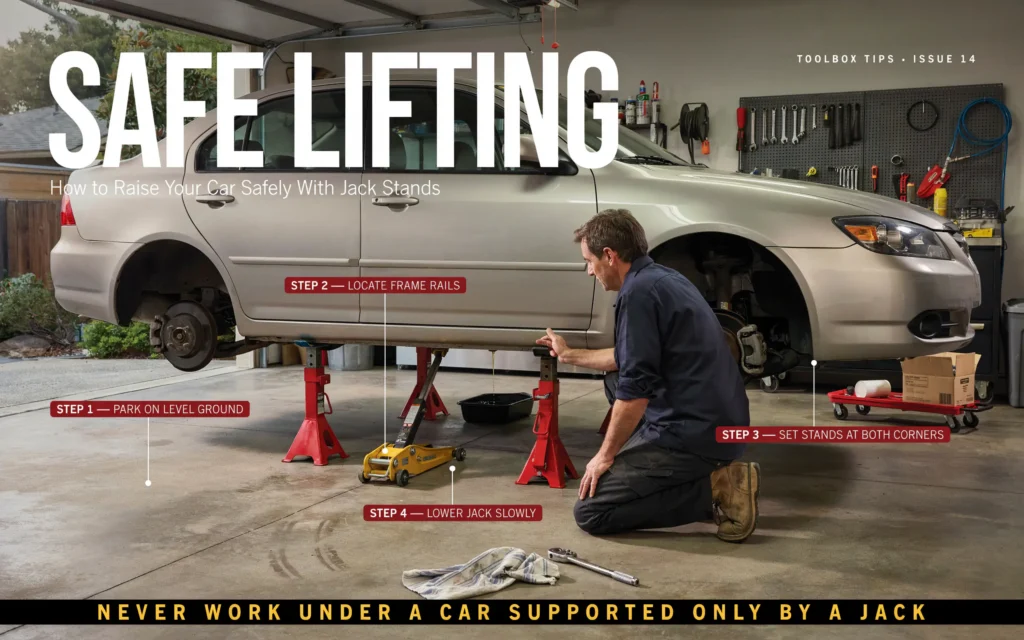
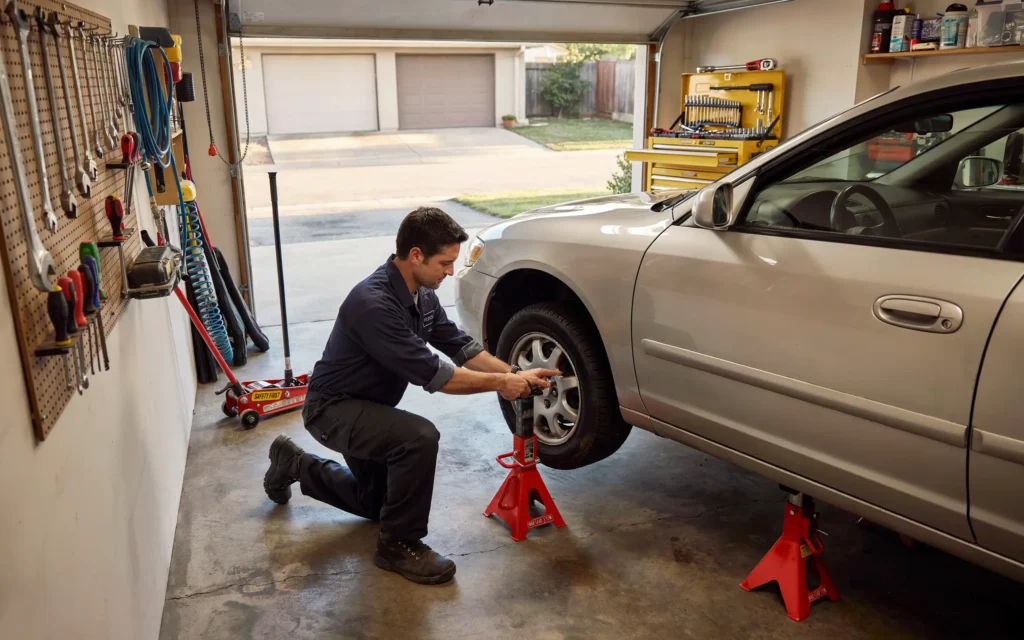
Step 6: Position the Jack Stands
This is where you lift a car safely with jack stands or you do not. Place each jack stand directly under the lifting point. There should be enough room at every jack point to accommodate the stand’s grip.
Raise the support bar until it is as close as possible to the contact point without lifting the car off the jack. The stand should fit snugly against the car’s frame or designated lifting point.
Step 7: Lower the Car onto the Stands
Slowly release the pressure on the floor jack. Let the car lower gently onto the jack stands. The weight of the vehicle should come down flush on top of the stand.
Only fully lower the hydraulic jack after confirming that the car is tightly pressed against the stand. The stand should not jiggle or move.
Step 8: Test for Stability
Before you get under the car, give it a firm push or shake. Bump the car with your shoulder or hip. If it moves or wobbles, something is wrong. Adjust the stands or reposition them until the car is solid and stable.
Many experienced mechanics leave the floor jack in place as a backup after setting the car on jack stands. This adds an extra layer of safety with almost no extra work.
Step 9: Repeat for Other End or Side
If you are lifting the whole car, repeat the process on the other end. Lift the front first, secure it, then lift the rear. Make sure all stands are at the same height so the car is level.
Common Mistakes to Avoid
Knowing what not to do is just as important as knowing the right steps. Here are some common errors people make when they lift a car safely with jack stands.
Using the Wrong Jack Points
This is one of the most frequent mistakes. Putting a jack or jack stand in the wrong place can damage the vehicle or cause it to slip off. Always consult your owner’s manual.
Overloading the Stands
Do not exceed the weight capacity of your jack stands. If your vehicle is on the heavy side, get stands rated for more weight. Remember that the rating is for the pair, not each individual stand.
Not Using Chocks
Skipping wheel chocks is a huge risk. Even with the parking brake on, a car can roll. Chocks are cheap and easy to use. There is no excuse for skipping them.
Working on Uneven Ground
A slight slope might not seem like a big deal, but it can cause the car to shift. Level ground is non-negotiable when you lift a car safely with jack stands.
Failing to Test Stability
Do not just assume the car is stable. Give it a push. Shake it. Make sure it is solid before you go underneath.
Using Damaged Stands
Inspect your jack stands before each use. Check for bent parts, cracked welds, or any signs of damage. If a stand looks questionable, do not use it.
Relying on the Jack Alone
This mistake can be fatal. A floor jack is for lifting, not supporting. Always use jack stands when you are under the vehicle.
Lifting Different Types of Vehicles
Not all cars are the same. Here is a quick reference for different vehicle types.
| Vehicle Type | Front Jack Points | Rear Jack Points |
|---|---|---|
| Sedans / Hatchbacks | Pinch welds behind front wheels | Pinch welds in front of rear wheels |
| Trucks / SUVs (Body-on-frame) | Frame rails near front wheels | Frame rails or axle tubes |
| Sports Cars | Reinforced frame rails or crossmember | Subframe or axle housing |
Some vehicles have specific requirements. For example, some modern cars have battery packs or other components that make jacking more complicated. Always check your owner’s manual.
Essential Safety Checklist
Use this checklist every time you lift a car safely with jack stands.
| Safety Item | Check |
|---|---|
| Level, solid surface | ☐ |
| Parking brake engaged | ☐ |
| Transmission in Park or first gear | ☐ |
| Wheel chocks in place | ☐ |
| Jack stands properly rated | ☐ |
| Jack stands inspected for damage | ☐ |
| Correct jack points identified | ☐ |
| Jack stands positioned correctly | ☐ |
| Car lowered onto stands securely | ☐ |
| Stability tested before going under | ☐ |
| Floor jack left as backup | ☐ |
A Note on Quality and Certification
Not all jack stands are created equal. The Automotive Lift Institute (ALI) recommends that support stands be certified to the ANSI/ASME PASE Safety Standard for Portable Automotive Service Equipment. Look for this certification when you buy stands.
“A common mistake is to assume all stands are the same and to grab whatever is handy,” explains ALI’s Dale Soos. Taking the time to choose quality equipment is part of learning how to lift a car safely with jack stands.
What to Do If Something Goes Wrong
Even with all the right precautions, things can sometimes go wrong. Here is what to do if you encounter problems.
The Car Shifts While Lifting
Stop immediately. Lower the car back down and reposition the jack. Do not try to correct a shifting car while it is in the air.
A Jack Stand Seems Unstable
Do not go under the car. Raise the car back up with the floor jack, reposition the stand, and lower it again. Make sure it is solid before proceeding.
The Floor Jack Loses Pressure
If the jack starts to drop while you are positioning stands, get clear of the vehicle. Do not try to catch it or hold it up. Let it down and start over with a different jack or a better setup.
Removing the Jack Stands
When you are finished working, removing the stands is the reverse of putting them in place.
Raise the car slightly with the floor jack to take the weight off the stands. Remove the stands one at a time. Lower the car slowly and smoothly. Remove the wheel chocks last.
Never try to pull the stands out while the car is still resting on them. Always use the jack to lift the car first.
Frequently Asked Questions
Can I use a jack stand and a floor jack at the same time?
Yes. Many mechanics use the floor jack as a backup while the car rests on jack stands. This adds an extra layer of safety. Just make sure the jack is not bearing the full weight of the car. The stands should do the primary support.
How many jack stands do I need?
You need at least two stands to lift one end of a car. To lift the whole car, you need four stands. Some people use two stands and leave the jack under the other end, but four stands are more stable for working underneath.
Where do I put jack stands on a unibody car?
On a unibody car, the jack points are usually on the pinch welds. These are the reinforced seams that run along the bottom of the car. Look for notches or arrows that indicate the correct spots. Use slotted adapters on your jack stands to fit the pinch welds properly.
Can I use wood blocks instead of jack stands?
No. Wood blocks, cinderblocks, or milk crates are not safe substitutes. They can crack, crumble, or shift under the weight of a vehicle. Only use certified jack stands designed for this purpose.
How do I know if my jack stands are safe?
Inspect them before each use. Look for cracks, bent parts, or damaged welds. Check the weight rating to make sure it matches your vehicle. Look for certification marks like ANSI/ASME PASE. If you have any doubts, replace them.
What is the best way to lift a car safely with jack stands on a slope?
The best way is to not do it. Find level ground. If you absolutely cannot, park close to a curb and turn the wheels inward. Use heavy-duty chocks and be extra cautious. But honestly, find level ground.
Should I leave the jack under the car after placing jack stands?
Yes, leaving the floor jack in place with slight pressure is a good safety practice. It provides a backup in case a stand fails. Just make sure the jack is not obstructing your work area.
How high should I lift the car?
Lift it only as high as you need to work comfortably. The higher you lift, the more unstable the car becomes. Use the minimum height that gives you enough clearance.
Final Thoughts
Learning to lift a car safely with jack stands is a skill that every home mechanic needs to master. It is not difficult, but it does require attention to detail and a healthy respect for the weight of a vehicle. A car weighs thousands of pounds. If it falls, it can crush you. There is no second chance.
Take your time. Follow the steps. Use the right equipment. Check everything twice. The extra few minutes you spend on safety are worth it.
As Todd Michalski from Gray Manufacturing points out, “Stands provide an independent, fail-safe support of the vehicle”. That is exactly what you need when you are working underneath a car. That peace of mind lets you focus on the job instead of worrying about whether the car is going to fall.
Remember, the best mechanics are not the ones who work the fastest. They are the ones who work safely and go home to their families at the end of the day. Every time you lift a car safely with jack stands, you are protecting yourself and everyone around you.
So get out there, work on your car, and enjoy the satisfaction of doing it yourself. Just do it safely. Your life is worth more than any repair job.
Stay safe, take your time, and never compromise on safety when you work under your vehicle.
Related posts
 2026 Torque Wrench Reviews: Choosing the Right Tool for Precision Fastening
Explore our 2026 torque wrench reviews to find the right tool for your automotive, bike, or gunsmithing projects. Compare top models for accuracy and value. Finding…
 Top Automotive Tools for Beginners: Essential Gear for 2026
Discover the top automotive tools for beginners in 2026. Compare essential pry kits, wrench sets, and repair gear to start your DIY car maintenance journey. Starting…
 Top Rated Mechanic Tool Brands for 2026
Explore top rated mechanic tool brands for 2026. Compare reliable socket sets and hand tools to find the right equipment for your home garage or auto…