
How To Diagnose Car Electrical Problems
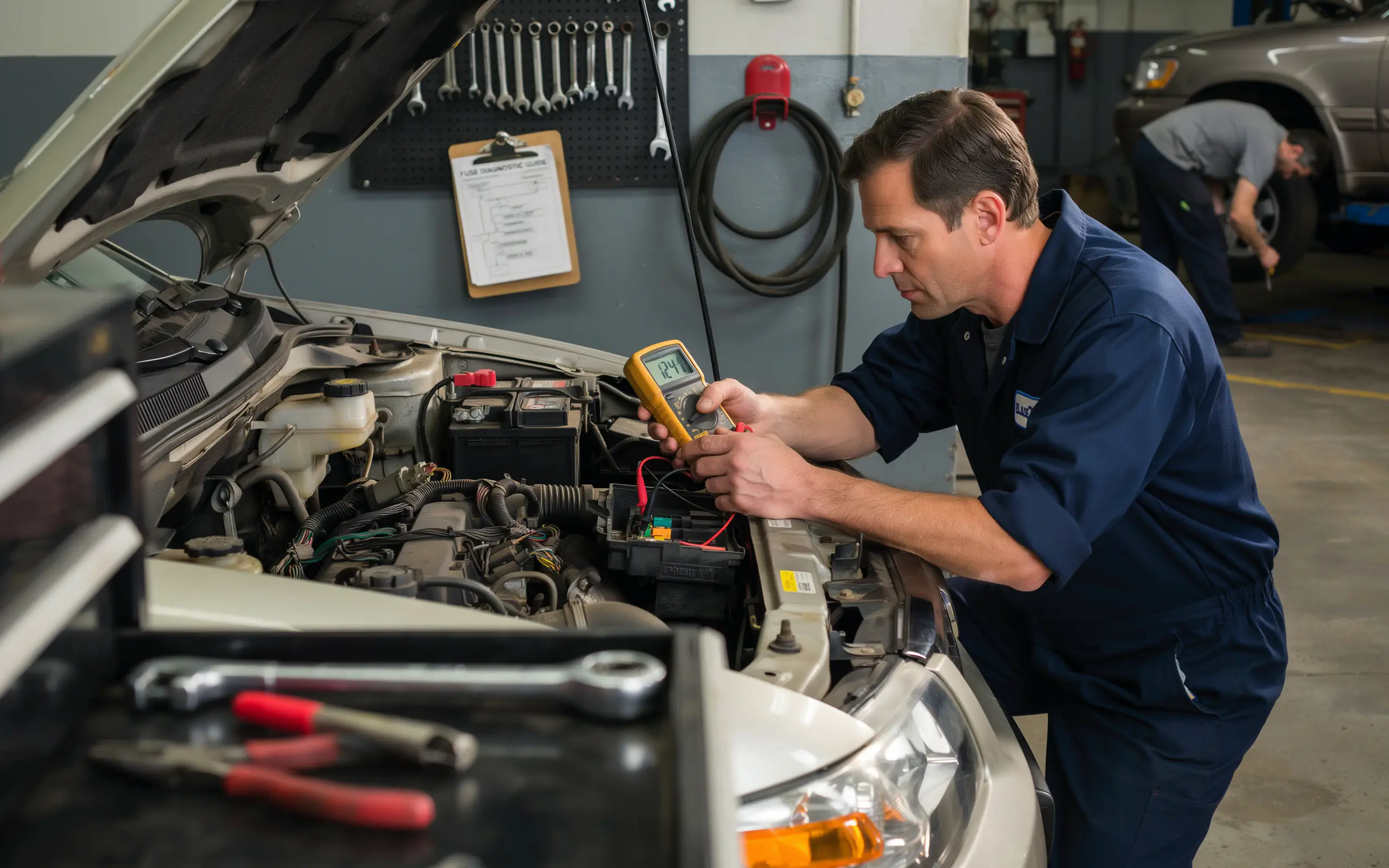
Learn how to diagnose car electrical problems step by step. This guide shows you simple tests for your battery, alternator, fuses, and wiring. Save time and fix your car’s electric issues yourself today.
You turn the key. Nothing happens. Or maybe your headlights are dim, and your radio keeps shutting off. Sound familiar? Car electrical problems can be frustrating. But here is the good news. You do not need to be a mechanic to figure out what is wrong. With a few basic tools and some patience, you can learn how to diagnose car electrical problems on your own.
I have worked on cars for over 15 years. I have seen dead batteries, broken alternators, and melted wires. And I want to share what I learned. This guide is for anyone who owns a car. It is simple, friendly, and full of real help. No fancy words. Just clear steps.
Let me start with a quote from someone who knows cars well.
“Most car electrical problems are simpler than they seem. Start with the battery and work your way forward.” – Mike Collins, ASE Certified Master Technician
By the end of this article, you will know exactly what to check, what tools to use, and when to call a pro. So grab a cup of coffee, and let us get started.
Signs Your Car Has an Electrical Problem
Before you pick up any tool, you need to know what you are looking for. Electrical issues show up in many ways. Some are obvious. Some are sneaky. Here are the most common signs.
Common Symptoms to Watch For
- The engine cranks slowly or does not crank at all.
- Your headlights are dim, especially when idling.
- Dashboard warning lights stay on, like the battery light.
- The radio, power windows, or interior lights work sometimes but not always.
- You smell burning plastic or rubber near the engine.
- Fuses keep blowing for no clear reason.
- The car starts fine one day, but the next day the battery is dead.
If you notice any of these, you likely have an electrical problem. Do not ignore them. Small issues can turn into big repairs.
Here is a quick table to help you match symptoms with possible causes.
Table 1: Symptoms vs Possible Causes
| Symptom | What It Might Mean |
|---|---|
| Engine cranks slowly | Weak battery, bad connection, or failing starter |
| Headlights dim at idle | Alternator not charging properly |
| Radio or lights work sometimes | Loose wiring or bad ground connection |
| Battery dies overnight | Parasitic drain (something stays on) |
| Burning smell from engine | Short circuit or melted wire insulation |
| Fuses blow repeatedly | Short to ground or faulty component |
Now that you know the signs, let us talk about the tools you need. Because to diagnose car electrical problems correctly, you cannot just guess. You need to test.
Tools You Need to Diagnose Car Electrical Problems
You do not need a full garage. Most of these tools are cheap and easy to find. Here is what I recommend.
- Digital Multimeter – This is your best friend. It measures voltage, resistance, and continuity. Get one for $20 to $40.
- Test Light – A simple tool that lights up when there is power. Great for quick checks.
- Battery Load Tester – Optional but useful. It tells you if your battery is truly weak or just low on charge.
- Fuse Puller (or small pliers) – For removing fuses safely.
- Wire Brush – To clean battery terminals and ground connections.
- Owner’s Manual – Your car’s wiring diagram and fuse box locations are inside.
Once you have these tools, you are ready. Next, I will walk you through a step by step process how to diagnose car electrical problems from the easiest checks to the more advanced ones.
“A $20 multimeter will save you $500 in unnecessary repairs. Learn to use it.” – Sarah Lee, Automotive Engineer
Step-by-Step Guide: How to Diagnose Car Electrical Problems
Follow these steps in order. Do not skip around. This flow saves time and keeps you safe.
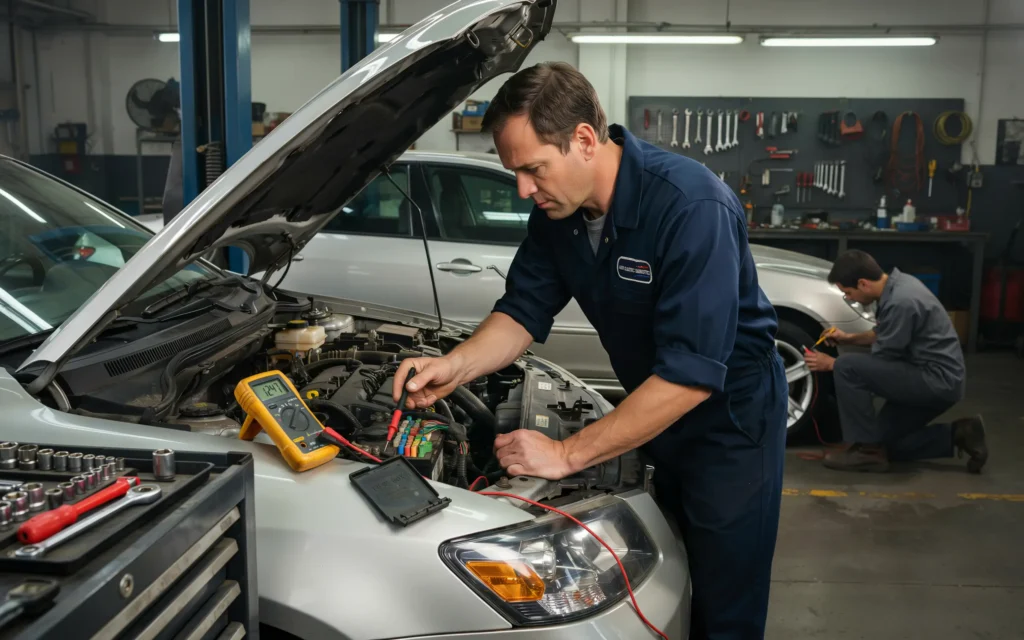
Step 1: Check the Battery First
The battery is the heart of your car’s electrical system. Most problems start here. Here is what you do.
Open the hood. Look at the battery terminals. Are they covered in white or green crusty stuff? That is corrosion. Clean it off with a wire brush and a mix of baking soda and water. Then check if the cables are tight. Loose cables cause many weird issues.
Now use your multimeter. Set it to DC voltage (20V range). Touch the red probe to the positive (+) terminal and the black probe to the negative (-) terminal. A healthy battery should read about 12.6 volts when the car is off. If you see 12.4 volts or lower, the battery is weak. If it is below 12 volts, it is likely dead or bad.
Next, try to start the car. While someone else cranks the engine, watch the multimeter. The voltage should not drop below 9.6 volts during cranking. If it drops lower, the battery cannot hold a charge. Replace it.
This first step alone solves many electrical issues. But if your battery is fine, move on.
Step 2: Inspect Fuses and Relays
Fuses protect your car’s circuits. When a fuse blows, that part stops working. For example, your brake lights or radio might die.
Find your fuse box. Most cars have two: one under the hood and one inside the cabin near the dashboard. Your owner’s manual shows the location and the diagram.
Pull out each fuse one by one. Look through the clear plastic. If the metal strip inside is broken, the fuse is blown. Replace it with the same amp rating (the number on top, like 10A or 15A). Never use a higher amp fuse. That can melt wires and start a fire.
Relays are small black boxes that act like switches. They click when they work. To test a relay, swap it with another identical relay from a different circuit (like the horn relay). If the problem moves, the relay is bad.
Step 3: Test the Alternator
The alternator charges your battery while you drive. If it fails, your battery will drain fast. Here is how to diagnose car electrical problems related to the alternator.
Start the engine. Set your multimeter to DC voltage (20V). Put the probes on the battery terminals again. You should read between 13.5 and 14.5 volts. If you see less than 13 volts, the alternator is not charging. If you see over 15 volts, the voltage regulator is bad.
Then turn on your headlights, radio, and AC. The voltage should stay above 13 volts. If it drops below, your alternator is weak.
“A bad alternator often kills a new battery in less than a week. Always test both.” – Tom Harris, Veteran Mechanic
Step 4: Look for Parasitic Drain
Parasitic drain happens when something stays on after you turn off the car. The glove box light, a faulty relay, or a stuck trunk light can drain your battery overnight.
Here is the test. Turn off everything. Close all doors. Remove the key. Then disconnect the negative battery cable. Set your multimeter to measure DC amps (10A or 20A setting). Connect the meter between the negative battery post and the negative cable clamp. Wait about 10 minutes for the car’s computers to go to sleep.
A normal reading is 20 to 50 milliamps (0.02 to 0.05 amps). If you see over 100 milliamps (0.1 amps), you have a drain. Now pull fuses one by one while watching the meter. When the reading drops, the fuse you just pulled is the circuit with the problem. Then you check everything on that circuit, like a light or a radio.
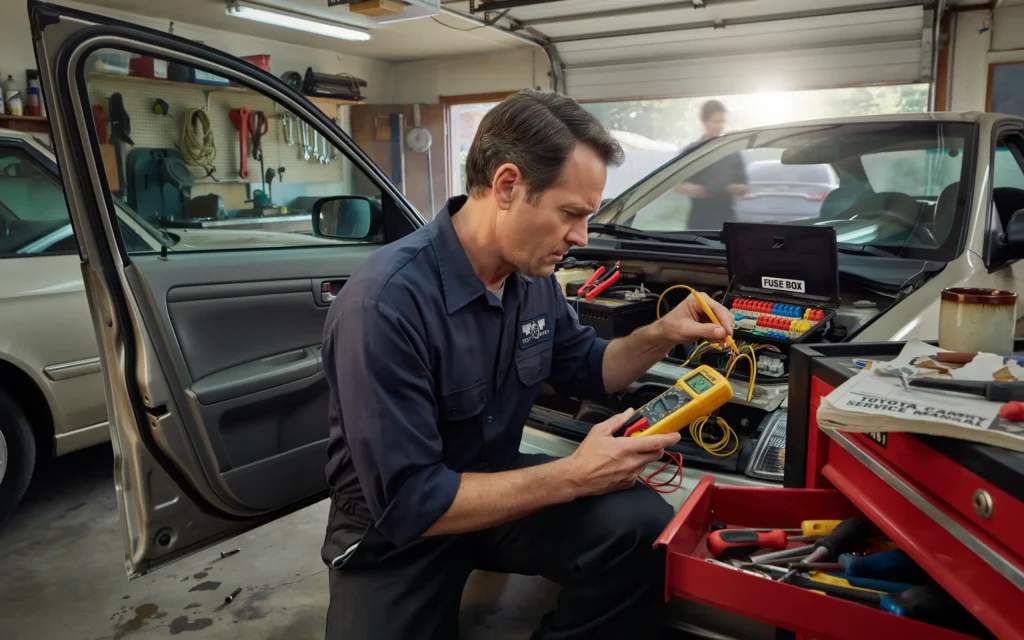
Step 5: Check Ground Connections
Bad grounds cause all sorts of strange problems. Lights flicker. Sensors send wrong signals. The engine runs rough.
A ground is a wire that connects a part to the car’s metal frame or engine block. Look for thick black wires bolted to the chassis, engine, or firewall. These bolts can rust or come loose.
Use your multimeter on the resistance (ohms) setting. Touch one probe to the negative battery terminal and the other to the engine block. You want less than 0.5 ohms. If you see higher resistance, clean the ground connection with a wire brush. Remove the bolt, scrub the metal, and reattach tightly.
Step 6: Use a Multimeter for Wiring Issues
Sometimes a wire breaks inside the insulation. You cannot see the break. But you can find it with a continuity test.
Turn off the power. Set your multimeter to the continuity setting (often a sound wave symbol). Touch the two probes together. You should hear a beep. Now test a wire by touching one probe to each end of the wire. If you hear a beep, the wire is good. No beep? The wire is broken.
For wiring that goes to a specific part, like a headlight, check if power reaches that part. Connect the black probe to a good ground. Touch the red probe to the connector at the part. Then turn on the switch. You should see 12 volts. If not, the problem is between the switch and the part.
Table 2: Multimeter Settings for Common Tests
| Test | Multimeter Setting | Expected Reading |
|---|---|---|
| Battery voltage (car off) | DC Volts (20V) | 12.6V |
| Battery voltage (car running) | DC Volts (20V) | 13.5V to 14.5V |
| Parasitic drain | DC Amps (10A) | 0.02 to 0.05A |
| Ground resistance | Ohms (200Ω) | Less than 0.5Ω |
| Continuity (wire test) | Continuity (beep) | Beep = good |
When to Call a Professional Mechanic
You can diagnose car electrical problems yourself, but you do not have to fix everything alone. Some jobs are better left to a pro. Call a mechanic if:
- You find melted wires or smell burning. That is a fire risk.
- You need to open the engine control module (ECM) or airbag system.
- You tried all the steps and still have no idea what is wrong.
- You do not have the right tools or feel unsafe.
A good mechanic charges around $100 to $150 for an electrical diagnosis. That money can save you from buying parts you do not need.
Remember this. You do not need to be an expert. Just knowing how to diagnose car electrical problems helps you talk to the mechanic with confidence. You save money and time.
Frequently Asked Questions
What is the first thing to check for car electrical problems?
Always start with the battery. Check the voltage and clean the terminals. Most issues stop here.
Can I diagnose car electrical problems without a multimeter?
You can try a test light for power checks. But a multimeter is much better for finding exact voltage and resistance. Spend $20 on one.
Why does my car battery keep dying overnight?
You likely have a parasitic drain. Something stays on. Follow step 4 above to find it. Common culprits are glove box lights, trunk lights, or a bad alternator diode.
How do I know if it is the battery or the alternator?
Use a multimeter. Battery alone (car off) should be 12.6V. With engine running, it should be 13.5V to 14.5V. If only the battery reading is low, replace battery. If running reading is low, replace alternator.
Is it safe to diagnose car electrical problems myself?
Yes, if you follow basic safety. Disconnect the negative battery cable before touching any wires. Never work on a wet car. And do not poke probes into connectors with force. If you feel unsure, stop and call a pro.
What does a bad ground feel like in a car?
You may see dim lights that brighten when you rev the engine. Or sensors give random errors. Sometimes the car will not start even with a good battery.
How long does it take to learn how to diagnose car electrical problems?
You can learn the basics in an afternoon. The steps above cover 90% of common issues. With practice, you will get faster each time.

Conclusion
Learning how to diagnose car electrical problems is not hard. You need a few simple tools, a calm mind, and this guide. Start with the battery. Then check fuses, the alternator, parasitic drains, and ground connections. Follow the steps in order. Do not jump around.
I have used these same steps on dozens of cars. They work. And they have saved me hundreds of dollars in mechanic bills. You can do the same.
So next time your car acts up, do not panic. Grab your multimeter. Open the hood. And go down the list. Most problems are simple once you know where to look.
And if you get stuck, remember this quote.
“The best mechanics are not the ones who never make mistakes. They are the ones who know how to test, not guess.” – Mike Collins, ASE Certified Master Technician
You have everything you need right here. Go ahead. Diagnose with confidence. Fix what you can. And drive safe.
Related posts
 Why Do Dogs Stare at Walls? Common Causes and When to Worry
Wondering why do dogs stare at walls? Discover the sensory, behavioral, and medical reasons behind this behavior, and learn when to contact your veterinarian. When you…
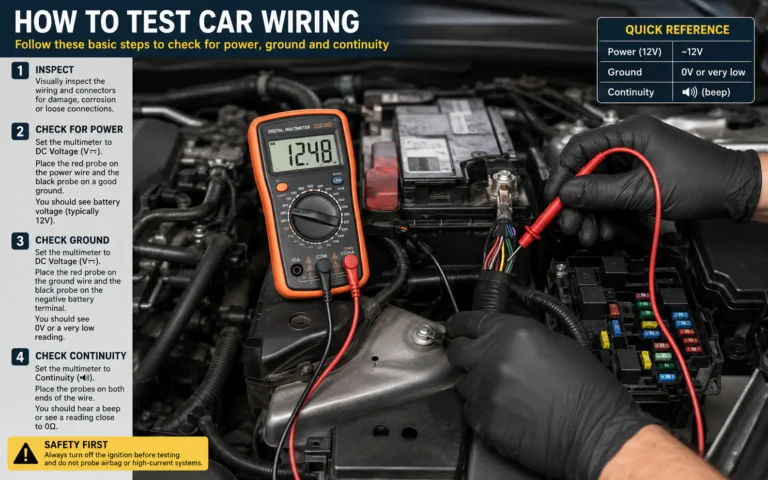 How to Test Car Wiring for Continuity Using a Multimeter
Learn how to test car wiring for continuity safely. Find broken automotive wires, check connector ports, and diagnose electrical issues with a multimeter. Testing car wiring…
 Why Organizing Space Reduces Stress: The Mental Clarity Connection
Discover why organizing space reduces stress. Learn how a tidy environment lowers cortisol, improves focus, and creates a sense of calm in your daily life. Organizing…