
How To Test Starter Motor At Home
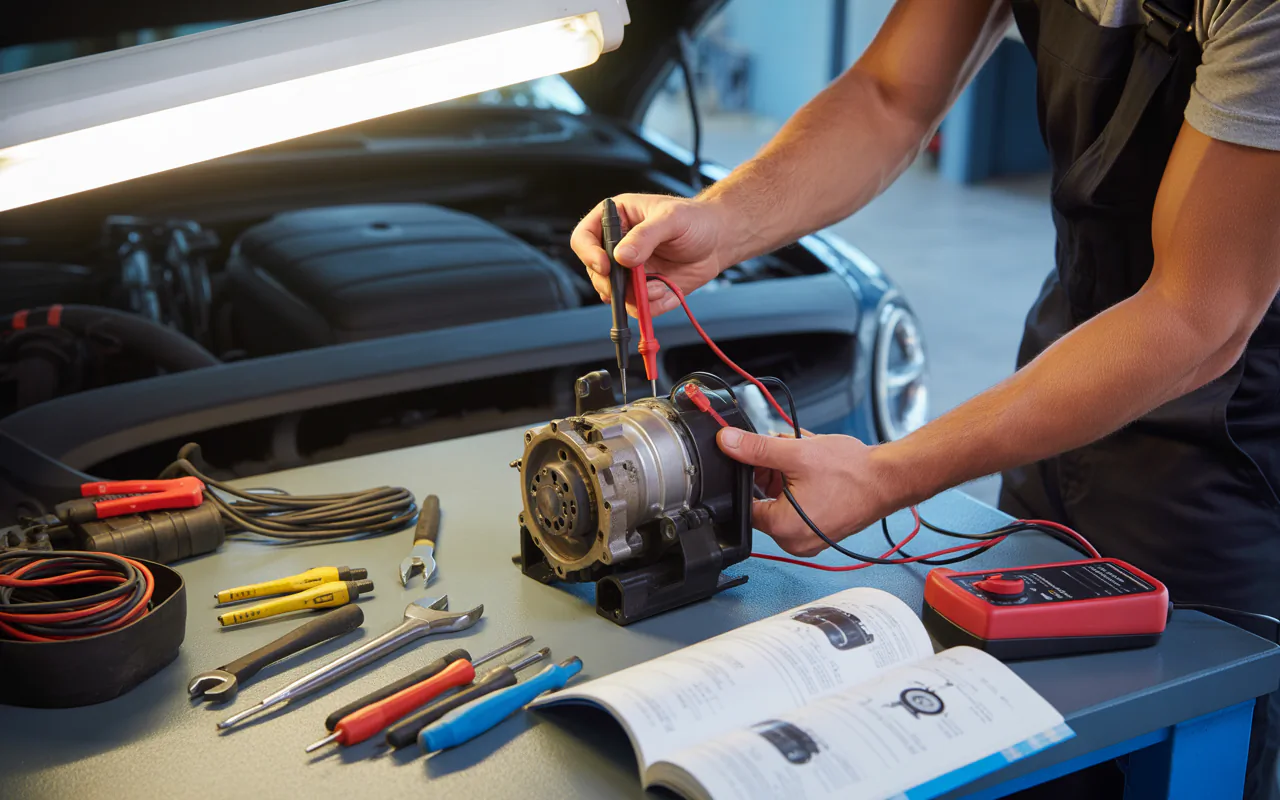
If your car only clicks when you turn the key, you can test starter motor at home with a multimeter and jumper cables. This DIY guide shows three easy ways to check if the starter is bad or something else.
You turn the key. The dash lights glow. But the engine does nothing. Or maybe you hear a single click. Or a rapid clicking noise. That is frustrating. Before you call a tow truck, take a breath. You can often find the problem yourself. In this guide, I will show you how to test starter motor at home using basic tools. No fancy garage equipment needed. Just some patience and a few common items.
I have fixed cars for over fifteen years. I learned that many “starter failures” are actually loose wires or low batteries. So do not rush to buy a new starter. Let us go step by step. By the end, you will know exactly what is wrong.
“Eighty percent of starter problems are electrical connections, not the starter itself.” – Robert L. Davis, Automotive Electrical Specialist
Is It Really the Starter? (Common Signs)
Before you test starter motor at home, know what to look for. A bad starter shows specific symptoms. Here are the most common ones.
- You hear a loud click, but the engine does not crank.
- You hear rapid clicks when turning the key.
- The engine cranks very slowly, then stops.
- Sometimes the car starts fine. Other times nothing happens.
- You see smoke or smell burning wires near the starter.
If you notice any of these, your starter is a likely suspect. But do not guess. Testing gives you proof.
Safety First: What You Must Know
Working on a car battery carries risks. Car batteries store a lot of energy. Follow these rules every time you test starter motor at home.
- Park on a flat surface. Set the parking brake.
- Turn off the ignition and remove the key.
- Wear safety glasses. Battery acid can splash.
- Remove metal jewelry. Watches and rings can cause short circuits.
- Keep loose clothing and hair away from moving parts.
Also know this: some starters sit near hot engine parts. Let the engine cool for an hour before you touch anything. Burns are no fun.
Tools You Need to Test a Starter at Home
Most of these tools are cheap. You may already own them. Here is what you need.
| Tool | Purpose |
|---|---|
| Digital multimeter | Measures voltage and resistance |
| Jumper cables | Provides power from another battery |
| Wrench set (10mm, 12mm, 14mm common) | Removes starter wires |
| Wire brush | Cleans corrosion off terminals |
| Safety glasses | Protects your eyes |
| Gloves (rubber or mechanic) | Keeps hands clean and safe |
| Helper (optional) | Turns the key while you test |
A multimeter costs about $15 to $30. It is a good investment for many car repairs. If you do not have one, borrow from a friend. Many auto parts stores also rent tools for free.
Quick Checks Before You Start Testing
Do not jump straight to the starter. Do these three simple checks first. They save time.
Check the battery. A dead battery acts exactly like a bad starter. Turn on your headlights. Are they dim? Then charge the battery fully. Try to start again. If lights are bright but the engine still does not crank, move on.
Check the battery terminals. Corrosion looks like white or green powder. Clean it off with a wire brush and baking soda mixed with water. Tighten the clamps. Loose terminals stop all power.
Check the starter relay or fuse. Open your fuse box. Find the starter relay (look at the diagram on the lid). Swap it with another identical relay, like for the horn. If the car starts now, the relay was bad.
These three checks take five minutes. And they solve many “no start” problems without any real testing.
Method 1: Voltage Drop Test (Easiest On-Car Test)
This is my favorite way to test starter motor at home. It checks if the starter gets enough power while connected. You do not need to remove anything. Here is how.
What You Do
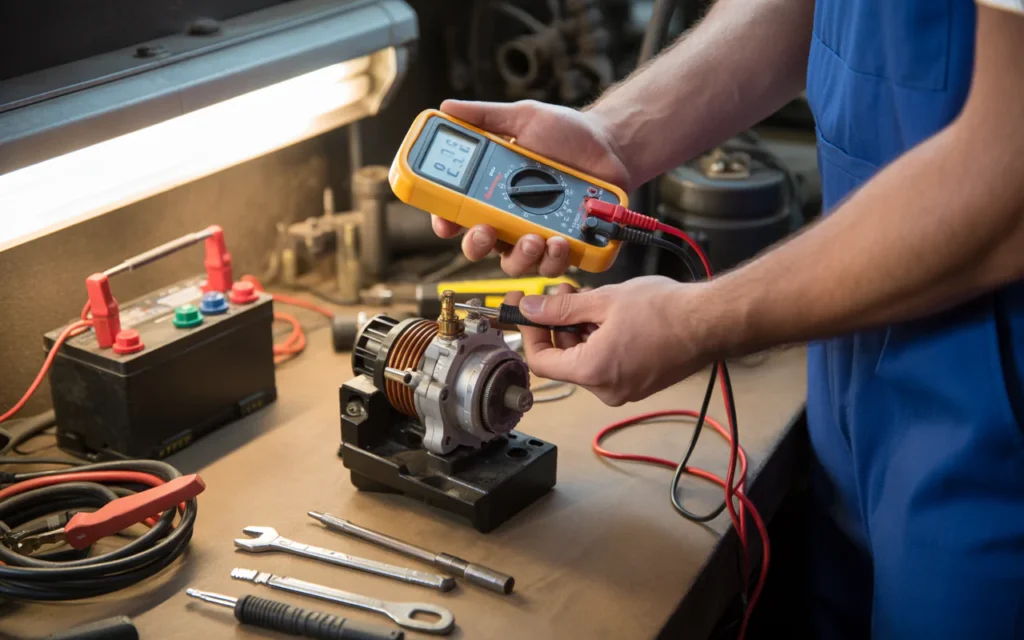
Set your multimeter to DC volts (20V scale). Connect the black lead to the negative battery terminal. Touch the red lead to the starter’s main positive terminal (the thick wire). Have a helper turn the key to “Start” for just one second. Watch the meter reading.
A good starter should show less than 0.5 volts drop. If you see 1 volt or more, you have a wiring problem. That could be a bad connection or a thin, corroded cable.
What the Numbers Mean
| Voltage Drop Reading | What It Tells You |
|---|---|
| Below 0.3V | Perfect. Wires and connections are great. |
| 0.3V to 0.5V | Acceptable. Still okay. |
| 0.6V to 1.0V | Poor connection. Clean and tighten everything. |
| Over 1.0V | Bad cable or loose terminal. Replace the cable. |
If your voltage drop is high, fix that first. Clean the battery posts. Clean the starter wire connection. Then test again. Many cars start fine after this.
“A voltage drop test tells you more than any other single test. It finds loose connections that fool most DIYers.” – Maria Chen, Electrical Engineer and Auto Blogger
Method 2: The Click Test (Listen Carefully)
This test uses only your ears. It helps you decide if the starter solenoid is working. The solenoid is a small cylinder on top of the starter. It pushes a gear into the engine flywheel.
Steps for the Click Test
- Turn the key to the “Start” position.
- Listen near the engine. Ask a friend to put their ear close to the starter area if needed.
- Note what you hear.
- One loud click means the solenoid works, but the starter motor does not spin. That often points to a dead spot inside the motor.
- Rapid multiple clicks means low battery voltage or a bad connection. Charge the battery first.
- No click at all means the solenoid is not getting power. Check the starter relay, ignition switch, or a blown fuse.
This test is fast. But it does not give a final answer. Use it together with the voltage drop test or the bench test below.
To properly test starter motor at home, you need more than just listening. The next method is the most reliable.
Method 3: Bench Test (Remove the Starter)
This is the surest way. You take the starter out of the car and test it on a workbench. It sounds hard, but it is not. Anyone can do it with basic tools.
How to Remove the Starter
First, disconnect the negative battery cable. Always do this. Then find the starter. It is usually near where the engine meets the transmission. Look from underneath the car. Follow the thick positive battery cable. It goes straight to the starter.
Use a wrench to remove the nut on the main positive wire. Remove the small trigger wire (push-on connector). Then unbolt the starter from the engine. There are usually two or three bolts. The starter then comes out.
Bench Test Setup
Now you can test starter motor at home on your bench. You need a good car battery (not the one in your car if it is weak) or a jump starter pack. Also need jumper cables.
Place the starter on a non-conductive surface like wood or a rubber mat. Clamp the negative jumper cable to the starter’s metal body. Connect the other end to the battery negative terminal. Clamp the positive jumper cable to the battery positive terminal. Now touch the other end of the positive cable to the starter’s main positive post. The starter should spin and push its gear out. If it does nothing, tap the starter lightly with a hammer. Sometimes a stuck brush frees up.
What a Good Bench Test Looks Like
| Observation | Meaning |
|---|---|
| Gear shoots out and spins fast | Starter is good |
| Gear comes out but spins slowly | Weak battery or bad internal windings |
| Gear does not move, just sparks | Short circuit inside starter |
| No movement, no sound | Dead starter or broken solenoid |
| Grinding noise when spinning | Damaged gears inside |
If the starter passes the bench test, the problem is elsewhere. Check the ignition switch, neutral safety switch, or wiring. If it fails, replace the starter.
I have used this bench test hundreds of times. It never lies. No guesswork. Just a clear pass or fail.
How to Test the Starter Solenoid Separately
Some starters have a separate solenoid. You can test it alone. Set your multimeter to ohms (resistance). Touch the probes to the two small terminals on the solenoid. You should see very low resistance (near zero ohms). If you see infinite resistance (OL), the solenoid coil is broken.
Another way: apply 12 volts directly to the solenoid’s trigger terminal. Use a piece of wire from the battery positive. If you hear a solid click, the solenoid works. If no click, replace the solenoid or the whole starter.
“Never replace a starter without bench testing it first. I have seen brand new starters fail out of the box.” – James T. Kirkland, ASE Certified Master Technician
Interpreting All Your Test Results
Now you have data. Let me help you understand what it means. Based on your tests, you can decide the next step.
Scenario A: Voltage drop is low. Click test gives one click. Bench test shows slow spin.
Answer: The starter motor is worn out. Replace it.
Scenario B: Voltage drop is high. Click test gives rapid clicks. Bench test not done.
Answer: Clean all connections. Charge the battery. Then retest. Most likely not the starter.
Scenario C: No click at all. Voltage drop test shows zero volts at starter.
Answer: Problem is upstream. Check the starter relay, ignition switch, or neutral safety switch.
Scenario D: Everything passes on the car. Bench test works great. The car still does not start.
Answer: Look at the engine ground strap. A bad ground can stop all cranking. Also check the flywheel teeth. They might be broken.
Each time you test starter motor at home, write down your results. Compare them to these scenarios. You will save money and time.
When to Replace vs. When to Repair
Most people think you must replace a bad starter. But sometimes you can repair it. Here is my honest advice.
Replace the starter if:
- The internal windings smell burnt.
- The commutator is deeply grooved.
- The starter is over ten years old.
- A new starter costs less than $80 for your car.
Repair the starter if:
- Only the brushes are worn. Brush kits cost $5 to $15.
- The solenoid clicks but the motor does not spin. A new solenoid is cheap.
- You enjoy fixing things and have time.
I usually tell beginners to replace the whole starter. It is simpler. But if you want to learn, open the starter. Clean the inside. Change the brushes. Many starters last another five years after a simple rebuild.
One warning: do not try to repair a starter with a cracked housing or melted wires. That is unsafe. Just buy a remanufactured unit. They come with a warranty.
Common Mistakes When Testing a Starter at Home
I have seen people make these errors. Avoid them.
Mistake 1: Testing the starter without checking the battery first. A weak battery fails every starter test. Always charge the battery fully.
Mistake 2: Using a cheap multimeter on the wrong setting. Set it to DC volts, not AC. AC volts will give strange numbers.
Mistake 3: Forgetting the engine ground. The starter needs a ground path through the engine block. If the ground strap is loose, nothing works.
Mistake 4: Touching hot exhaust parts. Let the car cool down for an hour. Burns heal slowly.
Mistake 5: Assuming a new starter is good. I have seen three bad starters in a row from a parts store. Test every new starter on the bench before installing it.
To properly test starter motor at home, take your time. Rushing leads to wrong answers.
Frequently Asked Questions
Can I test a starter motor without removing it from the car?
Yes. Use the voltage drop test and the click test. These two methods will tell you if the starter is getting power and if the solenoid works. For a final answer, the bench test is best, but the on-car tests catch most problems.
How do I test starter motor at home with a screwdriver?
You can jump the starter solenoid terminals with a large insulated screwdriver. Touch the main positive post to the trigger terminal. The starter should spin. Only do this if the car is in Park or Neutral with the brake set. This bypasses the ignition switch. If the starter works, your ignition switch or relay is bad.
What voltage should a starter get?
At least 9.6 volts while cranking. If the voltage drops below 9 volts, the battery is weak or the cables are too thin. Use the voltage drop test described above to find the exact problem.
Can a bad starter drain the battery?
Yes, a stuck solenoid keeps the starter engaged. That drains the battery in minutes. You may also smell burning wires. Disconnect the battery immediately if this happens.
How many hours does it take to test a starter at home?
The on-car tests take 15 minutes. Removing the starter for a bench test takes 30 to 60 minutes for a beginner. Add another 20 minutes for the bench test itself. So plan for two hours total your first time.
Do I need a multimeter to test starter motor at home?
A multimeter helps a lot. But you can do the click test and the screwdriver jump test without one. For accurate voltage readings, buy a cheap multimeter. It pays for itself the first time you use it.
What if my car has a start-stop system?
Start-stop starters are different. They are stronger and handle many restarts. The same tests work, but be careful. Some start-stop systems have a separate battery. Check your owner’s manual first.
Can I test a starter from a boat or lawn tractor at home?
Yes. The same bench test works for any 12-volt starter. Small engines like lawn mowers often have smaller starters. Use a smaller battery or a jump pack. The principles are identical.
Putting Everything Together: A Simple Decision Flow
Here is a quick summary. Follow this order every time you test starter motor at home.
- Check battery voltage. Charge if low.
- Clean all terminals.
- Do the voltage drop test.
- Do the click test.
- If both suggest a starter problem, remove the starter.
- Perform the bench test.
- Replace or repair based on bench test results.
That is it. Seven steps. No confusion.
Final Thoughts from Experience
I remember the first time I tested my own starter. I was twenty years old. My old truck would not start. I almost bought a new starter for $150. But a friend said “test it first.” I bought a $12 multimeter. I found that a cable had corroded inside the insulation. It looked fine outside. But the voltage drop test showed 1.8 volts lost. I replaced a $8 cable. The truck started perfectly.
That lesson stuck with me. So many car problems look big but are actually small. A starter motor is a simple device. It gets power, it spins. When it fails, the fix is often cleaning or tightening something. By learning how to test starter motor at home, you give yourself power. You do not have to trust a mechanic who might upsell you. You can see the truth with your own eyes and tools.
I encourage you to try these tests. Even if you feel nervous. Start with the click test. Then move to the voltage drop test. If you remove the starter, take a picture of the wires before you unplug them. That way you know where everything goes back.
One more tip: watch a video for your specific car model if you get stuck. But the basics are the same for almost every car made since 1960. Two wires and two or three bolts. You can do this.
“The best tool in your garage is not a wrench. It is the confidence to diagnose first and replace second.” – Linda Gray, Automotive Instructor
Conclusion
You now know three reliable ways to test starter motor at home. Start with the simple click test. Use the voltage drop test to find bad connections. When needed, pull the starter out for a bench test. Each method gives clear answers. No guesswork. No expensive shop fees.
Remember these key points. Always check the battery first. Clean every terminal. Use a multimeter for precise results. And never replace a starter without bench testing it. You will save money, time, and frustration.
Car repair does not have to be scary. You have the knowledge now. Go to your garage, gather your tools, and run the tests. Whether you find a bad starter or a loose wire, you win. You learned something real. And you kept your car running without paying someone else.
If you have questions, leave them below or ask a friend who works on cars. We all started as beginners. Every expert was once a person who turned the key and heard only a click. Now you know what to do next. Good luck. Stay safe. And enjoy the satisfaction of fixing it yourself.
Related posts
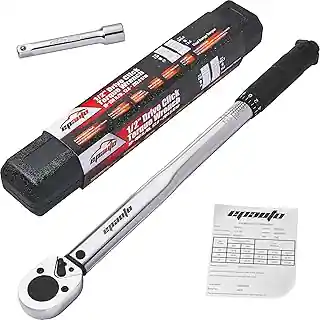 2026 Torque Wrench Reviews: Choosing the Right Tool for Precision Fastening
Explore our 2026 torque wrench reviews to find the right tool for your automotive, bike, or gunsmithing projects. Compare top models for accuracy and value. Finding…
 Top Automotive Tools for Beginners: Essential Gear for 2026
Discover the top automotive tools for beginners in 2026. Compare essential pry kits, wrench sets, and repair gear to start your DIY car maintenance journey. Starting…
 Top Rated Mechanic Tool Brands for 2026
Explore top rated mechanic tool brands for 2026. Compare reliable socket sets and hand tools to find the right equipment for your home garage or auto…