

Learn how do you change spark plugs yourself with this easy guide. We cover the tools you need, the steps to follow, and tips to avoid common mistakes. Save money and get your engine running smoothly today.
There is a small part under your hood that works very hard. It fires thousands of tiny sparks every minute to keep your engine running. When these parts get old, your car feels slow, uses more gas, or has trouble starting. The good news is that fixing this is easy and cheap. You do not need to be a mechanic to get it done. You just need to know how do you change spark plugs yourself.
Doing this job at home can save you a lot of money. A shop might charge you for labor, but the parts themselves cost very little. Plus, there is a great feeling that comes from fixing your own car. It makes you feel more connected to your vehicle and more confident on the road.
This guide will walk you through every step. I will tell you what to buy, how to stay safe, and exactly what to do. Let’s get your car running like new again.
What Are the Signs You Need New Spark Plugs?
How Do you Change Spark Plugs Yourself. Before you grab your tools, you need to know if your car actually needs new plugs. Your car will tell you when something is wrong. You just have to listen to it.
The most common signs are pretty clear. You might notice the engine feels rough when you are stopped at a light. This is called rough idling. You might also feel the car hesitate or jerk when you press the gas. That is a misfire. Another big sign is your fuel bill. If you find yourself filling up the tank more often, old spark plugs could be the reason. They do not burn the fuel as efficiently as they should .
Sometimes, the check engine light comes on. It might flash or stay solid. This is another clue that your ignition system needs help.
Car expert and mechanic Richard McCuistian once said, “The spark plug is the window to the combustion chamber. Reading its condition can tell you more about the health of your engine than any computer scanner.” This means that by looking at your old plugs after you take them out, you can learn a lot about what is happening inside your engine.
Tools and Parts You Will Need
You cannot do this job without the right tools. Walking to the store and buying the first spark plug you see is a bad idea. You need to get the right ones for your specific car.
Here is a simple list of what you need to get before you start.
Essential Tools for the Job
- Spark Plug Socket: This is not a regular socket. It has a rubber insert inside that holds the plug gently so you do not break it when you pull it out .
- Ratchet and Extensions: A ratchet turns the socket. The extensions help you reach plugs that are buried deep in the engine.
- Torque Wrench: This is very important. It lets you tighten the new plugs to the exact tightness the car maker suggests.
- Spark Plug Gap Tool: You need this to check the space between the electrodes on the new plug .
Which Spark Plugs Should You Buy?
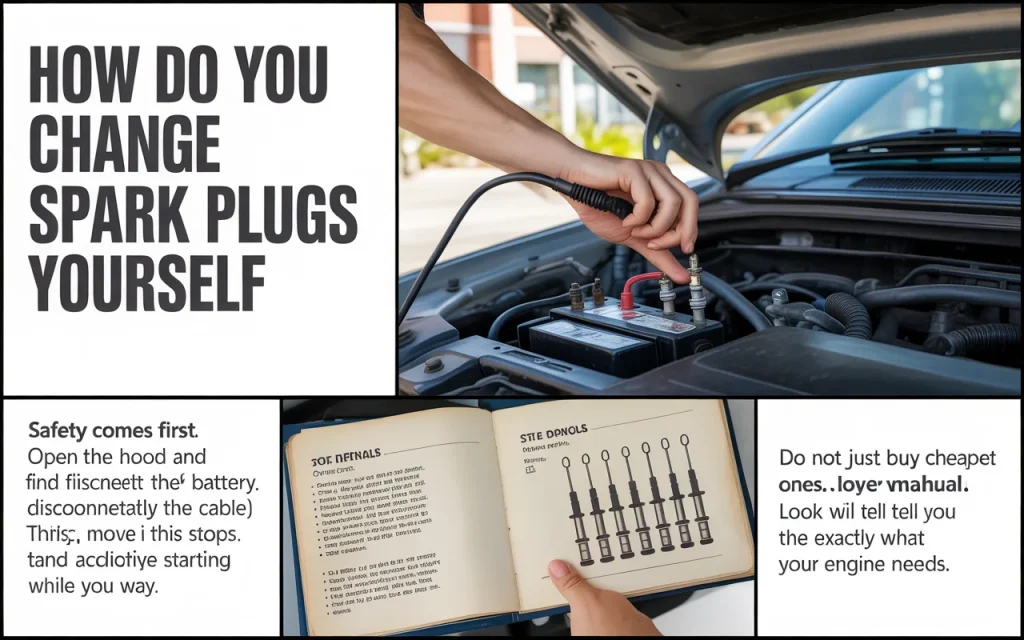
How Do you Change Spark Plugs Yourself? Do not just buy the cheapest ones. Look in your owner’s manual. It will tell you exactly what kind your engine needs. Some cars use copper, some use platinum, and some use iridium. Iridium plugs last much longer, often up to 80,000 miles or more . You should also pick up some dielectric grease. This helps the spark plug boots slide on easily and keeps moisture out.
Here is a quick look at the basic tools and what they do for you:
| Tool | Why You Need It |
|---|---|
| Spark Plug Socket | Protects the porcelain tip of the plug during removal. |
| Torque Wrench | Prevents over-tightening, which can ruin the engine threads. |
| Gap Tool | Ensures the spark is the right size for perfect combustion. |
How Do You Change Spark Plugs Yourself? The Step-by-Step Process
Okay, you have your tools and new parts. Now it is time to get to work. Follow these steps in order, and you will be just fine.
Step 1: Prepare Your Car and Workspace
Safety comes first. Open the hood and find your battery. Disconnect the negative cable (the black one) and move it out of the way. This stops the car from accidentally starting while you work .
Let the engine sit for at least an hour if you have been driving. A hot engine can burn you badly. Also, hot spark plugs are soft and can break when you try to twist them. You want the engine cool to the touch.
Step 2: Locate and Access the Plugs
On most modern cars, you will see a plastic engine cover. You might need to pull it off. Under that, you will see the ignition coils. These look like plastic blocks sitting on top of the engine with electrical connectors on them.
You should label each coil with a piece of tape before you unplug it. Mark them 1, 2, 3, and so on. This makes sure they go back in the right spot . Unbolt the coil and gently pull it straight up. This exposes the old spark plug underneath.
Step 3: Remove the Old Spark Plugs
Put your spark plug socket on the end of your extension and ratchet. Place it down over the plug. Turn the handle counter-clockwise (lefty-loosey) to break it free. Unscrew it all the way and lift it out.
When the plug comes out, look at it. If it has black soot on it, your engine might be running too rich (too much fuel). If it looks oily, you might have a bigger engine problem . Set the old plug aside.
Step 4: Check and Set the Gap on the New Plugs
This step is critical. Even if the box says “pre-gapped,” you should check it. Use your gap tool. Slide it between the electrode at the tip and the metal hook. It should slide through with light resistance. Check your owner’s manual for the exact measurement. If the gap is too small or too big, use the tool to gently bend the metal hook until it is right .
Step 5: Install the New Spark Plugs
Put a tiny drop of anti-seize on the threads if your manual says to. Be careful not to get any on the tip.
Here is the most important rule: start the plug by hand. Do not use the ratchet to start it. Turn it clockwise with your fingers until it stops turning easily. This makes sure the threads are lined up right and you do not “cross-thread” them, which would ruin the engine . Once it is hand-tight, use your torque wrench. Tighten it to the spec in your manual.
Step 6: Reassemble and Repeat
Put the ignition coil back on. Push it down firmly. You can put a little dielectric grease in the rubber boot to help it connect . Bolt the coil back down and plug the electrical connector back in. Now, move to the next cylinder and do it all over again.
Once all the plugs are in, reconnect the negative battery cable. Start the car and listen. It should sound smooth and happy.

Common Mistakes to Avoid
Even people who have done this before make mistakes. Knowing what they are will help you avoid them.
Overtightening is the biggest one. If you crank down on the plug as hard as you can, you can strip the threads in the cylinder head. Fixing that costs hundreds of dollars. This is why we use a torque wrench. According to Robert Bosch GmbH, a leading automotive parts manufacturer, “The few millimeters of thread in the cylinder head are all that hold the spark plug in place. Respecting the specified torque is not a suggestion; it is a necessity to prevent costly engine damage.”
Another common error is mixing up the wires. If you put cylinder one’s wire on cylinder two, the engine will run terribly or not at all. This is why labeling them at the start is so important .
Dropping dirt into the engine is also bad. Before you pull a plug out, blow or wipe away any dirt sitting around it. If a piece of dirt falls into the cylinder, it can get stuck in a valve and cause damage.
Here is a quick guide on how to handle the two most common situations you will face:
| Situation | Problem | Solution |
|---|---|---|
| Plug Won’t Budge | Stuck from rust or carbon. | Spray penetrating fluid, wait 15 mins, try again gently. |
| Plug is too loose/tight | Wrong torque. | Always use a torque wrench set to the manual’s spec. |
Frequently Asked Questions
How often should I change my spark plugs?
It depends on the metal used in the plug. Copper plugs usually need changing every 30,000 miles. Platinum and Iridium plugs can last between 60,000 and 100,000 miles . Check your owner’s manual for the exact interval for your car.
Is it safe to change spark plugs myself?
Yes, it is very safe if you take the right precautions. Always let the engine cool down completely. Disconnect the battery to prevent the engine from turning on. Work in a well-ventilated area and be gentle with the parts.
What happens if I gap the plugs wrong?
If the gap is too small, the spark might be too weak to burn the fuel properly. If it is too large, the spark might not happen at all, or it will cause a misfire. This leads to rough running and poor gas mileage. Always set the gap to the exact number in your manual.
Can changing spark plugs improve gas mileage?
Absolutely. Old, worn plugs have a weak spark. This means the engine has to work harder to burn the fuel, and some fuel gets wasted out the exhaust. New plugs provide a strong, consistent spark, which burns the fuel much more efficiently. You should see a bump in your miles-per-gallon right away .
Conclusion
Learning how do you change spark plugs yourself is one of the best skills a car owner can have. It is a simple job that makes a huge difference in how your car feels and runs. You save money on labor, you learn about your engine, and you get the satisfaction of doing it with your own two hands.

Veteran mechanic and author John Muir summed it up best when he said, “A car has its own personality, and working on it is the best way to get to know it.” By taking the time to do this job yourself, you are building a relationship with your vehicle. You are learning its quirks and how to keep it happy.
So, grab your tools, pick up a set of plugs, and give it a try. Your car will thank you with smoother rides and better performance for thousands of miles to come.



2 Comments