
How Does A Car Battery Tester Work
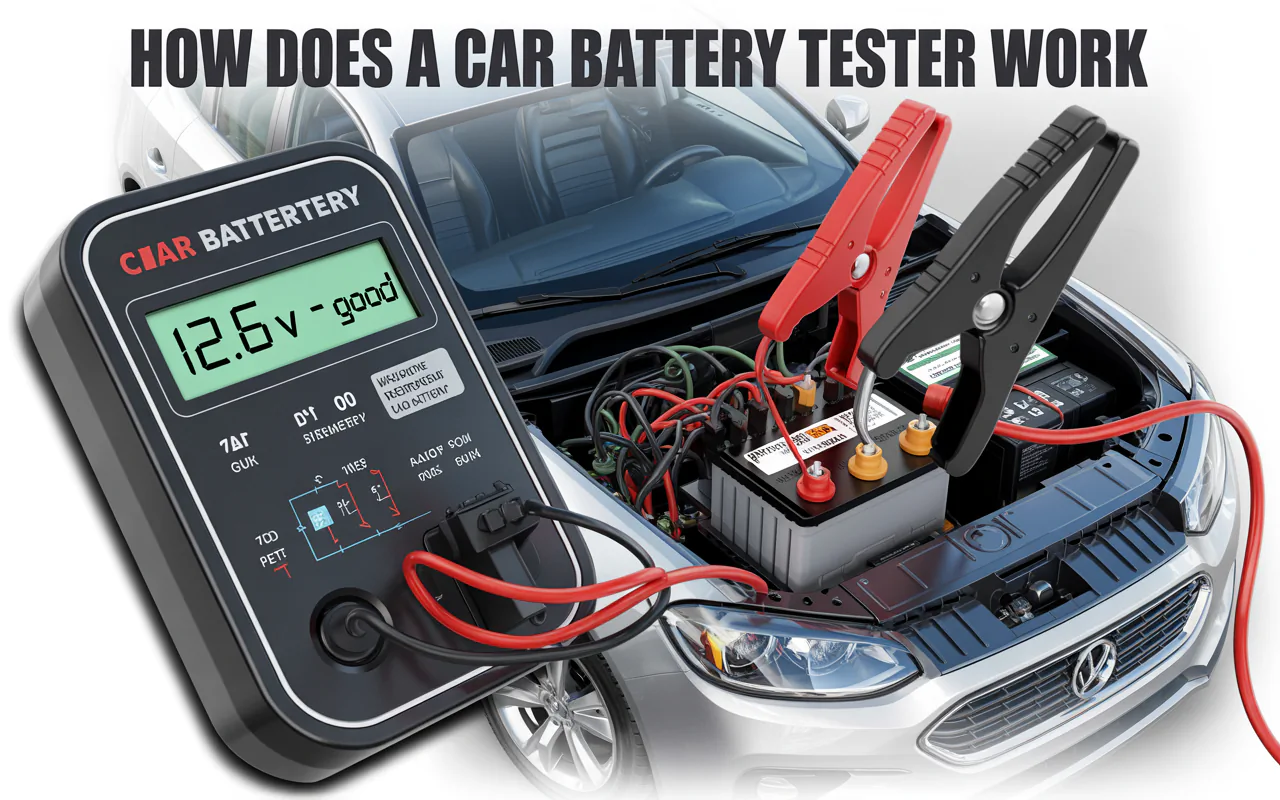
Want to know how a car battery tester work? This guide explains the simple science of load testing, conductance, and voltage checks. Learn how a car battery tester work to keep your car starting every time.
Have you ever turned your car key and heard that slow, sad cranking sound? Or maybe your headlights looked a little dim. That is your car battery saying it needs help. But how do you know for sure if the battery is good or bad? You use a car battery tester.
I remember the first time I held a small handheld tester. I had no idea what the numbers meant. But after a few years of fixing my own cars and helping neighbors, I learned that these tools are not magic. They use simple, clever science. In this article, I will explain how does a car battery tester work in plain English. No engineering degree needed. Just you, me, and a friendly conversation about keeping your car reliable.
Let me start with a short story. Last winter, my friend Sarah called me. Her car would not start. A shop told her she needed a new battery for two hundred dollars. But she was not sure. I brought my simple battery tester. Within thirty seconds, the tester showed her battery had 75% health and good cranking power. The real problem was a loose cable. She saved money. That is why understanding car battery tester work can save you time and cash.
What Exactly Is a Car Battery Tester?
A car battery tester is a small electronic tool. It connects to your battery terminals. Then it measures different electrical properties. The goal is simple: tell you if your battery is healthy, weak, or dead. Some testers are basic. They only show voltage. Others are advanced. They show cold cranking amps (CCA), internal resistance, and state of charge.
You can buy a simple tester for fifteen dollars. Professional models cost over one hundred dollars. But all of them use one of two main methods. Let me explain both.
Quote #1: “A battery is like a bucket of electricity. The tester measures how full the bucket is and whether the bucket has any hidden leaks.” – Tom Mueller, Auto Electrician with 30 years of experience.
The Two Main Ways a Car Battery Tester Work
Most testers fall into two categories. Each method has its own strengths.
| Method | How It Works | Best For |
|---|---|---|
| Load Testing | Applies a heavy draw (half the CCA) for 10-15 seconds | Old batteries, starting problems |
| Conductance Testing | Sends small AC signals to measure internal resistance | Modern cars, quick checks, battery health percentage |
Let me break down each method so you can see how does a car battery tester work in real life.
Load Testing: The Classic Method
Imagine you are checking if a water pipe is clogged. You turn on the faucet fully. You watch the flow. A load tester does the same thing with electricity. It puts a heavy demand on the battery. Usually half the cold cranking amps rating. For a typical car with 600 CCA, the tester pulls 300 amps for about ten seconds.
During that time, the tester watches the voltage. A healthy battery stays above 9.6 volts at room temperature. If the voltage drops below that, the battery is weak. If it drops very fast, the battery has a bad cell.
Load testers are simple and reliable. But they have a downside. They drain the battery a little. And they get hot. That is why many modern testers do not use this method anymore.
Conductance Testing: The Smart Modern Way
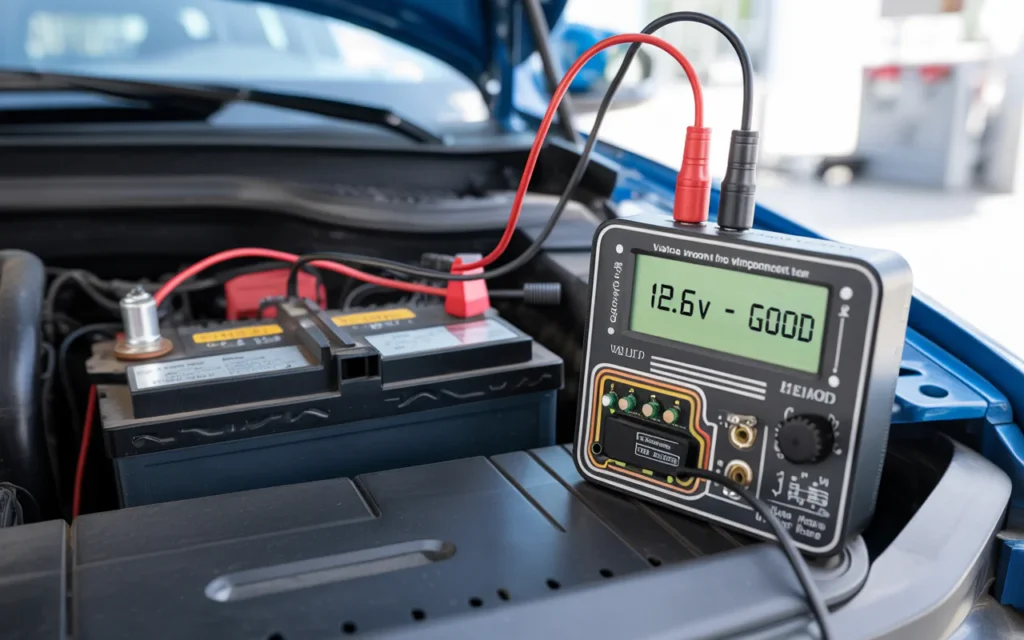
Most handheld digital testers today use conductance testing. This method is faster and safer. Here is how does a car battery tester work with conductance.
The tester sends a very small alternating current (AC) signal through the battery. This signal is low power. It does not drain the battery. Then the tester measures how easily that signal passes through the battery plates. Good, clean plates pass the signal well. Bad, sulfated, or damaged plates resist the signal.
The tester calculates internal resistance. Lower resistance means a healthier battery. Higher resistance means the battery is aging or failing. Then the tester converts that reading into a simple percentage. For example, “Battery Health: 85%.” That is very easy to understand.
Quote #2: “Conductance testing changed everything. I can test a battery in five seconds without discharging it. That means I can test any car that pulls into my shop, no waiting.” – Linda Hartz, Master Technician and shop owner.
What Does a Car Battery Tester Actually Measure?
To fully understand car battery tester work, you need to know the three key measurements. Every tester uses these.
1. Voltage (State of Charge)
Voltage tells you how full the battery is. A fully charged 12-volt battery should read about 12.6 volts or more when the engine is off. If you see 12.4 volts, it is about 75% charged. At 12.0 volts, it is only 25% charged. Below 11.8 volts, the battery is almost empty.
But voltage alone does not tell you if the battery is good. A dead battery can show 12.6 volts with no load. Then when you try to start the car, it drops to 4 volts. That is why testers also measure other things.
2. Cold Cranking Amps (CCA) Rating
CCA is the number of amps a battery can deliver at 0 degrees Fahrenheit for 30 seconds while staying above 7.2 volts. Your car needs a certain CCA to start in winter. A tester compares the battery’s current CCA to its original rated CCA.
For example, a battery rated for 600 CCA but testing at 400 CCA is weak. It might still start the car in summer. But winter will be a problem.
3. Internal Resistance
Think of internal resistance like a clogged pipe. New batteries have very low internal resistance. As a battery ages, sulfate crystals build up on the plates. That increases resistance. High resistance means less power reaches your starter. A good conductance tester gives you this number in milliohms (mOhms). Lower is better.
Step by Step: How to Use a Car Battery Tester
Let me walk you through a real test. This will help you see how does a car battery tester work in your own garage.
Step 1: Turn off the car. Make sure all lights, radios, and fans are off.
Step 2: Clean the battery terminals. Dirt or corrosion can give false readings. A wire brush works well.
Step 3: Connect the tester. Red clamp to positive (+). Black clamp to negative (-). Most testers have reverse polarity protection. So do not worry if you mix them up. The tester will warn you.
Step 4: Turn on the tester or press the test button. Some testers require you to enter the battery’s CCA rating from the label. Others automatically detect it.
Step 5: Wait 3 to 10 seconds. The tester runs its analysis. You will see readings for voltage, CCA, internal resistance, and a health percentage.
Step 6: Read the result. Most testers show:
- Good battery (green)
- Weak battery (yellow) – replace soon
- Replace battery (red)
That is all. You now know exactly what is happening.
Quote #3: “The best tool is the one you actually use. A simple ten-dollar voltage meter can save you from being stranded. But a proper battery tester gives you confidence.” – James Chen, Author of “Car Electrical Systems for Beginners.”
Why You Cannot Just Use a Multimeter
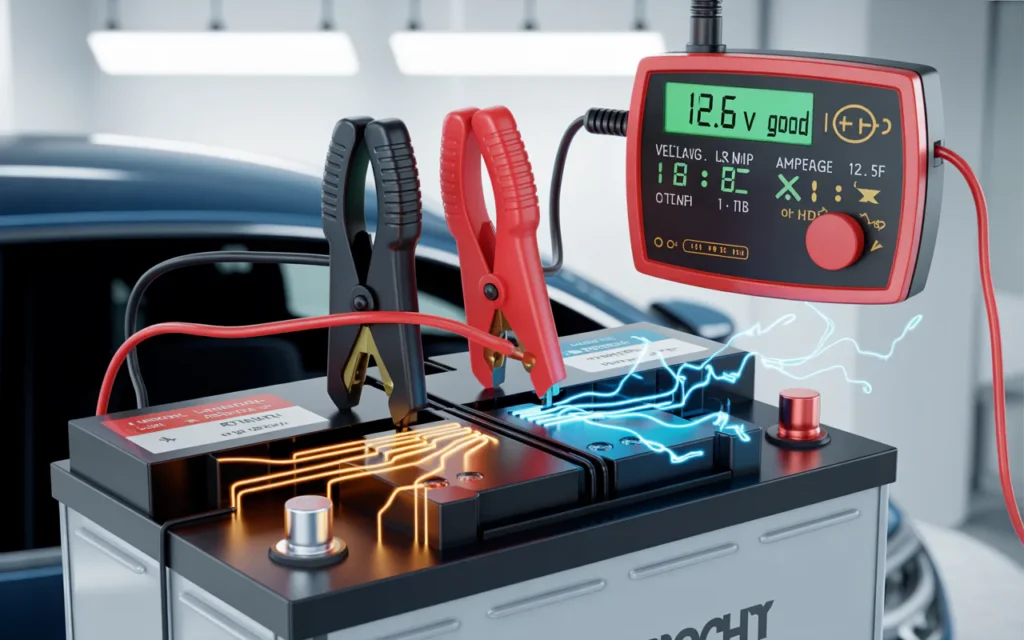
A multimeter is useful. It measures voltage. But a multimeter does not put a load on the battery. So a bad battery can show good voltage. Then it fails when you need to start the car. A dedicated battery tester applies either a real load or measures conductance under stress-like conditions. That is the key difference.
Here is a quick comparison:
| Tool | What It Measures | Can It Find a Weak Battery? |
|---|---|---|
| Multimeter | Voltage only | No. A bad battery can still show 12.6 volts. |
| Basic Load Tester | Voltage under load | Yes, but only for 10-15 seconds. |
| Conductance Tester | Internal resistance + CCA + voltage | Yes, very accurately. |
So if you only own a multimeter, you are missing half the story. A proper car battery tester work by simulating real demand.
What Do The Numbers Really Mean?
Let me give you a real example. Suppose you test a battery and see:
- Voltage: 12.4 volts
- Measured CCA: 350 (rated CCA: 550)
- Internal resistance: 9.5 mOhms
- Health: 58%
What does this mean? The battery has a decent charge (12.4 volts). But its capacity has dropped from 550 to 350 CCA. That is a 36% loss. Internal resistance is higher than normal (good is under 6 mOhms for most car batteries). The 58% health means you should start shopping for a new battery. It might last a few more months. But it will likely fail on a cold morning.
If you see numbers like:
- Voltage: 10.2 volts
- CCA: 0
- Health: 0%
Then the battery has a dead short or a broken cell. Replace it immediately.
Common Mistakes People Make
I have seen many people use testers wrong. Here are the top errors.
Testing a dead battery. If the battery is below 11 volts, many testers cannot give an accurate health reading. You need to charge the battery first. Then test again.
Testing right after driving. A battery that was just charged by the alternator shows surface charge. That is a false high voltage. Turn on your headlights for two minutes to remove surface charge. Then test.
Dirty clamps. Grease or corrosion blocks the electrical signal. Clean the clamps and terminals.
Wrong CCA setting. If you tell the tester your battery has 800 CCA but it actually has 500 CCA, the result will be wrong. Always check the label on the battery.
How Often Should You Test Your Battery?
Test your battery twice a year. Do it before summer heat and before winter cold. Heat damages batteries faster than cold. But cold reveals the weakness. I test my own battery in May and November.
If your car is more than three years old, test every three months. Most car batteries last three to five years. After year three, failure becomes more likely.
Also test after any event that drains the battery. Left your lights on overnight? Jump start the car, drive for thirty minutes, then test. You want to know if the battery recovered or lost permanent capacity.
Can You Test a Battery While It Is In The Car?
Yes. That is the best way. Testing in the car shows how the battery works with your car’s cables, starter, and ground connections. A battery that tests good out of the car might test weak in the car due to bad cables or corrosion. So always test with the battery installed and connected.
The only exception is if you cannot reach the terminals easily. Some cars hide the battery under the back seat or in the trunk. That is fine. Test it there.
What About Testing The Charging System?
Many good battery testers also check your alternator. After testing the battery, start the engine. The tester switches to charging system mode. It measures voltage at idle and at higher RPM. A healthy alternator keeps voltage between 13.5 and 14.8 volts. If you see over 15 volts, the regulator is failing. Under 13 volts, the alternator is weak. That is very useful information.
So when you ask how does a car battery tester work, remember that modern units do two jobs. They test the battery and the alternator. That helps you find the real problem. A dead battery could be old. Or it could be dying because your alternator never fully charged it.
Simple Table: Good vs Bad Battery Readings
| Measurement | Good Battery | Weak Battery | Bad Battery |
|---|---|---|---|
| Voltage (engine off) | 12.6V or higher | 12.2V – 12.5V | Below 12.0V |
| CCA compared to rating | 90% or more | 60% – 89% | Below 60% |
| Internal resistance | Under 6 mOhms | 6 – 10 mOhms | Over 10 mOhms |
| Health percentage | 80% – 100% | 50% – 79% | Below 50% |
Use this table as a quick reference when you test your own battery.
Do You Really Need A Fancy Tester?
No. A basic load tester for twenty dollars works fine for most people. It will not give you a health percentage. But it will show you if the battery holds voltage under load. That is the most important test. A simple tester with a voltmeter and a heating element is reliable and never needs batteries.
However, if you want to see battery health as a percentage and check internal resistance, spend forty to sixty dollars on a digital conductance tester. That is what most mechanics use. It is faster and easier to read.
Do not buy the very cheapest tester for ten dollars. Those often break or give wrong readings. Spend at least twenty dollars. Read online reviews first.
Frequently Asked Questions
Q1: Can a car battery tester work on a completely dead battery?
No. Most testers need at least 10.5 volts to perform a valid test. If your battery is below that, charge it first. Then test.
Q2: How long does a battery test take?
Between 3 and 15 seconds for a conductance tester. Load testers take about 15 to 20 seconds. Very fast.
Q3: Will testing hurt my car’s electronics?
No. Modern testers use low power or short load times. They are safe for all car computers and sensors.
Q4: What is the difference between CCA and CA?
CCA is cold cranking amps at 0°F. CA (cranking amps) is measured at 32°F. CA numbers are about 20% higher. Always compare CCA to CCA.
Q5: Can I test a lithium car battery with a standard tester?
Some newer testers have a lithium mode. Standard testers for lead-acid batteries will not give correct results on lithium. Check your tester’s manual.
Q6: Why does my tester say “bad cell”?
A 12V car battery has six cells. Each cell makes about 2.1 volts. If one cell fails, total voltage drops to around 10.5 volts. That battery cannot be repaired. Replace it.
Q7: How do I know if my tester is accurate?
Test a known good battery. Then test a known bad battery. The results should be clearly different. You can also compare with a friend’s tester. For professional accuracy, send your tester for calibration every two years.
Q8: Is a battery tester worth buying for home use?
Yes. A twenty-dollar tester can save you from buying a battery you do not need. It also prevents getting stuck in a parking lot. I think every home with a car should have one.
Final Thoughts on How a Car Battery Tester Work
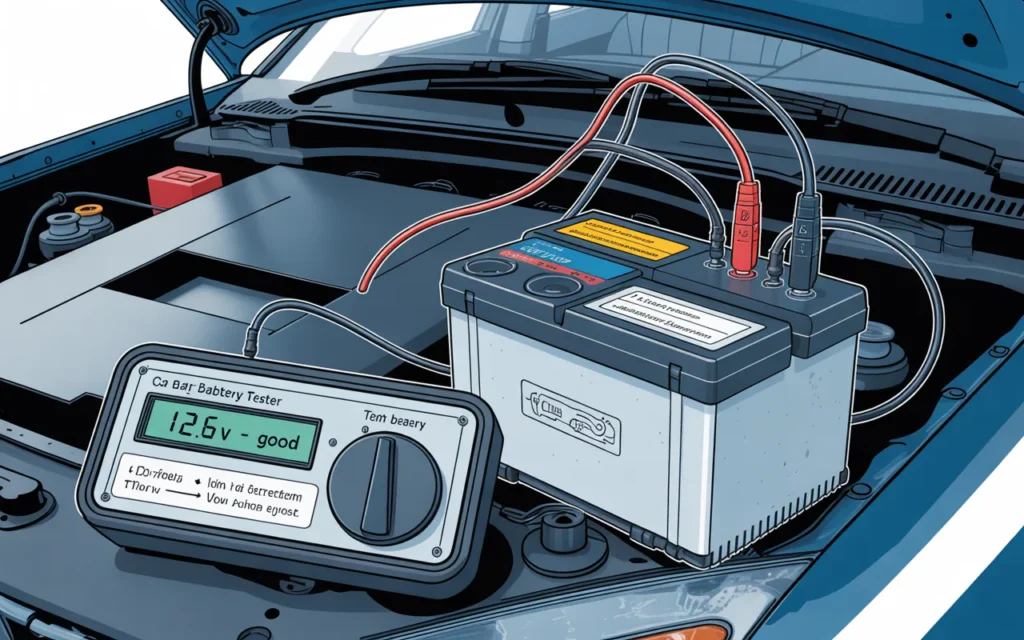
I hope this guide made everything clear. A car battery tester work by either applying a load and watching voltage drop, or by sending small signals to measure internal resistance. Both methods are reliable. Both give you real answers.
You do not need to be a mechanic. You do not need fancy tools. You just need a basic tester and five minutes. Test your battery twice a year. Write down the results. When the numbers start falling, you can buy a new battery on your own schedule. Not when the car refuses to start in a grocery store parking lot in the rain.
That peace of mind is worth more than the cost of the tester. So get one. Learn to use it. Help a friend test their battery. You will feel good knowing exactly what is happening under your hood.
Remember: a battery tester does not guess. It measures. And now you know exactly how does a car battery tester work. Go check your battery today. Your future self will thank you when the engine fires right up on the coldest morning of the year.
Related posts
 2026 Torque Wrench Reviews: Choosing the Right Tool for Precision Fastening
Explore our 2026 torque wrench reviews to find the right tool for your automotive, bike, or gunsmithing projects. Compare top models for accuracy and value. Finding…
 Top Automotive Tools for Beginners: Essential Gear for 2026
Discover the top automotive tools for beginners in 2026. Compare essential pry kits, wrench sets, and repair gear to start your DIY car maintenance journey. Starting…
 Top Rated Mechanic Tool Brands for 2026
Explore top rated mechanic tool brands for 2026. Compare reliable socket sets and hand tools to find the right equipment for your home garage or auto…