
How to Jump Start a Car Safely
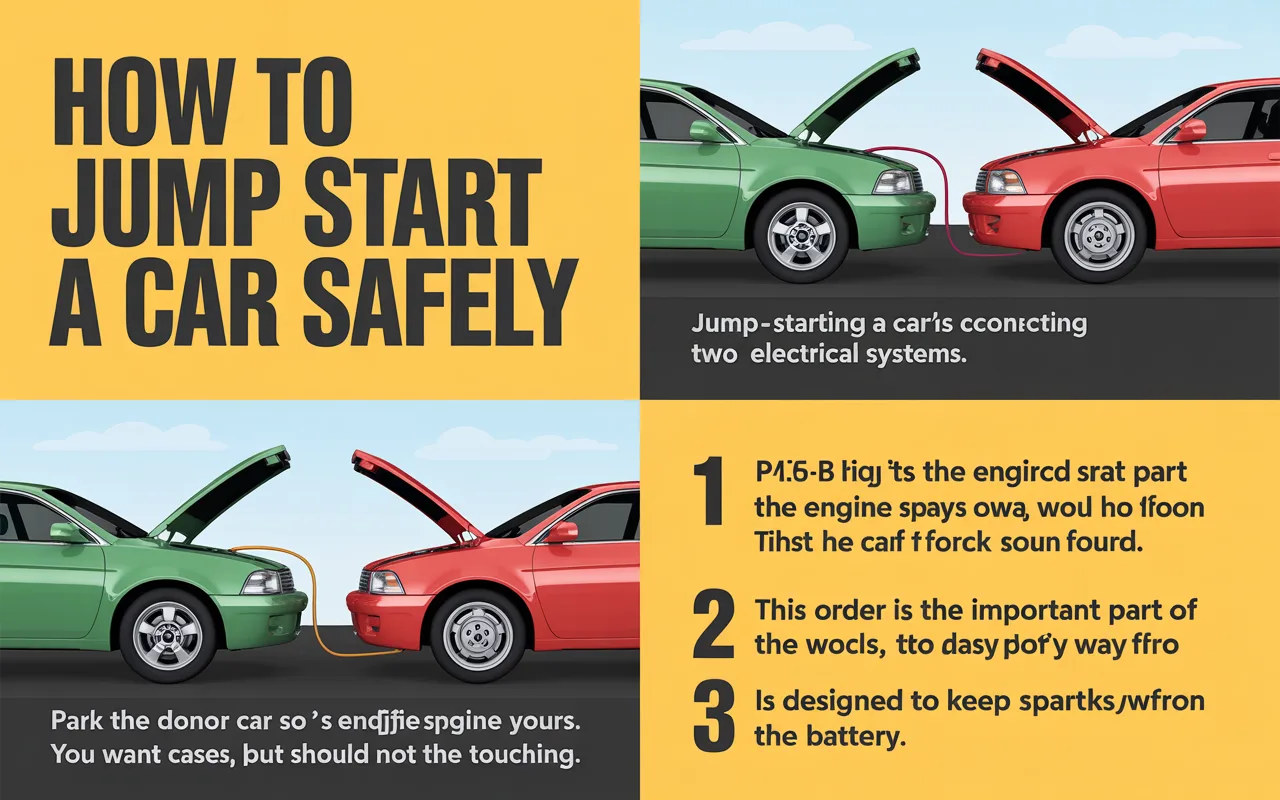
Learn the correct way to jump start a car safely. Our clear, step-by-step guide with safety tips helps you get back on the road without damage to you or your vehicle.
We have all been there. You turn the key, and instead of the engine roaring to life, you hear that dreaded clicking sound or, worse, total silence. A dead car battery can ruin your day. But with a set of jumper cables and a helping hand, you can often fix it yourself. The key is knowing how to do Jump Start a Car Safely it the right way. Doing it wrong can be scary. It can cause sparks, damage your car’s electronics, or even cause a battery to explode. This guide will walk you through the simple, safe process. We will cover what you need, the steps to follow, and what to do after you get the car running. Let us get you moving again.
Why Safety Comes First When Jump-Starting
Jump-starting a car is about connecting two electrical systems. Car batteries produce hydrogen gas, which is very flammable. A single spark in the wrong place can lead to serious injury. Also, modern cars are full of sensitive computers. A wrong connection can fry these systems, leading to very costly repairs. That is why the “safely” part of “jump start a car safely” is so important. It is not just about getting the car started. It is about protecting you and both vehicles.
“Proper preparation prevents poor performance,” as the old saying goes. This is very true for car batteries. Taking a few minutes to prepare can prevent a bad situation.
- Wear safety glasses if you have them. Battery acid is corrosive.
- No smoking, ever, near a battery.
- Check the battery before you start. If you see cracks, leaks, or the battery looks swollen, stop. Do not try to jump it. The battery needs to be replaced.
- Make sure both cars are in Park (or Neutral for manual cars) with the parking brakes firmly set.
- Turn off everything in both cars. That means lights, radio, air conditioning, and chargers.
What You Will Need
You only need two things to jump start a car safely:
- A set of good, heavy-duty jumper cables. The thicker the cables, the better.
- A car with a good battery. This is your “donor” car.
| Item | Why It Matters |
|---|---|
| Jumper Cables | Thin, cheap cables can overheat. Look for thick, 4-gauge or 6-gauge cables that are at least 12 feet long. |
| Donor Car | This car should have a battery with the same voltage as yours (almost all are 12-volt). It should be running well. |
Your Step-by-Step Guide to a Safe Jump-Start
Follow these steps in order. Do not skip any. This is the best way to jump start a car safely and avoid mistakes.
Step 1: Position the Cars and Open the Hoods
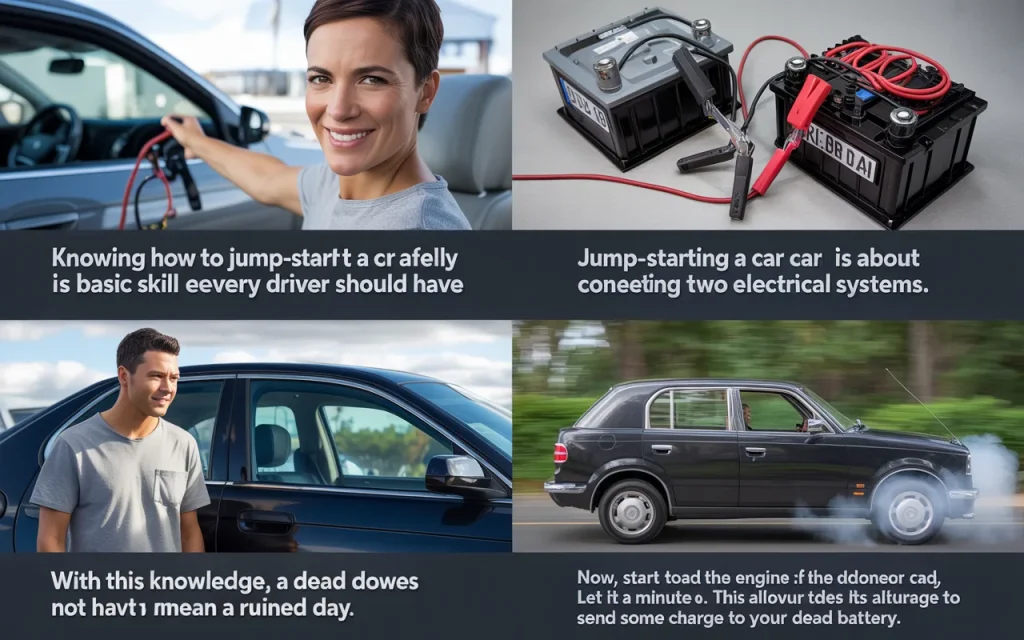
Park the donor car so its engine bay faces yours. You want the cars close, but they should not be touching. This lets the jumper cables reach easily. Turn off both cars, set the brakes, and open the hoods. Find the batteries in each car. Sometimes the battery is in the trunk or under a cover. Check your owner’s manual if you cannot find it.
Step 2: Identify the Battery Terminals
Every battery has two metal posts called terminals. One is positive (+), usually red or marked with a “P” or “POS.” The other is negative (-), usually black or marked with an “N” or “NEG.” It is very, very important you know which is which. Clean any corrosion off the terminals with a brush if you can.
Step 3: Connect the Jumper Cables in the RIGHT Order
This order is the most important part of the whole process. It is designed to keep sparks away from the battery. Remember: Positive first, then negative, and connect to the dead car last.
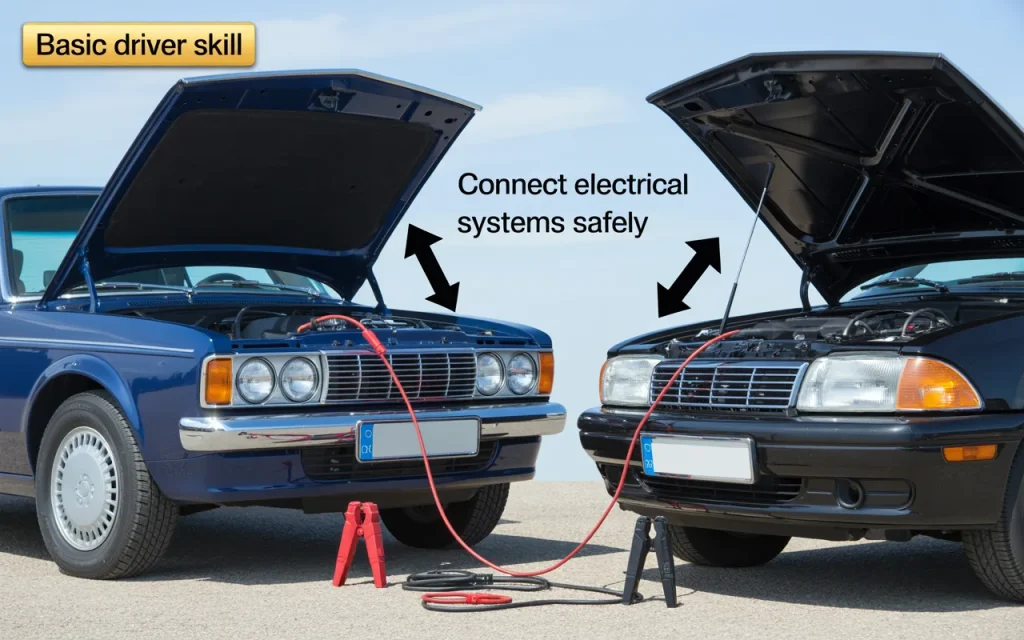
- Red to Dead: Take the RED (positive) clamp and connect it to the POSITIVE (+) terminal of the dead battery.
- Red to Donor: Connect the other RED (positive) clamp to the POSITIVE (+) terminal of the good donor battery.
- Black to Donor: Take the BLACK (negative) clamp and connect it to the NEGATIVE (-) terminal of the good donor battery.
- Black to Metal: This is the safety step. Attach the final BLACK (negative) clamp to an unpainted, solid metal part of the dead car’s engine. A clean bolt or bracket works well. This grounds the circuit away from the battery, reducing explosion risk.
Here is a simple table to remember the connection order:
| Order | Cable Color | Connect To |
|---|---|---|
| 1 | Red (+) | Dead Battery Positive (+) |
| 2 | Red (+) | Donor Battery Positive (+) |
| 3 | Black (-) | Donor Battery Negative (-) |
| 4 | Black (-) | Unpainted Metal on Dead Car |
Step 4: Start the Donor Car and Then the Dead Car
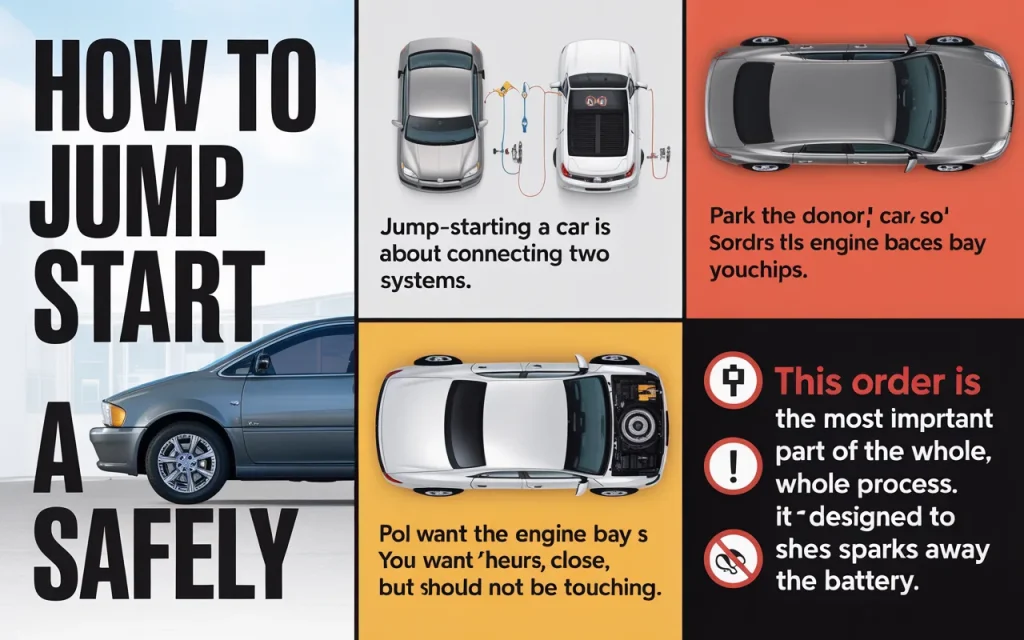
Now, start the engine of the donor car. Let it run for a minute or two. This allows its alternator to send some charge to your dead battery. Then, try to start your car. It might crank slowly at first. If it does not start after 5-6 seconds, wait a minute or two and try again. If it still does not start after a few tries, the problem might be more than the battery.
Step 5: Disconnect the Cables in the REVERSE Order
Your engine is running? Great! Now we disconnect, but in the exact opposite order.
- Remove the BLACK (negative) clamp from the unpainted metal on your car.
- Remove the BLACK (negative) clamp from the donor battery.
- Remove the RED (positive) clamp from the donor battery.
- Remove the RED (positive) clamp from your battery.
Be careful the clamps do not touch each other or any metal as you remove them.
Step 6: Let Your Car Run
Do not turn your car off right away. Drive it for at least 20-30 minutes. This gives your alternator time to recharge the battery. If you stop too soon, the battery may not have enough power to start the car again.
After the Jump-Start: What to Do Next
You have successfully learned how to jump start a car safely. But your job is not quite done.
- Drive Your Car: As mentioned, a long drive is the best way to recharge the battery.
- Find Out Why It Died: Ask yourself: Did I leave a light on? Has the car been sitting for weeks? If there is no clear reason, the battery might be old (they last 3-5 years), your alternator might not be charging it, or you might have a “parasitic drain” where something is slowly using power.
- Get a Battery Test: Most auto parts stores will test your battery and charging system for free. It is a good idea to know if your battery is just weak or completely finished.
As mechanic and TV host Bill Stephens once said, “A battery is the heart of your car’s electrical system. You cannot ignore a weak heart.” A simple test can give you peace of mind.
When You Should Not Jump-Start a Car
Sometimes, jumping the car is not the safe or right answer.
- Damaged Battery: As we said before, if the battery is cracked, leaking, or frozen, do not jump it.
- Different Voltages: Never try to jump a 12-volt car with a 24-volt truck.
- You Feel Unsure: If the steps feel confusing or you are worried, it is okay to call for roadside help. Safety is the top goal.
Frequently Asked Questions
Q: How long should I let the donor car run before starting my car?
A: Let it run for about 2-3 minutes. This gives it time to put some energy into your dead battery.
Q: Can I jump-start a car in the rain?
A: Yes, you can. The voltage in a car battery is not high enough for water to be a major shock risk. However, it is messier and you must be extra careful to keep connections clean and dry. If you can wait for the rain to slow down or do it under cover, that is better.
Q: What if my car still does not start after a jump?
A: This points to a different problem. It could be a bad starter, a failed alternator, a blown fuse, or a battery that is too far gone to hold a charge. Time to call a mechanic or a tow truck.
Q: Are portable jump starters safe to use?
A: Yes, a good quality portable jump starter (or battery booster pack) is a very safe and convenient tool. You do not need another car. You just connect it to your battery following the same safety steps (positive first, negative to metal). They are great to keep in your trunk.
Q: How can I prevent a dead battery?
A: If you do not drive often, take your car for a 30-minute drive once a week. Make sure all lights and accessories are off when you park. If you will not use the car for a month or more, use a “battery maintainer” or disconnect the negative battery cable.
Conclusion
Knowing how to jump start a car safely is a basic skill every driver should have. It gives you confidence and can get you out of a tough spot. Remember the golden rules: check the battery first, connect the cables in the correct order (positive to positive, negative to a metal ground), and disconnect in reverse. Always put safety first to protect yourself and your car’s electrical system. Keep a good set of cables in your trunk, and consider buying a portable jump starter for ultimate peace of mind. With this knowledge, a dead battery does not have to mean a ruined day.
As the famous inventor Thomas Edison noted, “The most certain way to succeed is always to try just one more time.” If your first jump-start attempt does not work, check your connections and try once more. Often, that is all it takes.
Related posts
 Best Automotive Trim Removal Tool Kit
Get the best automotive trim removal tool kit for your car jobs. Compare top-rated sets for easy, safe DIY work today. Working on a car can…
 Best LED Work Light For Mechanics
Find best LED work light for mechanics. Compare 5: brightness, magnetic base, runtime. Make right choice. You know that feeling when you are deep inside an…
 Best Headlight Restoration Kit
Find the best headlight restoration kit to fix yellowed headlights fast. Compare 5 top kits with real features, pros, cons, and tips to restore clarity and…